
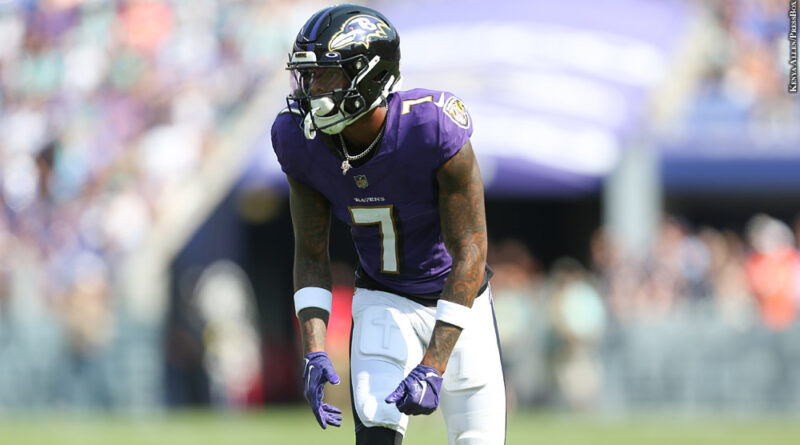
As the Ravens’ offense broke the huddle against the Pittsburgh Steelers in the 2022 home finale, wide receiver Sammy Watkins, who had been cut by the Green Bay Packers, went wide to the left. Demarcus Robinson, who had been cut by the Las Vegas Raiders, split out to the right. Andy Isabella, who had been cut by the Arizona Cardinals, stood on the sideline as another option, as did DeSean Jackson, this year’s Ravens Thirtysomething Wide Receiver Reclamation Project.
Such was the state of a wide receiver group that general manager Eric DeCosta admitted “took on some water” this past season.
The wide receiver position, seemingly a franchise problem since the first brick was laid at M&T Bank Stadium, is again a top offseason priority for DeCosta, head coach John Harbaugh and a new offensive coordinator. Greg Roman and the team parted ways after the season, and the Ravens announced the hire of Todd Monken on Feb. 14.
Harbaugh said the infrastructure of a strong offense is in place, with quarterback Lamar Jackson, a strong running game led by J.K. Dobbins, a deep tight end group led by All-Pro Mark Andrews and an improved offensive line.
“The one area that needs to be built,” Harbaugh said, “is the wide receiver room.”
The Ravens went 10-7 in 2022 and lost to the Cincinnati Bengals in the first round of the playoffs. They ranked No. 2 in the league in rushing but No. 28 in passing, averaging 178.8 yards per game through the air. Wide receivers accounted for less than half of that.
Robinson led all Ravens wide receivers with 458 yards, and the receivers collectively totaled 1,517 yards — the fewest in the league. To be sure, injuries played a major role, as did Roman’s run-first approach and heavy reliance on tight ends. Led by Andrews with a team-best 847 receiving yards, the tight ends totaled nearly as many yards as the receivers.
In addition, the Ravens traded 2021 leading receiver Marquise Brown to the Arizona Cardinals last spring and never suitably replaced him. There is speculation that the Ravens had hoped to draft a receiver at No. 14 overall, which would explain why the Brown trade was kept hush-hush until the Ravens were on the clock. (The trade had obviously been finalized in time for Brown to be at a draft party in Arizona that night.)
A run on receivers at Nos. 10-12, though, took Garrett Wilson, Chris Olave and Jameson Williams off the board. The Ravens ultimately selected Notre Dame safety Kyle Hamilton at No. 14 and did not draft a receiver with any of their 11 picks.
DeCosta essentially banked on Rashod Bateman and Devin Duvernay staying healthy and homegrown receivers James Proche and Tylan Wallace emerging. None of that happened.
Bateman, the presumptive No. 1 receiver in the wake of the Brown trade, had long touchdown catches in the first two games but missed the final nine games because of a Lisfranc foot injury that required surgery. He finished with 15 catches for 285 yards.
Duvernay, a Pro Bowl return specialist, flashed with three touchdown catches in the first three weeks, but the Ravens then went nearly three full months without a touchdown catch by a wide receiver. Like Bateman, Duvernay (37 catches, 407 yards) ended the season on injured reserve, missing the final three regular-season games and the playoff game.
Neither Proche (8-63) nor Wallace (4-33) had much impact on offense. Proche’s most notable play was his pass on a double-reverse that was intercepted.
All of that left the Ravens scrambling. They added Robinson in August and Watkins, Isabella and DeSean Jackson at various points later in the season, but they were little more than complementary aspects for an offense driven by its running game and tight ends.
“We’ll Have To Get Creative”
How the Ravens go about revamping the receiver room will be one of the major storylines of the offseason, but as with everything else on this team, Lamar Jackson’s contract situation towers over all.
“Honestly, when you have a big-ticket item at quarterback, it makes it more challenging, not impossible,” DeCosta said. “We’ll have to get creative. … There are a lot of different ways to go about constructing the team and finding players.”
DeCosta has maintained that he hopes to work out a long-term extension with Jackson, but the sides couldn’t agree to one before March 7. Jackson received the nonexclusive franchise tag, which costs roughly $32 million against this year’s cap.
In addition, linebacker Roquan Smith signed a $100 million extension late in the season, and tackle Ronnie Stanley and cornerback Marlon Humphrey are in the midst of deals that near $100 million each.
“It goes without saying, you can’t pay everyone,” DeCosta said.
Would that rule out pending free agent receivers such as JuJu Smith-Schuster or D.J. Chark? And would receivers see run-heavy Baltimore as an unattractive destination?
DeCosta has scoffed at that idea.
After the 2020 season, DeCosta said, “Players want to play with Lamar Jackson. I really do kind of laugh at the notion that players don’t want to come here and play with Lamar, because he’s one of the very best young players in the NFL.”
DeCosta has faced criticism for not building up the receiver corps for Jackson, but it hasn’t been for a lack of effort. In fact, the team has taken a decidedly more aggressive approach to drafting the position since 2019, when DeCosta succeeded Ozzie Newsome as general manager.
From 2006-2018, the Ravens selected just three receivers in the first three rounds of the draft — Yamon Figurs in the third round in 2007, Torrey Smith in the second round in 2011 and Breshad Perriman in the first round in 2015. They filled the gaps — with mixed results — by acquiring players such as Anquan Boldin, Lee Evans, Mike Wallace, Steve Smith and Jeremy Maclin.
Asked in 2019 about drafting receivers, DeCosta said, “It’s hard to be a .400 hitter if you’re only going to bat twice. So we have to take some chances.”
Since 2019, the Ravens have done that. They have drafted four receivers in the first three rounds — Brown (2019) and Bateman (2021) in the first round and Miles Boykin (2019) and Duvernay (2021) in the third round. Would the Ravens use their first pick on a wide receiver for the third time in five seasons? Jordan Addison from USC and Quentin Johnston from TCU are potential fits.
DeCosta could also explore a trade for an established star, something that paid big dividends for the Buffalo Bills and Philadelphia Eagles. They gave up first-round picks and more to acquire Stefon Diggs and A.J. Brown, respectively. The Ravens reportedly made a run at DeAndre Hopkins a few years ago, and he could be on the trade block again, though the three-time All-Pro is due nearly $20 million in 2023.
As of now, after sending two to Chicago in the Roquan Smith deal, the Ravens have just five draft picks this year, which would be their fewest since 1999.
“We’ll continue to look at [wide receivers] via free agency and the draft,” DeCosta said. “Our role is really just to find the best guys that fit our situation. We hear the fans. We hear you guys with the questions, certainly. Our goal is to build the very best team we can build. … That will be through the draft, through free agency, potential trades and things like that, but we will build the best team we can to compete every single week.”
Photo Credit: Kenya Allen/PressBox
Issue 279: February/March 2023
Originally published Feb. 15, 2022. Updated March 22, 2022