
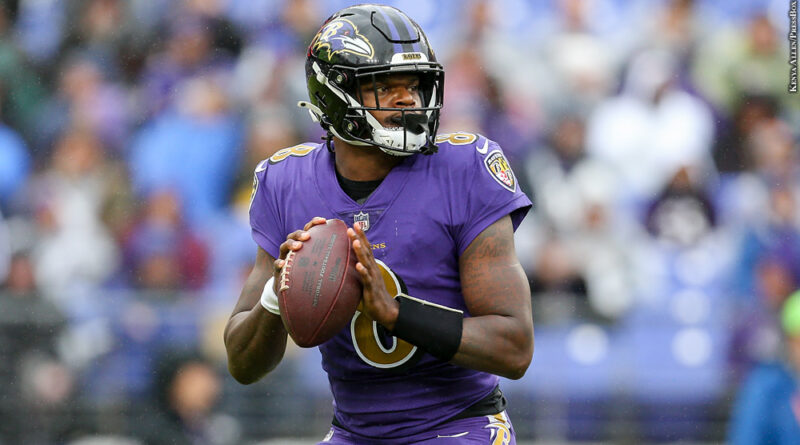
The Ravens have applied the nonexclusive franchise tag to quarterback Lamar Jackson, which will save them $13 million in cap room relative to the exclusive tag but will allow other teams to negotiate with Jackson, a move that ultimately could cost the team its former league MVP.
The move adds yet another layer of intrigue to a storyline that has dominated the NFL landscape this offseason.
The Ravens could have used the exclusive franchise tag, at a cost of $45 million in cap space, which would have prohibited other teams from negotiating with Jackson.
With the nonexclusive tag, at roughly $32 million, Jackson can entertain offers from other teams once free agency begins, and the Ravens would have the chance to match any offer sheet. If they decline to do so, the Ravens would receive two first-round draft picks in return, though many view that as a subpar return for a former league MVP who is still just 26 years old.
“There have been many instances across the league and in Baltimore when a player has been designated with the franchise tag and signed a long-term deal that same year,” Ravens GM Eric DeCosta said in announcing the decision to tag Jackson. “We will continue to negotiate in good faith with Lamar, and we are hopeful that we can strike a long-term deal that is fair to both Lamar and the Ravens. Our ultimate goal is to build a championship team with Lamar Jackson leading the way for many years to come.”
Jackson played out the fifth-year option of his rookie contract this past season, and he was set to become an unrestricted free agent on March 15. The Ravens had from Feb. 21 until March 7 to apply a franchise tag, and they waited until the final minutes to do so after expressing hope throughout the offseason that a long-term deal could get done.
The sides, though, never closed a gap that has existed since negotiations first began well before last season.
After Deshaun Watson signed a five-year, $230 million fully guaranteed contract with the Cleveland Browns last year, Jackson was reportedly looking for a fully guaranteed deal, something the Ravens opposed. The two sides had expressed optimism throughout last offseason, but both Jackson and DeCosta said before the 2022 season began than contract talks would be halted until after the season.
Speaking at his postseason news conference and again at the NFL Scouting Combine, DeCosta continued to express hope that a long-term extension would be finalized. To be sure, one still could be, with other teams now potentially having a hand in the negotiating process.
The nonexclusive tag hit commands roughly 14 percent of the team’s cap space, and saving that $13 million in cap space could help with other challenging decisions facing DeCosta in terms of roster-building. Any long-term deal likely would significantly drop the cap hit in the early years of the deal.
When asked at the Combine last week about potentially needing to tag Jackson, DeCosta said no decision had been reached about which tag the team would use.
With the nonexclusive tag now applied, Jackson and DeCosta can get a read on Jackson’s market value elsewhere.
The tag decision comes as the free-agent quarterback market is starting to fall into place. Derek Carr reportedly agreed to a deal with the New Orleans Saints worth $150 million across four years ($100 million guaranteed), and the Seattle Seahawks re-signed pending free-agent quarterback Geno Smith to a deal reported to be three years and $105 million.
Jackson, who does not have an agent, has not met with the media since December and has kept a low profile about contract talks since announcing in August that he was shelving discussions until after the season.
Jackson’s contract status has been storyline No. 1 in Baltimore and throughout the NFL this offseason, and while the tag provides a degree of clarity, speculation will continue to swirl with other potential suitors free to enter the fray when the new league year begins next week.
Harbaugh, DeCosta and owner Steve Bisciotti have publicly professed their desire for Jackson to remain the team’s franchise quarterback.
Jackson energized the Ravens fan base from the moment he was drafted with the No. 32 overall pick in 2018, and he has been must-see TV since roaring to the league’s MVP unanimous award in 2019. He led the league with 36 touchdown passes and ran for 1,206 yards that year, setting the NFL single-season record for a quarterback, as the Ravens rolled to a franchise-best 14-2 record.
Jackson is 45-16 in the regular season as the Ravens starter, though just 1-3 in the postseason. Including a postseason loss at Cincinnati, the team is 3-8 in the past two years when he hasn’t played.
This past season, the Ravens finished 10-7 and earned a wild-card berth to the postseason, losing to the Bengals in the opening round.
Jackson in 2022 completed 203 of 326 passes for 2,242 yards and 17 touchdowns, with seven interceptions. He threw 10 touchdowns in the first three games, then seven during the remaining nine games he played. He rushed 112 times for 764 yards and led the Ravens in rushing for the fourth straight season.
Jackson, though, suffered a knee injury against Denver in Week 13 that proved to be season-ending. It marked the second straight season Jackson missed the final month of the season because of injury.
The Ravens have used the franchise tag five other times since 2009 and reached long-term agreements with four of those players. Linebacker Matthew Judon played the 2020 season on the franchise tag and then signed with the New England Patriots the next year. Before that, kicker Justin Tucker (2016), running back Ray Rice (2012), defensive lineman Haloti Ngata (2011) and linebacker Terrell Suggs (2009) worked out long-term deals after receiving a franchise tag.
Photo Credit: Kenya Allen/PressBox