
Having to wait for someone to die before finishing a deal is not the best game plan for either side while trying to make a sound business decision.
Sadly, that is the situation the Orioles find themselves in for the second time in the organization’s storied 70-year history. If it’s any consolation, it would be the expectation that the outcome will be brighter and less complex than the last.
Whatever the opinion might be about Peter Angelos as owner of the Baltimore Orioles, there can be no question, or least there shouldn’t be, about his love of and commitment to the city, nor his desire to bring it a World Series championship. His contributions are well-documented throughout the community, but they often are overlooked by a fan base that has a hard time looking beyond the misses on the baseball field.

The ownership group headed by Angelos had a couple of good runs early with a free-agent-fueled payroll that once was the highest in the game and a few lesser playoff appearances near the end of a run that will become official with the sale of the team to David Rubenstein. But for the most part, his 30-year tenure is being remembered mostly for 14 consecutive losing seasons and a failure to end a World Series drought that dates back to 1983.
Down the road the fan base, which predictably can be fickle, might acknowledge the fact that the team will be in a better position to succeed when this deal is done than it was when Angelos bought the team at auction in 1993. But for now at least, that doesn’t make up for the frustration of the losing seasons.
But it is the circumstances surrounding the sale of the team that has made this such a sensitive situation. With Peter’s health declining in the last five or six years and his son John assuming the role as the team’s controlling partner, the sale won’t be completed until the father’s death.
I can’t speak for a fan base that is naturally excited about the prospects of the Orioles going forward, but the only way to celebrate a death is the life that preceded it and the legacy left behind.
All of which serves as a way to lead into the chronology of the five ownership groups that came before the one Rubenstein will lead sometime in the future — all of which had their share of trials and tribulations.
The original group that bought the St. Louis Browns from Bill Veeck for a little more than $2 million prior to the 1954 season included mostly local heavy hitters, with Clarence Miles serving as president and Joseph Iglehart as chairman of the board. It took that group one year to dismantle the front office and hand the keys to the dugout and front office to Paul Richards, who enjoyed a six-plus-year stretch during which he famously exceeded what was considered an unlimited budget while helping stockpile young talent known as the Kiddie Korps.
That original group stayed intact until 1964, when CBS bought the Yankees for $11 million (keep that number in mind), a move that also involved the Orioles. Iglehart, equally passionate about the Orioles and the city of Baltimore, had been an early investor in the broadcast company and thus thrust into ownership of two teams, which is not allowed.
Choosing between the two teams most likely was more of a financial than an emotional issue for Iglehart. Given the length of his tenure and depth of his investment, Iglehart regretfully had to give up his holdings with the Orioles.
After at least one failed negotiation Iglehart sold his share of the club to Jerry Hoffberger, one of the original investors who then became the primary owner a few months before the Orioles won their first World Series championship. The irony here is that Iglehart later divested himself of his CBS holdings in protest of the way the Yankees were being run by George Steinbrenner, who bought the team in 1973 for a reported $9 million, most likely the last sports franchise sold for less than the purchase price.
Hoffberger enjoyed a spectacularly successful run as principal owner, but the Orioles struggled financially with annual attendance that rarely climbed over 1,000,000 and by 1974, with the family reportedly looking to divest, it became widely known that the team was for sale. Not that it attracted much interest. With the Yankees having been sold for less than $10 million, and the Orioles’ asking price about $2 million more than that, investors were not knocking on the door, even though the team had made four World Series and two other playoff appearances.
This was probably the most vulnerable time for the Orioles to be sold to out-of-town interests, with Memorial Stadium (started in 1950, completed in 1954) showing signs of decay. It was a nervous populace when famed D.C. lawyer Edward Bennett Williams replaced his client William Simon, former Secretary of the Treasury, as chief negotiator. Five years after putting the team up for sale, Hoffberger sold the team for a reported $10.3 million.
When the deal was announced, the immediate speculation was the possibility of a move or at the very least the shifting of a portion of games to Washington. The Baltimore News American, my employer at the time, boldly (and without credible information) ran a headline: “Bye, Bye Birdies,” predicting that 13 games would be transferred the following year as well as an eventual move to Washington.
I remember doing a story quoting Mark Belanger, the team’s player representative, saying “the Players Association would never approve that unless we [the Orioles’ players] did — and there’s no way that’s going to happen.” It didn’t, but if nothing else EBW put the wheels in motion that rejuvenated the fan base, pushing attendance to 2,000,000 and putting in motion plans to build a new stadium.
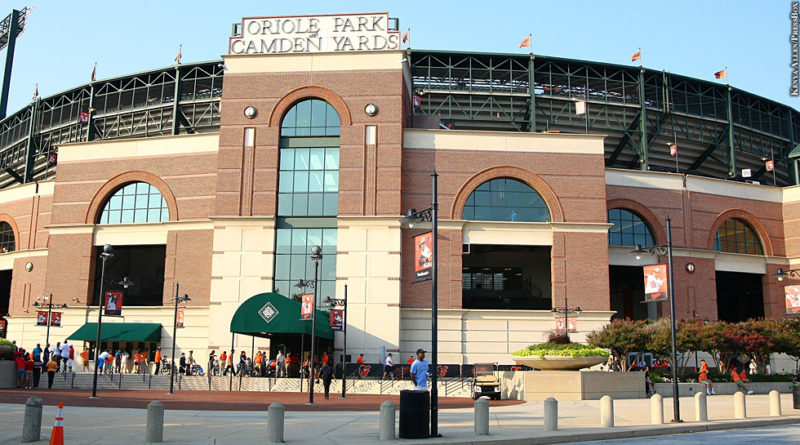
Williams signed a 15-year lease cementing the deal for Camden Yards just a few months before he died. He was able to oversee the team that won the Orioles’ last World Series in 1983, but the ensuing years saw a steady decline, culminating in the 21-game losing streak that opened the 1988 season, shortly before the signing of the lease. His death and a set of circumstances ushered in a new, often unpredictable era.
EBW’s estate sold the Orioles to Eli Jacobs, a New York investor who was around long enough to have his name placed on the right field Flag Court at Camden Yards — and go to bankruptcy court, which eventually ushered in the local group headed by Angelos. Unlike three decades earlier when the team went without much interest as Hoffberger looked for buyers, Angelos surrounded himself with many well-known local investors, many of whom remain today.
As his most significant contribution, Jacobs, on his way out the door, extended the original 15-year lease Williams had signed for another 15 years in exchange for additional benefits during his regime. As Jacobs’ bankruptcy case proceeded, Angelos moved forward with his group of mostly local investors and bought the team for $173 million.
In those first few years, Angelos’ main contribution wasn’t on the field but in the negotiating room. Long a supporter of unions during his law career, Angelos refused to participate when Major League Baseball flirted with the idea of using replacement players when a strike shut down the game and canceled the 1994 World Series and disrupted the 1995 season.
The refusal to use replacement players (long before analytics came up with Wins Above Replacement) not only hastened the end of the strike, it also ensured that Cal Ripken Jr.’s consecutive game streak (which eventually reached 2,632) would not be jeopardized.
A two-year foray into postseason play followed in 1996 and 1997, with Pat Gillick and Davey Johnson as general manager and manager. But despite continued reliance on free agents, success was hard to sustain through the early part of the century. It wasn’t until Buck Showalter and Dan Duquette teamed up for a good run from 2012-2016 that the Orioles could put together what would be the last extended playoff push under this ownership group.
It was around that time that the Orioles’ fortunes and Peter’s health began to decline. It was left for John Angelos to launch the “rebuild” Peter hoped would never have to happen. It began with a predictably painful teardown but now shows promise of being a solid foundation new ownership can guide into the future.
That’s the good news. The bad news is having to wait for somebody to die. A tough way to do business.
Jim Henneman can be contacted at JimH@pressboxonline.com.
Photo Credit: Kenya Allen/PressBox
Issue 285: February/March 2024
Originally published Feb. 21, 2024