
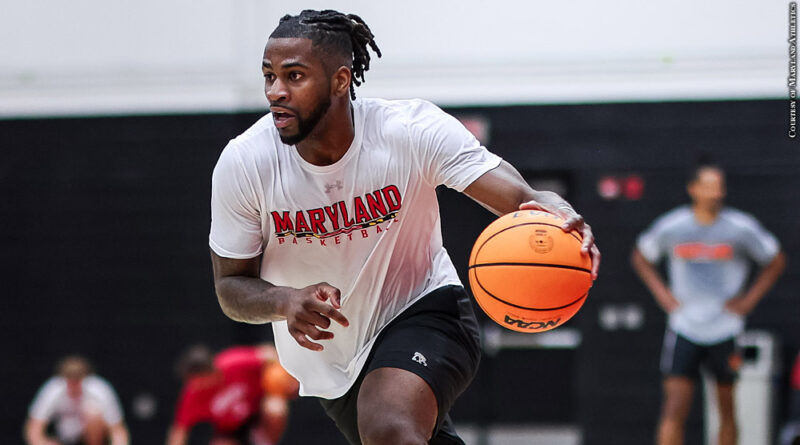
PressBox recently chatted with Maryland men’s basketball fifth-year senior Selton Miguel about his hoops journey since moving to the States, his relationship with cousin Bruno Fernando and more. The 6-foot-4, 217-pound guard averaged 14.7 points, 3.2 rebounds and 2.2 assists per game for South Florida in 2023-24 en route to AAC Sixth Man of the Year and Most Improved Player honors. Miguel is a native of Luanda, Angola, and graduate of West Oaks Academy in Orlando.
PressBox: How did you first become interested in basketball?
Selton Miguel: I first became interested in basketball because of my dad, [Henriques]. I used to play soccer. I was getting taller and my dad one day was just like, “Try basketball.” I stopped playing soccer because playing so much basketball, I just fell in love with basketball. I’ve been playing basketball until today.
PB: What kind of influence did your father have on your game growing up?
SM: My dad definitely was a big influence on my game even though he ran track. He never played basketball, but he definitely likes basketball. … He knew I could do something because we’re a family of athletes. He was like, “Try basketball.” When I tried, I was getting even better at it. He was always there for me — picking me up at practice, he would always be out there for the games. He never got a chance to come here [to the States]. It’s tough for him being back home and me here — just being positive through good games or bad games, motivating me to keep going no matter what.
PB: Who else influenced your game growing up?
SM: My big brother, [Rifen]. I started playing basketball because of him. I was playing soccer. He was playing basketball already. Just follow his lead and try to do the same thing that he was doing because I really enjoyed watching basketball before I was playing. He was a big influence, too.
PB: What’s the hoops culture like in Angola? How does it compare to the States?
SM: The hoops culture here I would say is the biggest culture in the whole world because of the NBA and everything. You’ve got college basketball. But I feel like in Angola it’s different. We go from high school straight to clubs and then straight to professional. We don’t have that time to develop like kids have here — high school, college and then pros. It’s definitely different. It’s more gritty there, for sure, because you’ve got to get things out of the mud. Being someone that came from there and seeing all these opportunities and being in this position to help others, the difference between America and Angola is a huge difference.
PB: When did you decide to come to the States?
SM: I came to the States when I was 15. I was playing in Portugal. My brother was already here at West Oaks Academy. That’s where I went to high school. They saw my videos from playing over there, so they offered me a scholarship to come over here. I’ve been here since.
PB: Why did you originally choose to go to Kansas State?
SM: Going to Kansas State, I had a good relationship with coach Bruce Weber. He offered me a scholarship to Kansas State. I was a freshman when he offered me. Just build that relationship with him through high school throughout the years. I always felt comfortable being with him. He was more than just Coach. He was more like a grandpa to me or dad. Building that relationship with me and my coaches and my family back home, he was big for me. That’s why I really chose to go to Kansas State. It was the best place to be.
PB: Why did you choose to transfer to South Florida after that?
SM: I chose South Florida in the portal just because I wanted to basically go back to Florida. I wanted to go somewhere where they needed a player. I feel like South Florida needed me to go over there. I feel like I didn’t do [well] at Kansas State, so I wanted to go somewhere to improve my stats and then improve the winning. I just felt like South Florida was the best place leaving Kansas State. I had a coach on the South Florida staff, [Louis Rowe], that I had known since high school. He just made it easier for me to go over there.
PB: Why did you choose to transfer to Maryland this past offseason?
SM: I can say the same thing — go to a place that needed me. They lost the [point] guard and [shooting] guard last year, and I already knew [head coach Kevin Willard] since I was in college freshman year. I always knew Coach Willard. I’ve been with [assistant coach] Kevin Norris for a long time, since I came to the States when he was at UCF. Now he’s at Maryland. Bruno [Fernando] is my distant cousin that grew up with me, came to the States two or three years before me. But he was a guy that always wanted me to follow his lead and be able to impact others like he did impact me to come here. He definitely was a big key in the recruiting process. But at the same time, just continue his legacy, to have two Angolans that have ever played for Maryland and actually try to come in and do [well]. I feel like Maryland needed somebody like me to come in and score the ball. Coach Willard lets the guards play. I want to play for a coach that lets the guards play and play fast. And I wanted to win. Maryland has a tradition of winning. I like to win. It’s my last year, definitely make it to the NCAA Tournament. That’s my goal.
PB: Have you been close with Fernando your entire life?
SM: Yes, I’ve been close to Bruno since I was I would say like 12, 13. Back home, we definitely played on the same team but then he came here. We played on the same team for like four or five months, but that’s when he came to the States and I went to Portugal. When I came here to the States, we were at different high schools, of course. He went to college before me. But we’ve always been connected. … We’ve played for the same national team two times already. This past summer we tried to play for the Olympics. We [had] our chances to qualify there, but we didn’t. Every time we had a chance to be with each other, we always [were], especially in the summers.
PB: How long have you known four languages?
SM: My main language is Portuguese. Spanish I learned because of my dad. My dad went to military school in Cuba, so he used to growing up talk both languages — Portuguese and Spanish. I learned French in school, even though I don’t speak fluently. It’s one of the harder languages to speak. And English, that’s when I came to the States. I’ve been speaking four languages since I was like probably 15, 16.
PB: Your dad went to military school in Cuba?
SM: I went to military school in Portugal. That’s probably why he wanted us to go to military school in Portugal, me and my brother, because he went to military school in Cuba. My dad’s dad is from Cuba. That’s probably why he went to military school in Cuba. I think my grandpa just wanted my dad to have a good education. I feel like military education at that time was the best for him.
PB: What’s your favorite thing about Maryland so far?
SM: I would say just the culture. I feel like it’s been a family culture since I’ve been there. The fans have really embraced me since I got there. It’s been fun. It’s been fun being around. Coach Willard [is] somebody fun, somebody that coaches players but they’re made even better being around him.
PB: Who did you look up to early in your college career?
SM: I would say Mike McGuirl. When I got to Kansas State, he was already a senior. I was a freshman. With COVID, he got the one more year [in 2021-22]. I think he’s overseas now. … He already knew Coach Weber and he knew everything, so I was under his wing and he [taught] me everything.
PB: Who’s your best friend on the team and what’s a story that underscores your friendship?
SM: Me and Ja’Kobi, we’re really tight. We became tight really quick just because we play on the same team in practice every day. We work hard together. … We’ve been playing with each other the whole time, basically, so me and Ja’Kobi definitely.
PB: What advice would you give to younger players, especially those playing internationally who are seeking opportunities in the States?
SM: I would just say that anything is possible. I was one day the same kid in Angola that didn’t know we would be here in the States. Anything is possible. Keep living your dreams. I’m living proof of that, so I think anything is possible if you’re really want to do it and improve.
PB: What are your goals for after basketball, whenever it ends?
SM: I have a foundation right now called M3M Foundation. It’s really just to help as many kids as I can for Africa to pursue their dreams — not just basketball but whatever they want to do and just be there for them. I hope I can help a lot of kids after I’m done playing basketball.
Photo Credit: Courtesy of Maryland Athletics
Issue 289: October/November 2024
Originally published Oct. 16, 2024