
This probably isn’t the best time to bring it up, but I thought I’d share a dream I had recently. It involved a 295-495-695 World Series between the Orioles and Nationals!
Before anybody goes all ballistic about that ever happening, don’t go rushing to judgment. It’s not as farfetched as you might think — and going on past experiences, it’s cool just thinking about how much fun it would be.
I’ve been fortunate enough to cover an I-95 series (Orioles-Phillies), an I-70 matchup (St. Louis-Kansas City) and a couple on the I-5 corridor (Dodgers-A’s and Giants-A’s). What I remember most about them (except for that earthquake thing in 1989) is how cool the rivalries were and how the cities were so accessible to the fan bases.
Despite the Orioles’ disappointing loss to the Royals in the Wild Card Series, this is not a team that needs to be overhauled. Maybe a touchup or two, but the World Series window should remain open for at least a couple more years.
The same might soon be said for the Nationals, quietly following in the footsteps of teams like Detroit, Kansas City and Arizona, all postseason participants in the last two years. And you can probably throw Cincinnati into that mix along with Pittsburgh if the Reds and Pirates can ever get it figured out.
The Nationals are believed to be a team that would be heavily invested if Juan Soto doesn’t re-up with the Yankees (maybe not as big a long shot as perceived). The irony is the Nats are starting to blossom with the talent they acquired when they traded Soto a few years ago. At the age of 26, he’s the biggest name out there.
In the meantime, let me enjoy my dream of logjams on 295 between 495 and 695. As traffic jams go, it would be a blast.
* * *
The fact that Orioles general manager Mike Elias even had to address a question about whether manager
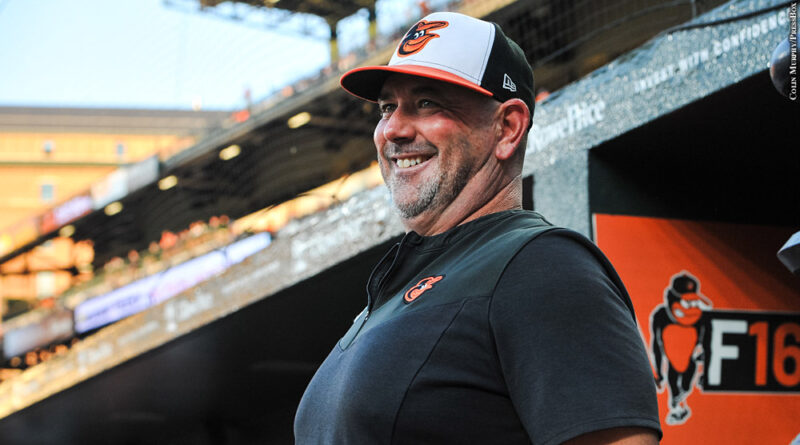
Brandon Hyde would be back next year is more testimony to the power of social media than it is the game itself. With respectful apologies to those who disagree, and there are many, I find it hard to believe any team with 192 wins the last two seasons would consider firing the manager.
I get that five straight postseason losses and the “what have you done for me lately” question drive the narrative, but the idea that Hyde is solely responsible for those perceived failures doesn’t seem to follow any form of logic. And we’re not going to get into who gets credit for the wins because we do realize they just happen. It’s only the losses that matter in this discussion.
I pay just enough attention to social media and talk radio to know there is a large segment out there that believes Hyde is the reason the Orioles haven’t won the World Series the last two years — which, pardon my rudeness, is really ridiculous. This is a good, but not great, team. It might be capable of winning a World Series very soon, but it is not yet complete.
I have heard and read some opinions that Hyde alone cost the Orioles at least 10-12 wins this past season, what I believe to be a somewhat outlandish declaration. Even in his dreams in his best years Earl Weaver didn’t have the influence to affect that many games, either way.
As with every manager out there, most of the criticism directed at Hyde revolves around pitching changes, especially in the late innings. I actually concur on many of those occasions. But most of my disagreement revolves around the way the game is played today rather than the outcomes, because one thing analytics teaches is that you can’t argue results.
For all Hyde’s supposed mishandling of the pitching staff, the O’s were 79-7 when they led after six innings, 81-5 when leading after seven and 86-3 leading after eight. Unless you figure a team should go undefeated in those circumstances, those numbers are hard to argue with. The only hole, if you want to dig that deep, is a 4-8 record when tied after six innings.
The fact that the Orioles were tied after six innings only a dozen times in 162 games is almost irrefutable evidence that baseball has become a five-inning game. It’s the reason why games like the Orioles’ 2-1 loss to the Royals in Game 2 of the Wild Card Series results in the use of 13 pitchers. It’s a trend that bothers me, and probably most of Hyde’s critics, but the end result was 54 outs produced only three runs.
That’s one problem baseball hasn’t been able to solve while it makes rule changes to speed up the game. One of these days we’ll figure out that the quality of the game is more important than time.
* * *
I have to admit to being somewhat at a loss for words (a rare development) when Pete Rose died earlier this month. My most immediate reaction was one of sadness.
Sad of course that he had passed away, but also because a bad mistake earned him a lifetime ban from baseball. And even sadder that he was too proud to admit it until the time (and price?) was right.
I only saw Pete play during World Series games, at the height of and near the end of his career. There were also a couple of exchanges during exhibition games in Florida when he managed the Reds before his gambling investigation. In both instances, Pete was an affable interview who could fill up a notebook, so he was a natural favorite for writers. Many of my colleagues who had closer ties have torn emotions about Pete’s lifetime ban for gambling, and so do I.
I believe he got the punishment he deserved. I also believe it would have been lifted had he heeded the advice of many, including his Hall of Fame teammates Johnny Bench and Joe Morgan, and owned up to his mistakes and apologized. Waiting 20 years before doing so in a book he authored sealed his fate. His career is well-documented in the Baseball Hall of Fame, but there is no plaque.
The question now: Is the lifetime ban over since he is gone? It’s certain to be hotly debated the next few months, especially with another election right around the corner. I don’t have any answer there either, but I do believe this — if Pete Rose’s ban is lifted and he eventually is admitted to the Hall of Fame, Shoeless Joe Jackson will either go in with him or be right behind.
So sad that it had to get to this stage.
* * *
When Detroit eliminated Houston from postseason play, a post noting that the payroll for the Tigers’ Wild Card roster ($18.8 million) was less than that of Astros reliever Josh Hader ($19 million) quickly went viral. But that was only half the story.
The payroll for two players not on that roster (Javy Baez and Kenta Maeda) was more than double ($39 million) that of the teammates who eliminated the Astros and moved on to the next round of the playoffs. Baez ($25 million) and Maeda ($14 million) accounted for a big chunk of the Tigers’ $92 million payroll for the year.
Of the 26 players on the Wild Card roster, Colt Keith, at $2.8 million, had the highest salary. The Tigers had 20 players with contracts under $1 million this year. Arbitration will change that in the coming years.
And oh, by the way, if you had three teams from the AL Central playing in the Division Series, raise your hand. Thought so.
* * *
Alex Bregman’s three-word Twitter post “Thank You Houston” undoubtedly sent some shock waves through America’s fourth-largest city. The Astros missed the League Championship Series for the first time in eight years, and it might take that long to get back, given how fast teams like Detroit and Kansas City are coming on and with Texas and Seattle lurking in the West.
It’s a reminder, even with playoffs watered down with three Wild Card teams in each league, it’s tough to get there — and even tougher to stay, as the Orioles can attest.
The 80th anniversary of the Oct. 9, 1944, Junior World Series game between the Orioles and Louisville Colonels recently passed. The game drew a crowd of 52,833 to Municipal Stadium and put Baltimore on the radar screen, leading to the major league franchise 10 years later.
Jim Henneman can be contacted at JimH@pressboxonline.com.
Photo Credit: Colin Murphy/PressBox
Issue 289: October/November 2024
Originally published Oct. 16, 2024