
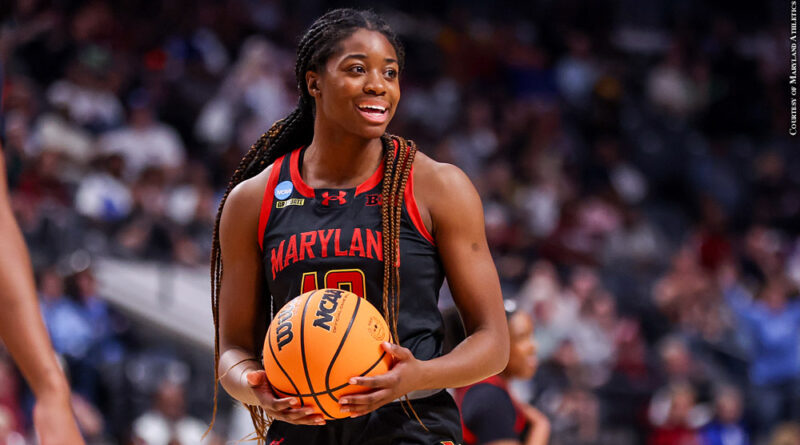
Maryland women’s basketball graduate student Mir McLean recently chatted with PressBox about her six-year college career, playing for Brenda Frese and more. The 5-foot-11 guard/forward averaged 4.0 points and 4.3 rebounds per game for the Terps in 2024-25. McLean is a native of Baltimore and graduate of Roland Park Country School.
PressBox: How did you first become interested in basketball?
Mir McLean: My whole entire family within my household is super athletic. Both of my parents played basketball. My dad also played football. I didn’t really want to play basketball to begin with because I grew up with all brothers, so I thought basketball was more of a boys’ sport. You couldn’t wear earrings. You couldn’t wear bows and barrettes in your hair, so I wasn’t down for that. But then as I got older, I realized the sports that I was putting myself into weren’t as competitive as my spirit. My parents kind of nudged me. It was kind of the end of an era of being super girly.
PB: Who was the biggest influence on your game growing up?
MM: My family really liked Michael Jordan, so I grew up watching him. His competitive drive and his nature kind of stuck out to me.
PB: What are your favorite memories from Roland Park?
MM: My favorite memory from Roland Park is probably lunch time when I got to spend time with my friends, my Arabic class with my professor and my classmates and just my entire senior year even though it was cut short. The half that I did spend with everyone was super wholesome.
PB: Why did you initially choose to go to UConn?
MM: I chose to go to UConn because a lot of my high school experience was just based off of my athleticism and I didn’t really know or understand the game from an IQ standpoint. The biggest reason why I went to UConn at first was I felt like God nudged me in that direction, but also I wanted to learn the game from a different outlet.
PB: Why did you choose to transfer to Virginia after that?
MM: I went to Virginia because I knew the coach really well. Again, God nudged me to move. I wanted to use what I learned on the court.
PB: What was it like playing for UConn and Virginia during the 2021-22 season?
MM: Honestly, it wasn’t as hard as you would think. My Virginia teammates were very welcoming, so I felt like I had a good transition. I guess it was just weird because at the same time [I played] for two teams in a year I also had three different coaching staffs [in a calendar year], which was a little bit harder trying to understand each coaching staff and implementing what they wanted out of me. … UConn was the first, then when I transferred I went to UVA. My coach got fired [after the 2021-22 season. Amaka “Mox” Agugua-Hamilton] came in, all in that same year.
PB: Why did you come home to Maryland?
MM: I came home to Maryland because it’s home. It’s just a great full-circle moment. I got everything that I needed to out of Virginia, and I felt like I made myself really comfortable there. I knew transferring again would be super hard, but I wanted to get out of my comfort zone and kind of expose myself and force myself to be uncomfortable. Yes, it was a comfortable move in going home, but at the same time, it was something that I didn’t necessarily want to do but felt like I needed to just to get out of my comfort zone.
PB: You sat out the 2023-24 season at Virginia. What was the injury?
MM: The initial injury was a dislocated knee. It wasn’t the kneecap. It was the entire knee. Then, that tore a whole bunch — MCL, ACL, cartilage, it was a lot. … It was in a game. I went up for a rebound, landed and then my leg just gave out.
PB: What kind of challenge was rehab?
MM: I think it was hard because the doctors were saying that they’ve never seen it in a female and the initial injury was very rare. They had to watch me super closely. A lot of it was more of a mental battle than a physical battle. I would say getting back to running and walking was kind of surreal because I’ve never had, to my memory, to teach myself how to run and walk. It was a little weird, but I think I did a good job of trusting God’s plan and being prepared to just give out what he gave to me. It was challenging in a way.
PB: What was the process to get your confidence back on the court following the injury?
MM: I think just exposing myself. A lot of coming back with confidence and reassurance in your body is just trying new things and knowing that you won’t get hurt in them, knowing that it was just a freak moment, a freak accident in time and not necessarily avoiding the things that got you hurt — just trying to expose myself. Not dare myself but expose myself to those concepts that I just didn’t want to do.
PB: Do you feel like your college career has been a whirlwind?
MM: Whirlwind isn’t the word I would use. I don’t even have a word for it. I think I’ve just had a really good time being in college. This will be my fourth year that I’ve actually played just because of the COVID year and my injury where I sat out a year, so it doesn’t really feel like I’ve been in college for six years … but at the same time, my age shows it, so my freshmen let me hear about it.
PB: What’s your favorite thing about Maryland?
MM: The family aspect. I feel like everyone says that, but it really is a family.
PB: What’s one thing that fans might not know about Brenda Frese?
MM: I think with her history of winning and her having a national championship and everything like that, people may think that she’s kind of cold or that those types of coaches have that [way] about them. I think it’s the complete opposite. Every coach is different, and every winning coach is different. I think Coach B is more of a maternal figure to everyone on the team. She wants the best for everyone. It’s not always about her or what she has going on. I think she really cares for her athletes and I think that’s really important in a head coach.
PB: Who’s your best friend on the team and what’s a story that underscores your friendship?
MM: I know a lot of them from a lot of different places, but I would say probably [Saylor Poffenbarger or Kyndal Walker]. Saylor, we obviously went UConn together. When we both transferred out, we both talked every day on the phone. Kyndal, we know each other. I know her from when she was super young. People said that we looked alike, so we grew close in that.
PB: What advice would you give to younger players looking to play in college?
MM: Just to continue making hustle plays. Coaches don’t really care about the mistakes that you make. Rather, [they care] about the effort that you make out of those mistakes — chasing after a loose ball or giving the ref the ball when it goes off the court or going to get a steal after you turn the ball over. I think that’s more important than the actual mistakes.
PB: How did you learn Arabic?
MM: My high school really taught a lot of languages. By the time I was in my freshman year of high school, I had taken Spanish, Latin, French and sign language. I knew all of those. I wanted something new and different. My freshman year, I figured out that I liked Arabic because of the drawing aspect of the words and the letters. I really liked my teacher and classmates, so I continued to do it throughout college.
PB: You have a degree in Middle Eastern Language and Literature and a certificate in Public Policy. Now, you’re working on a master’s degree in International Relations. What do you want to do after basketball?
MM: I want to be an intelligence analyst. I think I just want to be the person that bridges the gap between cultures. I feel like with immigrants in our country, there’s a lot of times where they may feel singled out or left out because a lot of people don’t know their language.
Photo Credit: Courtesy of Maryland Athletics
Issue 295: October / November 2025
Originally published Oct. 15, 2025