
Welcome to our 12th season of fantasy baseball coverage as we will help you get ready for your drafts and prepare for the upcoming season so you can become a champion.
As a refresher for those who have followed our coverage throughout the years and to any new readers, in fantasy baseball there are different league formats that are used, but the traditional is the five-by-five rotisserie league format, and that is what I will base my opinions on.
For those who are not familiar with what that means, there are five hitting categories — batting average, home runs, runs scored, RBIs and stolen bases. For pitching, the categories consist of wins, strikeouts, ERA, walks plus hits per innings pitched (WHIP) and saves.
On-base percentage continues to become more popular as a replacement to batting average, so I will refer to that stat as well since it could change how we evaluate certain players.
I personally feel fantasy baseball continues to be at a crossroads with the current format. Major League Baseball teams are not valuing starting pitchers and closers anymore, and we need to adjust as an industry. Unfortunately, this hasn’t happened.
Even though roto leagues are still the standard, I encourage commissioners to think about implementing head-to-head formats along with total points. Adding more categories and getting the fantasy football feel of going against an opponent every week will only help enhance the fantasy baseball experience.
This is part one of our draft guide. Part two can be found here.
DRAFTING MULTIPLE-POSITION PLAYERS
Flexibility is crucial in fantasy baseball. Having multiple players that you can move around to different positions will set you up for success. This is especially important for those in leagues that require daily moves.
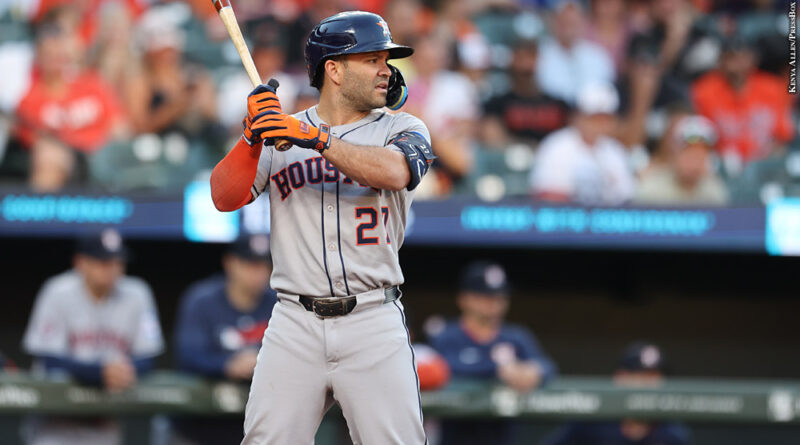
Jose Altuve of the Houston Astros is still a productive hitter at the age of 35 and because he played 45 games in the outfield in 2025, he is eligible to be used in the outfield or at second base. He’s a strong target in Round 10. The catcher position is historically bad, so having a player like Ben Rice of the New York Yankees eligible at catcher increases his value tremendously as he can be used at first base as well.
This may be one of the most important strategies available to us, so I can’t stress it enough. Targeting players who can help at multiple positions is paramount.
It is important to know the rules of the site you play on. Some players are eligible at a position on one site but may not be on another. Maikel Garcia of the Kansas City Royals is a perfect example. He has outfield eligibility on Yahoo! Sports but not on other fantasy services. He’s a great target on Yahoo! Sports as a result. Other sites grant eligibility quicker during the season than others. Knowing your league rules goes a long way to building a championship roster.
DRAFTING MULTIPLE-CATEGORY PLAYERS
In order to build a strong, well-rounded team, we need to target players who will help in every category. Fantasy managers can fall in love with a player who hits a ton of home runs or drives in a bunch of runs but has a low batting average or doesn’t steal any bases.
I would draft a player like Los Angeles Angels shortstop Zach Neto. The 25-year-old is in the prime of his career, bats leadoff and has averaged 76 runs, 24 home runs, 69 RBIs and 28 stolen bases the past two seasons. The infielder puts up really solid numbers across the board to help a fantasy roster.
The perfect strategy is to draft the elite hitters in the early rounds who will finish in the top 10 in many offensive categories and then in the middle rounds attack hitters who will help each category even if they don’t perform in the upper echelon of those categories. A balanced roster allows fantasy managers to compete throughout the long season and helps minimize the possibility of making mistakes on the waiver wire or through trades.
Houston Astros shortstop Jeremy Peña fits this profile. The infielder has finished the last two seasons with 20 stolen bases. He only played 125 games in 2025, but he still hit .304 with 17 home runs. He also played at least 150 games in 2023 and 2024.
Heading into 2026, I project Peña to hit better than .270 with around 20 homers and 20 steals. Peña is slated to lead off for an Astros lineup that will score a lot of runs, so it’s not out of the question he pushes for 100 runs scored. With his ability to hit for power, he could clear 70 RBIs as well. Peña is a player I want to roster.
POSITIONAL TIERS
In case you aren’t familiar with positional tiers, it simply means ranking players by position who you think will put up similar value. It helps us avoid drafting players based on their overall rankings. The elite players at their position go in the first tier, the next level in the second tier and so on.
Some positions may have five elite guys in the first tier, and others may have two. Some positions may have a strong second tier, while others are deep and have three tiers of players who make sense to draft. Instead of targeting a certain player, target a certain tier.
Fantasy owners get so caught up in drafting a player based on his average draft position, they lose sight that they could fill that position later with another player who could give you similar value.
If you are drafting solely on player rankings and not positional rankings, it’s more likely than not that you’re going to reach on a position that you probably could have drafted later and gotten similar value as a player you drafted a couple of rounds earlier.
Photo Credit: Kenya Allen/PressBox
Issue 297: February / March 2026
Originally published Feb. 18, 2026