
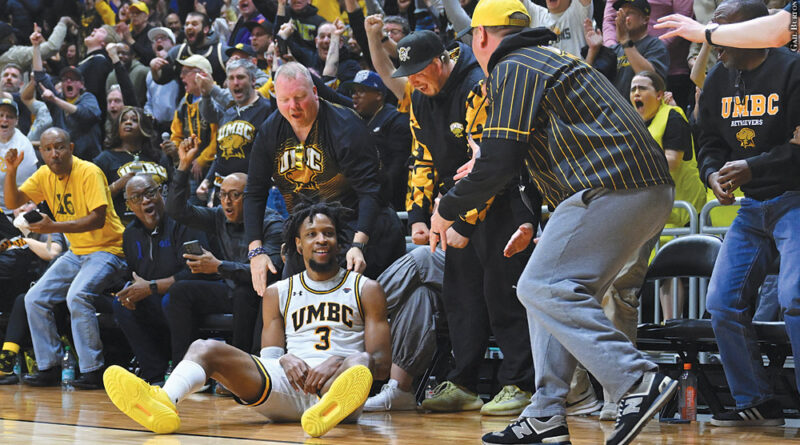
Late in UMBC men’s basketball’s 74-59 victory against Vermont in the America East championship game, once the game was already in hand, graduate wing DJ Armstrong Jr. took a moment to take it all in.
The Retrievers had drawn a UMBC hoops record 4,753 fans to Chesapeake Employers Insurance Arena for the title game. The crowd had become more and more raucous as Armstrong scored 17 points in the final 6:04 to lift the Retrievers to the third America East championship in program history.
UMBC was down, 51-48, when Armstrong’s takeover started. The 6-foot-4, 190-pound wing led the Retrievers on a 26-8 run to finish the game. Toward the end of that stretch, he couldn’t help but bask in what he and his teammates had built.
“I just took in the moment and just was looking like, ‘Dang, this is what we created,’ from Game 1 where it’s a lot of empty seats to the whole community’s coming out just to watch us,” Armstrong said. “They could be doing anything else in the world, and they’re coming out to cheer us on and watch us because of the success we’ve had. I took in that moment. I’ll never forget that moment. It’s probably one of the reasons I’ve watched the game about 500 times already.”
Forgive Armstrong if he’s savoring the moment. He came to UMBC for his final year of eligibility after two years of junior college ball at Odessa College (Texas) and two years of Division II ball at Texas Permian Basin. The southpaw averaged 13.3 points and 2.9 rebounds and shot 41.9 percent from 3-point range for the Retrievers in 2025-26, earning second-team All-America East honors in his first and only year of Division I ball.
Everything Armstrong had worked for throughout his five-year career in college hoops came to fruition when he scored a career-high 33 points on 9 of 11 shooting (7 of 9 from 3-point range) against Vermont on March 14 to lead UMBC to an NCAA Tournament bid. The final four 3-pointers he made were part of his late 17-point barrage — all of them difficult looks against a swarming Catamounts defense.
“I didn’t realize how far I was on a lot of my threes, I’ll say that,” Armstrong said of rewatching the title game. “I didn’t realize how much of a flow state I was in and how locked in I was. I had a sense of urgency. I was on a mission.”
Careers like Armstrong’s — three stops in five years — are no longer atypical in today’s college hoops environment, but needing just one year to leave a lasting impression might be. Not only did Armstrong push UMBC to the finish line against Vermont, he also hit a game-winning 3-pointer with one second left at Morgan State on Nov. 11 and a buzzer-beating 3-pointer to top Wagner in overtime six days later.
It would be easy to assume that Armstrong’s knack for producing in the biggest moments was passed down from his father, Darrell Armstrong, who played in the NBA for 14 years, won Sixth Man of the Year with the Orlando Magic in 1997-98 and served as an assistant coach with the Dallas Mavericks from 2009-2025.
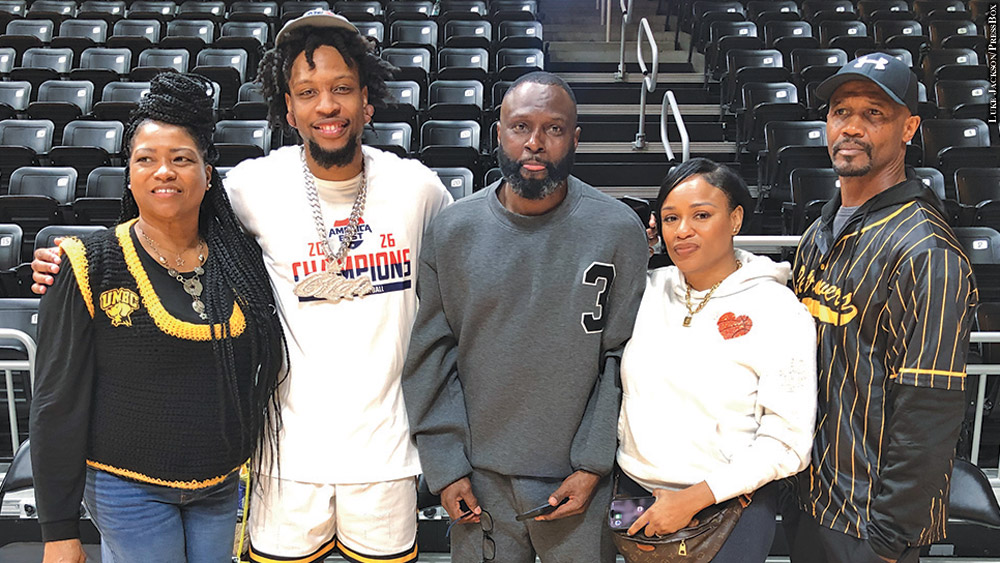
That is not the case, according to DJ and Darrell. For most of his college career, DJ was a catch-and-shoot wing who typically didn’t have his hands on the ball in the biggest moments of the game. That changed in 2025-26. Both credit the strides DJ made in becoming a more complete scorer for allowing him to come up big in crunch time.
Darrell, who watched most of the Retrievers’ games on ESPN+, noticed teams were running DJ off the 3-point line and had some advice for his son.
“I’d say, ‘You’ve got to start putting the ball on the ground, one or two dribbles or even getting all the way to the basket,'” Darrell said. “I would show him sometimes when he does it. When he started doing it, they always got a hand on the ball when he would drive it, when he was trying to get to the basket.”
Darrell asked Magic assistant coach God Shammgod, who had been on the Mavericks’ staff with Darrell from 2019-2025, for some help. Shammgod shared clips of James Harden, Kyrie Irving and Ja Morant for ideas about how DJ could expand his offensive game and finish more effectively at the rim.
“I thought that was very important because one thing a lot of teams knew, he was a shooter. He was a standstill shooter,” Darrell said. “Now, he started getting to the basket. He started getting that one- or two-dribble pull-up. I told him, ‘Even use your floater.’ He started doing that.”
A more complete offensive bag made DJ a more confident player in crunch time. It showed in the America East title game.
“I think this year that’s where my growth came in, just staying in the gym and just trusting my work,” DJ said. “… It’s more of a mindset thing, just owning up to the moment — not shying away from it. The Vermont game, I just knew what had to be done, honestly.”
DJ Armstrong is now pursuing a professional hoops career, vowing to “ride this ‘til the wheels fall off.” But he will always remember his final season of college ball fondly. UMBC went 24-9 overall and won its final 12 America East games by an average of 16.8 points, possibly the best extended stretch in program history.
The season ended with an 86-83 loss to Howard in the First Four play-in round of the NCAA Tournament, but that doesn’t dampen Armstrong’s spirit regarding the season the Retrievers had. Yes, Armstrong made an impact on UMBC, but the reverse is true, too.
“I will remember the camaraderie we had, the unselfishness we had and the will to win just down the stretch with all these games,” Armstrong said. “Whatever happens, down the stretch we handled adversity. Everything didn’t go our way every single game, but we just stuck it out and found a way. The willpower that we had to win and the enjoyment that I had playing with these guys … I wish we had all four years playing together to do it.”
Photo Credit: Gail Burton
Originally published April 15, 2026