
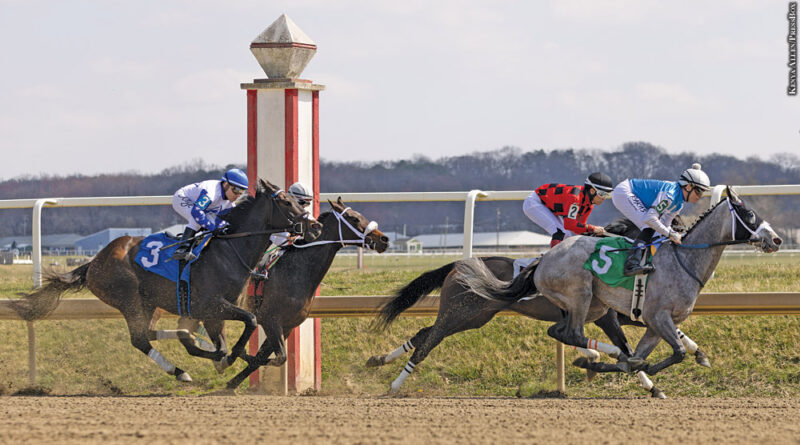
Longtime sports gambling writer Bill Ordine recently talked with PressBox about the recent trend of Kentucky Derby winners skipping the Preakness Stakes, how that might impact the race at Laurel Park and more.
PressBox: In recent years, it hasn’t been uncommon for the Kentucky Derby winner to skip the Preakness Stakes. Why is that?
Bill Ordine: I think that a lot of trainers have looked at whatever the circumstances were going to be in Baltimore and then tried to analyze whether or not it is to their advantage to bring the horse to Baltimore or take the extra rest. There’s no getting around it — the two weeks between the Kentucky Derby and the Preakness is lightning fast. There’s nothing else in horse racing that really even comes close to this. The trainers have just taken the point of view from the health of the horse that they can do just as much good for the reputation of their horse if they just let the horse rest and bring him to the Belmont.
Really, this only becomes a real consideration for the winner of the Kentucky Derby. Does the connection of the Derby winner think that they can actually go out and win a Triple Crown? To use an old-timey expression, is the juice worth the squeeze? Is the result worth the effort? Is it just as profitable for the connection to have a horse win the Derby and the Belmont and not consider the Preakness a necessary, essential part of the horse’s legacy? If your 3-year-old wins the Derby, skips the Preakness, wins the Belmont and then you decide to run him in the Breeders’ Cup and he does well at the Breeders’ Cup Classic, is your horse’s legacy tarnished by doing that? It appears that more and more trainers are feeling that’s just fine.
PB: Do you think the Derby winner will skip the Preakness at Laurel Park?
BO: I don’t know how trainers are going to feel about bringing this top-of-the-line, million-dollar colt to Laurel. I am no expert and I am not trying to be judgmental about the condition of either the dirt or the turf track at Laurel, but trainers have to make that calculus. Do they want to bring a zillion-dollar horse and run him at Laurel Park? Those are going to be the factors that are in the minds of trainers as they consider whether or not to make this stop at Laurel.
Betting is not something that you can really dive into until you know the field. It very well could be that we have a very small field. That could be the case. We don’t know until it happens, but we have seen Preakness fields diminish. [The 2019 Preakness] had a field of 13 horses in it. … They haven’t had a field like that since. Wagering on the Preakness is going to be dependent on who comes — whether or not we’re going to see the Kentucky Derby winner show up.
PB: How does a thin Preakness field impact how bettors evaluate the race?
BO: Any colts or fillies who finished in the money or near the money at Churchill Downs will wind up being morning-line favorites. We’re going to see a lot of money on those horses. Of course, if the Derby winner shows up that would be great for the Preakness. I think savvy bettors will start looking at the second tier of competitors. Let’s assume the Kentucky Derby winner comes to Laurel. That Kentucky Derby winner is going to be the chalk, by far. It almost makes no sense to bet on him.
Now you go to the second tier of horses. You’re looking for horses that have odds of 5-1, 6-1, 7-1, that sort of thing. In addition, you may want to start looking at the more exotic bets — first and second in any order, which is called a quinella. I think what happens in a case like this where you’ve got an overwhelming favorite — that would be the Derby winner, in this case — now I can start looking for the second-tier horses that have longer odds. Or if in fact they are in love with the chalk, they can look at more exotic bets like quinellas where you are going to pair up that Derby winner with a horse that is further down the line in terms of odds.
PB: What advice do you have for any bettors attending Black-Eyed Susan Day, the Preakness Stakes or another Saturday of racing at Laurel Park?
BO: I can’t say that it’s any different from any other track. I don’t think that there’s any trick that we pass along or any inside information. It should feel a little more leisurely than a regular Preakness at Pimlico. One would think that the ticket windows are going to be less crowded and more convenient. This Preakness at Laurel [might] feel more relaxed, less crowded, less frenetic than a Preakness at Pimlico. On one hand, it may feel more comfortable, more elbow room, it may be easier to get to concession stands, get your Black-Eyed Susan cocktail. On the other hand, we may find that it lacks the energy that a normal Preakness would have at Pimlico.
Photo Credit: Kenya Allen/PressBox
Originally published April 15, 2026