
Competitive golf is a cutthroat world by nature. Style doesn’t matter if it isn’t matched by substance — everything boils down to making a score. And in fields full of immensely talented players, only one score can merit a victory. Even the best simply can’t win on a regular basis. But some can consistently give themselves a chance.
Calvert Hall’s Lorenzo Sanz has been doing just that.
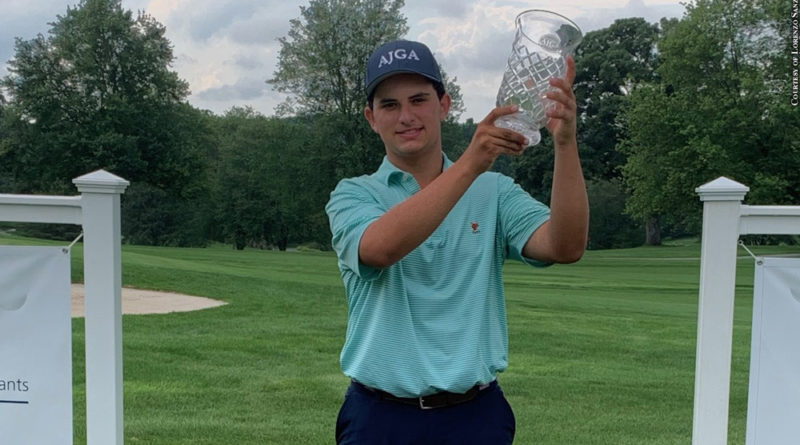
In his first tournament this summer after a pandemic-induced pause, Sanz won the Bob Benning Middle Atlantic PGA Championship in Round Hill, Va., by seven shots. On the American Junior Golf Association (AJGA) circuit, which is considered the pinnacle of competitive junior golf, Sanz finished tied for 10th in the first week of August and won the UHY / The First Tee of Greater Baltimore Junior Championship by five shots the following week.
After this breakout summer, Sanz ranks as the No. 65 junior player in the country per Junior Golf Scoreboard. He’s 25th among Class of 2022 prospects in those rankings and first among junior golfers in Maryland.
“Most accomplished players have an extraordinary skill set that usually has a flaw in it somewhere … but I would say Lorenzo’s pretty close to having as well-rounded of a game as any junior I’ve seen,” Calvert Hall golf coach Drew Forrester said. “I’ve had a handful of special players. This kid’s really special.”
Other elite junior golfers might smash their drives further or hit their irons more precisely. But Sanz holds his own in those areas, then separates himself with his short game and putting. In his AJGA victory, which came at Hillendale Country Club in Phoenix, Md., he needed just 26 and 28 putts in the first two rounds and missed just one putt inside 12 feet across three days.
Sanz started playing golf at 10 years old. He quickly developed a love for the game and a burning desire to improve. Forrester notes that improvement becomes more difficult as a player’s scores get closer to even par, but Sanz was breaking par by his freshman year of high school.
“I really just played the game because I loved the game and it was a lot of fun and then I just didn’t really stop,” Sanz said. “I didn’t really think about how good I could get or what I could become. I always just wanted to get a little bit better every single day. And I would just practice for hours and hours on end because if you’re not as talented as anybody else, you’ve got to work harder than everybody else. And I’ve kept that mindset ever since.”
It wasn’t long before Forrester took notice and recruited Sanz to play at Calvert Hall. He joined a team with several elite players already in the fold — 2020 graduates Austin Steckler and Michael Crowley will play Division I golf at St. Joseph’s and Loyola (Md.), respectively. The Cardinals lost in the MIAA final to Loyola Blakefield in 2019 and entered the spring 2020 season with championship aspirations.
But after just one match — an 18-3 win against St. John’s (D.C.) — Calvert Hall’s season was suspended due to the COVID-19 pandemic. While Forrester and the players initially thought the stoppage would last just a couple weeks, it soon became clear the season wouldn’t resume. The state of Maryland closed golf courses entirely from late March to early May.
In the face of disappointment, though, Sanz was determined to put a positive spin on losing out on his sophomore season.
“Mentally, I was able to take a step back, get a little refresh, and look at the different aspects of my game and say, ‘OK, where do I need to get better?'” Sanz said. “And instead of just lying at home, I was able to … make myself physically stronger so I can get back out there and it’s not a whole restart — I can get back out and start swinging again and feel better, feel like I accomplished something.”
Sanz’s first tournament action after returning to golf came at the Bob Benning, where he followed a first-round 71 (1-under) with a 7-under par 65, the low round of the tournament by four shots. At his next event, the AJGA’s Imperial Headwear Junior Classic from August 3-6, Sanz shot 72-70-74 to finish 3-over for the tournament and tie for 10th. The following week, everything was working, as Sanz opened the Greater Baltimore Junior Championship with rounds of 67 and 68 to open up a five-shot lead. He closed with even-par 72 in windy, rainy conditions, more than enough to claim the trophy.
“Really all I had to wait for was every part of my game to just click and everything to come together, and I feel like that week in Baltimore, it definitely happened for me,” Sanz said. “I knew my game was there and all I had to do was wait and keep putting myself in positions to succeed, and I did, and I ended up winning and I shot 9-under, so that’s not bad.”
Sanz’s next tournament appearance will come at the 114th Middle Atlantic Amateur Championship from Oct. 1-3 at Bethesda Country Club. He’ll then be part of an eight-player team representing Maryland at the Mid-Atlantic Junior Invitational, taking on contingents from Virginia and West Virginia at the Suburban Club of Baltimore County from Oct. 23-25.
When he tees it up in competition again, his win at Hillendale will be seven weeks in the rearview. And tournament golf presents a challenge that’s nearly impossible to replicate elsewhere. But Sanz has always found ways to improve with or without an event around the corner.
“Every time I see him, it feels like he’s gotten a little bit better somehow,” Forrester said. “Either he hits it a little further, he hits it a little straighter, he hits it on the greens a little tighter to the pin, he makes an extra birdie or two a round, he gets a couple par-5s in two that, maybe six months ago, ‘I [hadn’t] see you hit that kind of shot.’ Every time I see him, I feel like he’s gotten a bit better, even if it’s just been three weeks or a month.”
While athletes in some sports commit to colleges as high school freshmen, golf programs aren’t allowed to officially offer prospects until Nov. 1 of their junior years. So although Sanz has been in contact with multiple Division I schools, his recruitment is still in its infancy. He hopes to be committed by next fall, but is content to take his time with the decision.
Only the best high school golfers get the free ride to college. Only the best college golfers even consider turning pro. And it takes both brilliance and luck to earn major-tour status and make a living at this game. Forrester, who’s seen his fair share of elite golfers — he’s still a competitive player himself and was an alternate in last year’s U.S. Senior Amateur — knows Sanz has a long way to go. But what he’s seen to this point is worth believing in.
“I haven’t had many kids that I would say have a legitimate chance to potentially play professionally because it’s just really, really hard. The numbers are so against you,” Forrester said. “But he’s got a chance. He really does have a chance. He’s got the beginning look of it.
“He’s probably on the third hole of his journey — he’s still very, very young into his golf journey. But the first three holes are looking pretty impressive so far.”
Photo Credit: Courtesy of Lorenzo Sanz