
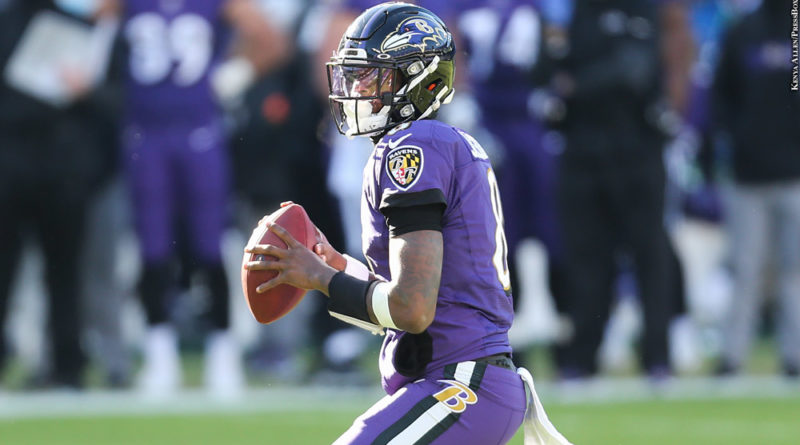
Just about a month ago, Lamar Jackson spent most of his week sleeping, sidelined by COVID-19 with the Ravens’ season on the brink of imploding. After four losses in a span of five games — including one at Pittsburgh that Jackson and 16 other players missed while on the reserve/COVID-19 list — the Ravens stood at 6-5, their lofty Super Bowl aspirations crumbling by the week.
But since returning to action after missing the Steelers game — and were it not for some NFL scheduling gymnastics, he likely would have missed two — Jackson has been one of the hottest quarterbacks in the league and the centerpiece of a Ravens resurgence.
Jackson has led the Ravens (10-5) to four straight wins and has posted a passer rating better than 100 in all four games — the only quarterback in the league with such a streak intact heading into Week 17.
The Ravens are once again viewed as a dangerous playoff team, though they likely need to win a fifth straight, at Cincinnati (4-10-1) in the regular-season finale Jan. 3, to secure their postseason berth.
Beginning with a win against the Dallas Cowboys, and including his epic sprint-from-the-locker-room, fourth-down heroics to save the season in Cleveland, Jackson has looked much more like the reigning league Most Valuable Player than he did early in the season, when turnovers, poor throws and inconsistent play left Jackson at times visibly frustrated on the sideline.
What has been different during the past month? What has made the post-COVID Jackson so much more effective that the early-season Jackson? It’s never a simple answer, but here are five key factors:
1. Improved offensive line play.
The Ravens lost All-Pro left tackle Ronnie Stanley to a season-ending injury in early October, which could have been disastrous, but the reshuffled line has solidified throughout the past month and exceeded expectations in the wake of Stanley’s injury.
Orlando Brown Jr. moved from right tackle to left tackle and has excelled in that role. Patrick Mekari took over as the starting center in place of Matt Skura, whose snapping issues proved to be especially problematic in a loss at New England. And when Mekari shifted from right guard to center, Ben Powers, who had played sparingly in his first 1.5 NFL seasons, became the starting right guard and has been one of the big surprises of the second half of the season.
Rookie Tyre Phillips, who had begun the season as the starting right guard before missing time with an injury, has been rotating with D.J. Fluker at right tackle, the spot vacated by Brown’s move to the left side.
It’s understandable if all that shuffling led to some missteps, but this group seems to have found its rhythm as a unit.
This refurbished group might have been at its best in the win against the Giants, whose defense entered that game ranked No. 12 overall and No. 6 against the run. Jackson was not sacked at all by the Giants on 26 pass attempts and the Ravens piled up 249 rushing yards — 90 more than the Giants had given up in any game all season.
“We know we need to play well on our offensive line,” head coach John Harbaugh said after the Giants game. He stressed execution was important at every position but added, “We always do talk about starting with the offensive line.”
2. A more dynamic, creative running game.
Veteran Mark Ingram has been a healthy scratch the past two weeks and played just one snap in the game before that, as the Ravens have focused on rookie J.K. Dobbins and Gus Edwards as the leaders of the ground game. Their success has made Jackson more effective as a runner and passer.
The Ravens lately have showed more two-back looks with Dobbins and Edwards in the game together, and at times they have lined up Dobbins as a slot receiver and brought him in motion on a jet sweep, giving him a full head of steam once he gets the ball. His balance and vision both come into play as he stretches the field horizontally and turns upfield.
On one such play early in the Giants game, Dobbins took the handoff and had Edwards out in front of him as a 240-pound lead blocker on the edge. Dobbins gained 17 on the play, setting up a 2-yard touchdown run two plays later.
Edwards, who ran for a team-best 85 yards against the Giants, has also showed more speed to the edge, and the threat of those backs getting outside is sometimes all Jackson needs.
Dallas inside linebacker Leighton Vander Esch bit hard on a fake to Dobbins, and by the time he realized Jackson kept the ball, it was too late: Jackson shot through a gaping hole up the middle and went untouched for a 37-yard touchdown, one of his four rushing touchdowns in the past four games.
Harbaugh said the two-back look has been in the Ravens’ playbook for a long time, but he acknowledged they are using it now more than ever and credited offensive coordinator Greg Roman with “being creative with those groups and those backs. … It’s put defensive position players and coordinators in conflict, and that’s what we always try to do.”
3. More spontaneity.
It’s hard to quantify, but Jackson is at his best when he is spontaneous, when he uses his otherworldly athleticism to improvise, and he appears to be doing that more than earlier in the season.
In the past month, Jackson has shown greater willingness to tuck the ball and run when the pocket breaks down or receivers can’t gain separation. In the win against Dallas, the Ravens twice faced third-and-long on a third-quarter drive. Jackson dropped back to throw, assessed the coverage, and then, seeing a lot of green in front of him, took off. He gained 7 yards on third-and-6, and then 14 yards on third-and-10. On the next play after that 14-yard gain, Jackson lofted a 20-yard touchdown pass to Marquise Brown for a 24-10 lead.
Earlier in the season, Jackson seemed to force more throws, as if he and the Ravens were trying to proclaim his eminence as a passer. True, there are times Jackson needs to be able to hit a tight window, make a sharp, on-target throw to the boundary, or manufacture a quick scoring drive through the air. Seeing him miss on such throws earlier in the year, and seeing the downfield passing game all but disappear, was discouraging.
But Jackson is most difficult to defend when he is most spontaneous, and for all the preparation, that might be when the Ravens’ offense runs at its best.
4. More consistent throws and catches.
For all Jackson’s dynamic scrambling and improvisation, that doesn’t lead to 100-plus passer ratings. The NFL system for rating quarterbacks factors completion percentage, yards per attempt, touchdowns and interceptions, and Jackson has shown marked improvement in those areas during the past month compared to earlier in the season.
Through his first 10 games, Jackson completed 63.4 percent of his passes, averaging 7.1 yards per attempt, with 15 touchdowns and six interceptions. In half of those games, Jackson had a completion percentage of lower than 60 percent.
During this four-game winning streak, Jackson has completed 69.5 percent of his passes (57-for-82), averaging 8.5 yards per attempt. He has thrown seven touchdowns and two interceptions. Jackson aired out a 44-yard touchdown to Marquise Brown on that epic fourth-down, straight-from-the-locker-room play at Cleveland, and also lofted a 44-yard pass to Brown in the win against Jacksonville.
Brown, who has hurt the Ravens with drops this season, has been more consistent of late, and so has Miles Boykin, whose mistakes on route-running earlier in the season led to some bad incompletions.
To be sure, some of Jackson’s throws — including some completions — have been off target, and players such as Brown, Mark Andrews and Willie Snead deserve credit for adjustments to make contested catches. But Jackson has been more consistent now than earlier in the season.
5. A more forgiving schedule.
The schedule figured to soften during the final quarter of the season, and the Ravens benefited from facing two of the league’s lowest-rated defenses in the Cowboys (23rd overall at the time, dead last vs. the run) and the Jacksonville Jaguars (dead last overall, 30th vs. the run, 28th vs. the pass).
The four teams the Ravens have played in their past four games had a collective record of 18-32 at the time the games were played; other than the Browns (9-3), the other three teams were a combined 9-29.
The Ravens still had to execute, and for the most part, Jackson has done that. He will stress it’s a team game, and all these factors have come into play. An improved line has given Jackson more time to go through his progressions, a more dynamic running game has made the offense more difficult to defend, and more consistent passing from Jackson has led to positive results.
Of course, Jackson and the Ravens know this is a week-to-week league, and none of that will matter unless the Ravens continue their resurgence and dispatch the Bengals to advance to the postseason. Harbaugh said the Bengals, who have won two straight despite losing No. 1 overall draft pick Joe Burrow to a season-ending knee injury, are “playing their best football of the season, really, by far.”
“We just have to keep clicking and keep staying focused on the task at hand,” said Jackson, who admitted to feeling rejuvenated and remotivated after missing a game earlier this year.
The 10 wins the Ravens have thus far? “They’re over with,” Jackson said. “We have teams in our way right now,” beginning with the Bengals.
“We’re going to Cincinnati. We’re going to play a tough defense,” he added. “That’s all we can focus on right now. We can’t focus on anything else.”
Photo Credit: Kenya Allen/PressBox