
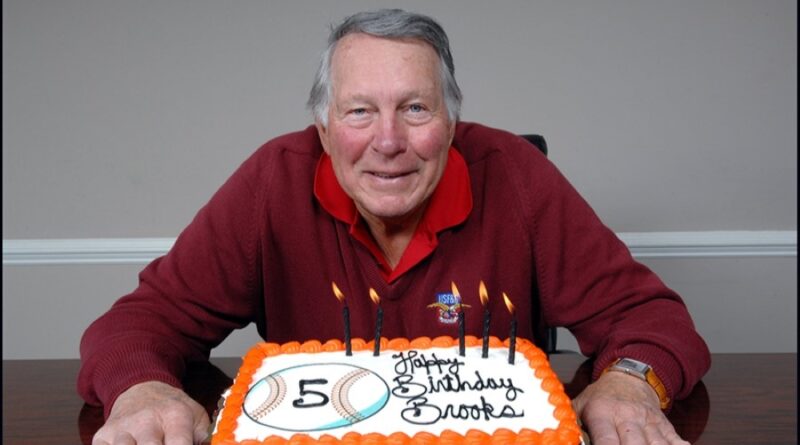
It seems like only yesterday that a 29-year-old Brooks Robinson leaped into sports photographic history at the conclusion of the Orioles’ 1966 World Series victory over the Los Angeles Dodgers. In real time, however, that scene played almost 41 years ago and on May 18, Robinson turned 70 years old. Time and tide do indeed wait for no man.
PressBox publisher Stan Charles recently sat down with the man who always will be known as Mr. Oriole and talked about a variety of subjects — growing old, the state of baseball today and how Brooks came to be immortalized not only by his athletic prowess, but also by legendary painter Norman Rockwell.
Not surprisingly, Robinson remains basically the same unassuming country boy who came to Baltimore those many seasons ago. And yes, he still is amazed — and honored — that people want to shake his hand.
Stan Charles: Brooksie, how’s it feel to be turning 70 years old?
Brooks Robinson: You know what? It scares me to death, if you want to know the truth. I didn’t think much about 50 or 60, but when I start thinking about 70, it scares me to death.
SC: You’ve had some health issues that started a few years ago.
BR: Yeah, probably about eight years ago. I had a case of diverticulitis and when I was getting ready to be released from the hospital, they did an EKG and they saw I had some atrial fibrillation. So it’s something that I take medicine for, but the final word from the electrophysiologist at Hopkins was, “Hey, your heart likes not to be normal so don’t worry about it,” and I think he probably meant, “You’ll die of cancer before you die of this.” I’m feeling great though. I do everything. I walk a lot, play golf a lot.
SC: Did it limit the lifestyle that Brooks Robinson had before the a-fib?
BR: No, it did not. I had a total knee replacement about eight years ago. I don’t jog anymore, but I’m able to run. I do play in the fantasy camp games down in Florida, and I’m even slower than I was before. I still can’t outrun Boog Powell.
SC: How was it to see the guys last fall at Morgan State for the 1966 Orioles reunion?
BR: It was wonderful, it really was and I made a vow then that I would try to keep up with everyone a little more. We saw Hank Bauer then. Dick Gordon, who works with Hank, called when they had this memorabilia show here and said that Hank was sick and couldn’t make it and I started to think, “Well he’s not going to be with us too long.” I make it a habit now to call different guys and say hello and see how they’re doing. Guys like Rocky Johnson, [Vic] Roznovsky just to say hello to them. It makes me feel good when I do that to see how they’re doing. I saw a lot of Dave McNally when he was not doing well in Palm Springs; I went out for a golf tournament and we spent some time together.
SC: Was the 1966 World Series the greatest thrill of your career?
BR: Yes, it was. I think that looking back, as a youngster growing up in Arkansas, I dreamt of signing a professional contract. I was a pretty good player. No one was going to give me a lot of money. I got $4,000. That was a minimum. If you got more than that, you were a bonus player and had to come directly to the major leagues. But certainly I had a lot of question marks. I didn’t run real well. I had an average arm. As a kid, you dreamt about signing a contract. I had several scholarships, basketball scholarships. One to Arkansas to play up there, and it was a big decision and my parents left it up to me. I had seven or eight teams that were interested in signing me, all for the $4,000, and I signed with the Orioles.
I dreamt about signing a contract and playing in the minor leagues, getting to the big leagues, winning a pennant and being on a World Championship team. That was it. And then in ’60 we had a good shot to do it and we didn’t quite make it, didn’t quite make it in ’64 and then in ’66, we got over the hump and we were the World Champions.
SC: How high did you really get in that famous 1966 World Series picture? Is it a real representation of how high you jumped?
BR: Well, of course it is! No, I’m not sure. All my kids used to say that’s trick photography. Let’s just say I couldn’t dunk, but in that picture I probably could have dunked.
SC: A lot of the players in your generation came up through the minors. You probably played what three, four years in the minor leagues?
BR: Two and a half.
SC: That was expedited. It used to be four years, five years. What are we missing by watching today’s players in the game be rushed quickly to the big leagues?
BR: Well, I think that the No. 1 reason that I got to the big leagues in a hurry was because Baltimore was not very good. And that was one of the reasons that I signed with them. And they sold me on the fact that, “Hey, if you got some ability, you’ll get to play here in a hurry.” And I got to play here a couple weeks when I was 18. But you’re going way back to the ’50s and ’40s, when guys spent a lot more time in the major leagues. Well, you got 30 teams now and when I signed, you had 16 teams and they just rush players to the major leagues. I see these same things happen.
SC: The fundamentals. Do they play baseball as well as you did when you were in the major leagues?
BR: You know what? I would say overall they don’t. I really think there’s a certain instinct you gain by going out as a kid and just playing pickup baseball. I might be all wrong about this, but I always felt that there is a certain instinct I gained at a young age about how to play the game. These kids today, it puzzles me…
There’s a certain instinct that a lot of these guys don’t have.
SC: The instinct is really learning fundamentals.
BR: Yeah. I was fortunate enough to have Paul Richards. He was like God when I signed. And he was way ahead of the game. I think he knew every position, what made every position tick and I was real fortunate to have him as a manager the first few years that I played. But I do think they rush players to the big leagues now. They just don’t give guys a chance to really get their feet on the ground and really play the game and excel against guys of their own caliber of baseball. They rush them, they’re overmatched, they lose a little confidence. It’s hard to bounce back for a lot of these guys.
SC: Frank Howard once hit a line drive that you leaped up for, and the ball went over your head and ended up being a home run. True story?
BR: Yeah. I don’t think it was a home run, but it was off the wall in left field. Gene Brabender was pitching. It was a bright and sunny day, a lot of white shirts. He hit a ball, and I always say I jumped like that and my hat flew off, and when I jumped, the ball was already bouncing against the wall. Frank was the only guy who really scared you, and when you played against him, he ran like me, so you could back up to the outfield fence and play him.
SC: You never had to rush him?
BR: I never had to rush him for a bunt. He did you a favor if he bunted. But that’s an actual true story. That’s the way I like to tell it but the ball was like the hardest ball you’ve ever seen hit.
SC: A Brooks Robinson signature is still extremely valuable relative to other players in your era. First of all, are you aware of that?
BR: I’m aware of it. The older you get, your autograph becomes real valuable because they think you’re going to die real soon. That’s the whole point.
SC: What do you honestly attribute that to? Because it’s not just your age. There’s a lot of Brooks Robinson autographs out there, also.
BR: My wife says, “I know you signed autographs for everyone in this country.” Well, not this country. This city. This state, we’ll say. And I’d say, “I think you’re probably right.” I don’t know. I enjoy people. I enjoy talking to the kids and things. That’s the only thing. I’m thrilled. If I walk downtown with my hat off down on Baltimore and Charles Street, I guarantee you four or five people will hang out the car window: “Hey, Brooks, [you] gave me my autograph back in Highlandtown or Trappe, Maryland.”
SC: I remember still when I got my first Brooks Robinson autograph. I was at the JCC and you were playing racquetball with John Orsino and I still have it.
BR: How about that. That’s nice. That’s one of those things I attribute to being here for as long as I have. Living here year-round since 1960, started coming here since ’55. That’s been fun.
SC: Do players miss out by not living in communities they play in? Melvin Mora’s the only current Oriole who lives here year-round.
BR: Well, a lot has to do with their family, where they come from. Melvin’s got a large family and it makes sense. He’s from Venezuela. He’s figured out this may be a better spot to raise [his] family than there. And in my case, my wife didn’t want to go to Little Rock and I didn’t want to go to Detroit, so we said we’ll stay in Baltimore. We raised all our family here.
SC: Do the players miss something by not getting attached to one community?
BR: Well, yeah, I would say so, and the fans miss something, too. I mean, I stayed here because I really needed a job during the winter time. I went to work for the Orioles doing four or five banquets for $125 a week. I think that’s what I was making and I was out a lot during the winter time.
In the long run, at the end of your career, I think that’s when people really appreciate you more than during your career.
SC: In other words, if you were to come along today, you probably would have played in three or four different cities.
BR: That’s a possibility.
SC: And that would have totally altered the landscape of how people perceive you?
BR: Absolutely. There’s no doubt about it.
SC: How did Norman Rockwell choose you for his famous painting and what does the painting symbolize to you?
BR: Well, if we can take the last question first, it symbolizes me connecting generations. That’s what baseball is all about. Your father taking it, in that picture, that little boy, “Gee, thanks, Brooks,” and I’m signing an autograph. That’s his dad on the right of me, and his mother’s over there on the left. To me, that’s what baseball’s all about: connecting generations.
And the first part of it was a gentleman named Harry Figge, who owned a company called Figge International and it was a big conglomerate. A couple of the subsidiaries were called Rawlings Sporting Goods and Adirondack Bats. So he had commissioned Rockwell to do some other paintings. They owned LeFrance Fire Trucks. So he had four or five Rockwell paintings hanging in his gallery at his place of business out of Cleveland. After I was MVP in the 1970 World Series, he commissioned Rockwell to do that painting. I went up to Normal Rockwell’s studio in January or February of 1971, and he did the painting. He put himself in the painting, which of course, I didn’t know he was going to do. He’s in the right-hand corner with the cigar. He was a wonderful gentleman. He knew a lot about baseball.
Of course, when Figge sold the business, he put all his Rockwells up for auction. I was a little upset about that because he always knew that I wanted it and I certainly would’ve paid for it. But anyway, I found out about two weeks before that it was going to be auctioned off at Sotheby’s, and a lawyer friend of mine, Sam Wellslogger, was in New York. And around Sotheby’s, there’s four or five hotels, and they put up this book [with] what’s going to be auctioned off. That picture was on the front of the book. He said, “You know your painting’s getting auctioned off.”
The day of the auction, I was supposed to be in Puerto Rico playing the golf tournament. Of course, the Sotheby’s people knew that I was interested in the painting. So, I sent my son up. I told my son he could go up to $175,000. So, anyway, my son went up, I’m there on the golf course, my wife is on the phone with the lady from Baltimore at Sotheby’s, and she’s giving a running account of the bidding. It went from 125, 35, 45, 55. Got to 175, went to 185, went to $190,000, I think. 195. I don’t know. Something like that. And so the lady said, “Mrs. Robinson, the bidding has stopped.” She says, “Tell him to go one more.” I went $200,000, so I got the painting.
I got the original and when I came home from the golf course, I looked at Connie and said, “Am I poor again?” She said, “Yeah, you’re poor.” And I was happy I got it. It’s been a blessing, really, now that I have it.
SC: When Cal Ripken broke Lou Gehrig’s record, you got up there and I can’t remember the exact words, but you said, “Cal, they call me Mr. Oriole, but after tonight you are Mr. Oriole.” What was that like, first of all being part of that event, and did you mean that?
BR: Well, I knew Cal’s dad. Cal’s dad was a coach here for years while I was here. A wonderful guy, and that’s certainly where Cal Jr. got his instincts for the game, the stick-to-it-tiveness or whatever the word is, that’s Cal all the way. I had the pleasure of doing a lot of games while [Cal Jr.] was doing it. He’s a guy who came along and played and did everything I did. I think both of us will always have a place here in Oriole history and I love it.
SC: What’s your relationship like with the Orioles today?
BR: I have a nice relationship with them. I had a few meetings with Peter [Angelos] over the years. I had lunch with him three or four times. I’ve told him, “Listen, Peter, I can go to spring training. I can go to your minor league camp, work with the guys, talk about what it is to be a big league player, I can sell a ticket, I can entertain when you entertain, I can do a lot of these things.” But we’ve just been never able to work it out. They want someone there that’s 24/7, and I don’t have the time to do that. I’m not that guy. But it’s kind of been a one-way conversation. I’d tell him what I can do, but you don’t get a whole lot of response back from them. I’m past that now. I’m past all that now.
SC: Do you root for the team?
BR: Oh, yeah. Absolutely. I root like hell for the team. I’m just sick about what’s happened.I get discouraged. I listen to the talk shows and get discouraged like everyone else does. I see all the mistakes that have been made. You’ve got to have some continuity. You can’t keep changing general managers. You can’t change managers and expect to win in this game. It just doesn’t happen.
And it’s not necessarily who has the most money. That’s part of it, yeah, but you give a few general managers a little money and they can be winners. You talk about the guy in Oakland. You talk about Minnesota. These guys are able to be a little smarter than other general managers, but I don’t know if [Mike] Flanagan and that group, [Jim] Duquette, are the right group, but whatever you do, leave them there. It looks like they’re headed in the right direction. I mean, I think we’re going to be better this year. Certainly got a lot of question marks, but you’ve got to let those guys do their job.
SC: Well said, Brooks. Speaking of your time as a minor league player, you played in York, Pa. You are now part owner of the York Revolution and part of the ownership group of the whole Keystone baseball
BR: That’s right. Maryland Baseball here, Keystone there. But we own 50 percent of the Camden, N.J. team. They bought 50 percent of that team. They had an owner that passed away. I was not part of that when they purchased it, but we own that and we own Lancaster.
I was just down to the Senate and the House yesterday in Maryland. They’re giving us some money to support our effort down there. We’ve had the land donated. We’re going to be the Southern Maryland Blue Crabs.
SC: That’s exciting.
BR: Yeah. The state has helped us out with money and I was asked to join the group as part owner. So I’m happy.
SC: Is there a special place in your heart for Earl Weaver?
BR: Absolutely. I respect him more than most, equal with anyone I could think. Here’s a guy who, when you stop to think about it, he didn’t want to do anything in his life except be a big league baseball player. He did not get that opportunity. He did not have the talent. Although he was an MVP in a league or two when he was in the minor leagues.
SC: If they had 30 teams then, he would have made a solid major leaguer.
BR: I agree 100 percent. He grew up in St. Louis, a big Cardinal fan. I was a big Cardinal fan growing up in Arkansas. But I respect him because here’s a guy who went back to class D, C, B, A, AA, AAA, major leagues, Hall of Fame. And that’s terrific. And Earl, I think his big forte was he got 25 guys and he picked them and everyone played. He didn’t let anyone sit on the bench. God rest his soul, Hank Bauer, if you got in his doghouse, you might not play for two weeks. But Earl, you could punch his lights out if you were out with him the night before and if you’re the best guy for that job, the next day you were in the lineup. Everyone knew what their job was, when they were going to be called on.
SC: Before the 1966 season, the Orioles acquired another Robinson named Frank. The salt and pepper Robinson guys. What was that like? He had come here with a little bit of sullied reputation or was he immediately kind of “The Man?”
BR: Well, he was immediately the man, but I think everyone took a step back and [said], “Well, let’s see what this guy’s all about.” And you’re right. He came over here with a little sullied reputation from Cincinnati and they were kind of glad to get rid of him. He came over here and I think that he had something to prove… He really fit in well over here. He was certainly the greatest player that I ever played with and he really put us over the hump.
SC: If Barry Bonds breaks Hank Aaron’s record, should it be considered the record?
BR: It’s going to be the record. No doubt about it. I don’t know, I mean, I’ve heard people talk about it. I’m on the board of directors up there at the Hall of Fame. He’s got to be elected to get in the Hall of Fame, and of course with all the conversations surrounding him and steroids, like [Mark] McGwire and you just knew McGwire wasn’t going to. McGwire said, “Well, I’m going to talk about the future. Not the past.” Well to me, the Hall of Fame is about the past. It’s not about the future. I don’t think they’ll do that, if he gets in the Hall of Fame, there will not be an asterisk or “played in the steroid era.”
SC: It is said that you met your wife Connie when she was a stewardess and you kept ordering iced teas from her.
BR: Yeah, that’s pretty true. 1959. I had just got out of the army right when the season started. I ended up going to Vancouver for awhile and ended up coming back to Kansas City. We always flew United Airlines and she just happened to be on that particular flight that particular day. She was on reserve. She wasn’t even supposed to be on the flight. She got called up and they said, “We got to go down and pick up the Orioles and take them to Boston.” That was a piston plane, so that took a few more hours than a jet.
But anyway, on this flight, word has it that I was really smitten. Somebody mentioned the word “smitten” and I said, “I like that word. I’m really smitten with her.” Anyway, I would go back. I drank a lot of iced tea. I was a big iced tea man anyway, so I kept going back for more iced tea and more iced tea, and I think I finally said, “Look, I’m the only single guy on the team. Everyone else is married. I don’t care what they tell you. I’m the only single guy.”
So I kind of cut everyone out in a hurry and I asked her out that night in Boston. It’s funny. She didn’t know if she was going to stay over or not. So I said, “This is where we’re staying at the hotel. If you’re going to stay over, call and let’s have dinner.” Stupid me. I didn’t even get a phone number from her in Chicago. So if she headed back to Chicago, I’d have a hard time finding her.
Anyway, she calls and says we’re staying over, so we went out to dinner that night and I saw her after the season. I drove to Chicago on the way back to Little Rock. She came to Little Rock on New Year’s that year and went to Chicago on the way to spring training on the next year… We got married the season after in 1960 in Canada.
SC: Happily ever after.
BR: Yeah.
SC: What has she meant to you?
BR: She’s been a lot smarter than me. I’ll tell you that. She’s a lot smarter than me. She’s just been part of my whole career. The fact is, we had four children pretty quickly. We could be home and take care of the kids. That’s all she wanted to do. Have kids and take care of them and raise them and I’m away half the time. So that’s the bad part of being a baseball player, if there is one. There’s a lot of traveling. It was difficult for her, but she was terrific. Best thing to ever happen to me. That was part of the reason for my success. No doubt.
SC: The late Associated Press writer Gordon Beard used to say, “Brooks never asked anyone to name a candy bar after him, but Baltimore people name their children after him.”
BR: He hit the nail on the head.
SC: How did that make you feel?
BR: It made me feel great. I try to keep a list of people who, I mean I still get films every year. Little videos of, “This is Brooks now. He’s 12 years old and he’s playing here.” I was down at this steakhouse the other day and a lady said she named her son Brooks. That’s unbelievable. You know I always try to write them a little note: “I’m honored to know you.”
Photos by Jim Burger
Issue 2.21: May 24, 2007