
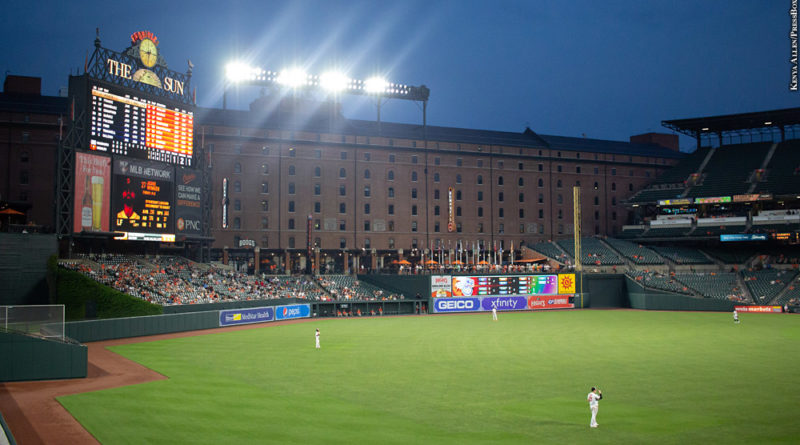
At the Clark house, I regularly sit down after getting my kids to bed and pop on whatever the most relevant sporting event of the night is. Mrs. Clark and I have long had a routine. When she enters the living room, she asks me if this is a game I “HAVE” to watch for my job.
In case she’s reading one of my columns for the first time in the history of our marriage, I want her to know that I’ve definitely never taken advantage of her trust in these situations. I mean, how could I be expected to do a Baltimore sports internet radio show if I didn’t watch a vital Tuesday night Arizona Coyotes-Carolina Hurricanes showdown on NHL Network???
When she does happen to dispute whether I actually “need” to watch a certain event, she often says something along the lines of “It’s 2022 now, couldn’t you just follow along with the game on Twitter?” About a month into the Orioles season, I sheepishly admitted to her that yes, yes I could do that. If she wanted to watch “MasterChef: Back To Win,” I’d be happy to do that with her and I could just let Twitter tell me about whatever misery was occurring in the baseball game.
Just months later, I found myself on a cruise ship without cable or any form of streaming video last week. So I was forced to watch the most relevant baseball our city has seen in more than six years … by reading about it on Twitter. I do not recommend it!
It is truly incomprehensible that the Orioles are where they are at the 2022 MLB All-Star break. A team with a starting rotation of Tyler Wells, Jordan Lyles, Dean Kremer, Spenser Watkins and Austin Voth and a bottom third offense in all of baseball is somehow .500 despite playing in the toughest division in all of baseball. They could be the poster of pre-poster-ous.
When the Orioles last selected at 1.1 (in 2019), the fan base was so desperate that they immediately made the selection (Adley Rutschman) the face of the franchise and pinned all of their hopes and dreams on his success. As they made another 1.1 selection this week, the response to Jackson Holliday was something more along the lines of “Yeah, we hope he’s good too.”
None of which is to say we can declare the franchise’s rebuild “complete” or declare the process a resounding success or anything along those lines. No one hangs a banner for “winning as many games as you lost in the first half of the season.” Not even the Indianapolis Colts. And improving upon this success in the second half (or even replicating it) will be improbable, mostly because it was improbable that they would even get to this point!
So as we take stock of this team at the break, we’re forced to consider the micro as well as the macro for the first time in … well … a long time. The social media debates about the MLB trade deadline strategy are wholly warranted! Even those of us who have accepted that Trey Mancini specifically is likely to be dealt have to ask questions.
While a dreadful first week out of the break (which is possible given that the Yankees and Rays come to Baltimore) could make it more palatable for the team to move on from Mancini, we have to discuss this more frankly. If the Orioles hold their own against two of the American League’s top teams and are still within a game of .500 either way, what exactly is the point of a Mancini trade? Sure, he’s not likely to take his player option for 2023. But while he’s having a good season and remains beloved here, he’s a positionless, decent bat anywhere else.
What exactly does that fetch?
Even if Buck Showalter really wants him back in New York, what are you giving up for two months of a designated hitter who is on pace to finish shy of 20 home runs this season? Sure, any prospect could prove to be organizational depth but … is that what the Orioles should be doing right now?
This isn’t specifically a Mancini column, however. My opinion is not absolute. Should Mike Elias be able to coax the Mets (or another team) to give up a legitimately helpful, nearly major league-ready piece in exchange for Mancini, such a move could be justifiable! It doesn’t seem logical of course, but perhaps some team really does get desperate for one more bat.
And that’s the point of the column. In my season preview column, I referenced the significance of this season being about the move to “Phase 2” of the team’s rebuild. And now the organization needs to prove that they’re ready to move to Phase 2 of their decision-making. Decisions should no longer be about “rebuilding.” They should be based around competition, if not now then in the very near future.
It’s unreasonable to think the Orioles should try to add pieces to fortify a Wild Card push. But it’s equally unreasonable to continue focusing on “lottery ticket” prospects in trades. In the last couple of years, it was appropriate to say “Let’s trade __ for whatever 19-year-old another team signed on the international market but doesn’t appear to have room for any longer.” But that shouldn’t be the case anymore.
The unspoken part is that the Orioles have to prove there’s a “there there.” They have to prove this really was a “rebuild” and that they’re not just going to keep trading every player before they might have to pay them, never creating a viable window to compete for anything of significance. They have to prove that they’re not the Miami Marlins. Not that anyone has reason to believe they are. But trading away veterans for minimal returns when a team has at least a chance of competing wouldn’t exactly be a comforting message.
The opposing argument in the Mancini debate is that a rebuild should always be about building a World Series contender and even a minimal “prospect” is more likely to be a part of a future World Series team than a player who could depart in free agency from a team that almost certainly won’t be in the World Series this year. And I get the argument.
I just think it’s time to say, well, “it’s time.”
Because it’s time.
Photo Credit: Kenya Allen/PressBox