

The Ravens took a strange trip en route to a 6-3 record in the first half of the season. They lost three times after holding big leads in the second half, including a meltdown for the ages in Week 2, when Miami scored four touchdowns in the fourth quarter to stun the Ravens, 42-38. Yet the Ravens won at New England, at Tampa Bay and at New Orleans, three games that looked daunting when the schedule was revealed in the spring.
The Ravens have their bye this week, essentially at the midpoint of a 17-game season, giving players and coaches a chance to rest up before they resume play at home against the Carolina Panthers on Nov. 20.
With the second half of the season looming, here are five key questions facing the Ravens throughout the remainder of the season:
Can the Ravens win an aerial shootout if need be?

In their final two games before the bye, the Ravens clearly showed their strength as a run-first offense: After struggling through a pass-heavy first half at Tampa Bay in which they scored three points, the Ravens piled up 204 rushing yards in the second half en route to a 27-22 win. They totaled 132 rushing yards in the second half in their 27-13 win at New Orleans.
They have built their team to win on the ground, to get the lead, hold the lead, and chew up the clock. That was their formula in the 14-2 season of 2019, and that seems to be their preferred formula in 2022.
What happens, though, when they have to win through the air? Can they do it? It’s a fair question with no sure answer.
Lamar Jackson has continued to dazzle as a dual-threat quarterback and leads the league with 7.4 yards per carry, but he has thrown for fewer than 150 yards in three of the past six games. He ranks 25th in completion percentage at .623, his lowest since his rookie year. More than once, he has missed an open receiver that could have resulted in a huge play, and he has had ill-timed turnovers in Ravens losses. And now top wide receiver Rashod Bateman is out for the season with a foot injury that requires surgery.
Devin Duvernay will presumably be the top target not named tight end Mark Andrews, but his total of 25 catches ranks tied for 79th in the league. The Ravens did not to draft a wide receiver, or sign a high-profile one in free agency, or trade for one at the deadline once the extent of Bateman’s injury was known. Those decisions invite scrutiny.
Granted, the Ravens face a forgiving schedule during the second half of the season and should be favored in every game until at least the regular-season finale at Cincinnati. If all goes according to plan, they will be able to assert their will on the ground with the league’s No. 2 rushing offense against weaker competition. And Jackson is, above all else, a winner; he has a career regular-season record of 43-15 as a starter. He usually finds a way.
But could this team go toe to toe, pass for pass, with the best teams in the league come playoff time? Or if they fall behind and need to catch up late through the air, can they do it with their roster as presently constructed? They must rely on players such as Duvernay and Demarcus Robinson and little-used James Proche, and hope that recently signed DeSean Jackson still has something in the tank at age 35.
Will J.K. Dobbins return to form this year, and does it matter?
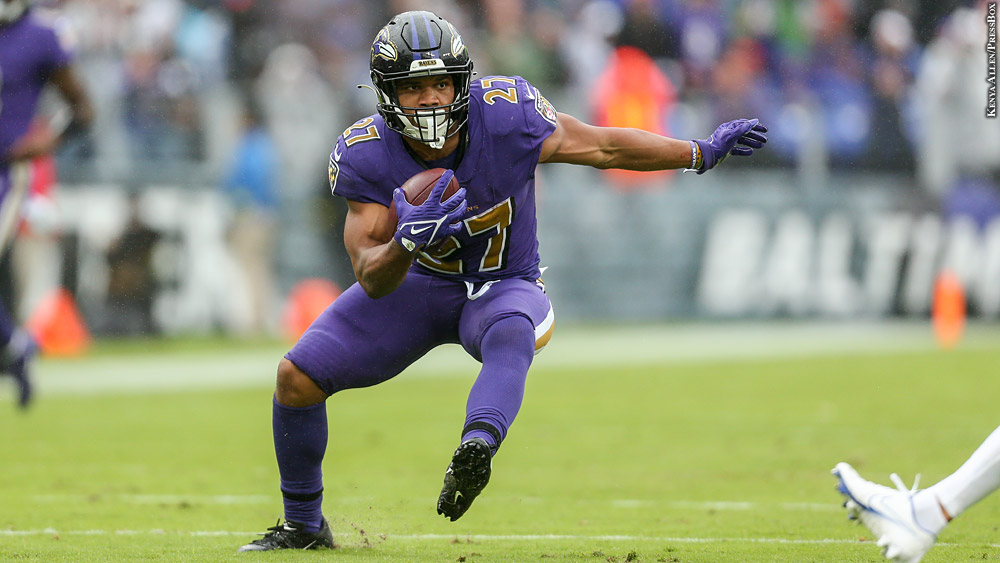
Dobbins was expected to be the centerpiece of the Ravens’ running game after returning from the torn ACL that cost him the entire 2021 season. Instead, he played in just four games before being shut down again to have a procedure to address scar tissue in his surgically repaired knee that was limiting his range of motion. Dobbins has 35 carries for 123 yards (3.5 avg.).
In his absence, and with Gus Edwards slow to work back from his own 2021 injury, the Ravens have turned to a cadre of backs including Kenyan Drake, Justice Hill and Mike Davis. That trio showed little in the first few weeks, but Drake has emerged as a factor, with 119 yards on 10 carries against the New York Giants and 93 yards on 24 carries against New Orleans — the biggest workload by any Ravens running back since 2015.
Edwards, who missed the Saints game with a hamstring injury, is expected back after the bye, head coach John Harbaugh said, and he looked like his old power-running self in his brief return this season, with 131 yards on 27 carries.
Perhaps the most significant development for all of these backs is improved play up front. Left tackle Ronnie Stanley has returned to his All-Pro form since working back from the ankle injury that cost him 1.5 seasons, and rookie center Tyler Linderbaum has played to his first-round draft slot. Guards Ben Powers and Kevin Zeitler and right tackle Morgan Moses round out an offensive line that has been getting better each week.
Dobbins’ return to form would certainly boost this offense, but the constant threat of Jackson as a runner, and an offensive line that is winning at the point of attack, bodes well for whoever is carrying the ball.
Will the pass rush become this team’s biggest strength?

Throughout the summer, questions abounded about the Ravens’ pass rush, but the team always took a long view; Tyus Bowser and rookie second-round pick David Ojabo would be returning from Achilles injuries by about midseason, bolstering a group led by ascendant second-year player Odafe Oweh.
Still, it looked bleak early in the season, as the Ravens had just two healthy outside linebackers on the initial 53-man roster, including Justin Houston, who at age 33 had contemplated retirement before returning for his second season in Baltimore. They signed veteran Jason Pierre-Paul after Week 3 to help address the shortage.
Overworked early in the season, Houston was sidelined for three games by a groin injury, but since returning he has looked 10 years younger. He has produced 6.5 sacks and in interception in his past three games, and as the Ravens anticipated, the edge group is only getting deeper and better.
Bowser made his 2022 debut against New Orleans, and Ojabo, who thrived under Ravens defensive coordinator Mike Macdonald at Michigan, shouldn’t be far behind. That gives the Ravens the depth to rotate five edge rushers in various packages, which should make all of them better and more potent as a game wears on.
Oweh has been surprisingly quiet thus far, with just one sack in nine games, but overall the Ravens have 27 sacks, tied for fourth-most in the league, including several from defensive backs coming on blitzes well timed by Macdonald. Last season, the Ravens totaled 34.
Will Roquan Smith or anyone else be extended?

Lamar Jackson’s contract status hovers over all with the Ravens, but after the team and the quarterback failed to reach an extension in the preseason, both sides said negotiations are off until after the season. Like Jackson, newly acquired linebacker Roquan Smith is set to become a free agent in the spring. Will the Ravens try to sign Smith to a long-term deal this season?
The Ravens generally keep their extension talks quiet, but general manager Eric DeCosta is always at it; in recent years, the team has worked out December extensions with fullback Patrick Ricard, cornerback Marcus Peters and offensive lineman Patrick Mekari. Peters, like Jackson and Smith, is also a pending free agent.
To be sure, Smith is going to command a higher price that a fullback or sixth offensive lineman, but in Smith, the Ravens see a thumper and two-time Pro Bowl pick around whom they could build their defense for years. One potential complication: Like Jackson, Smith has no agent, so any extension discussions would go directly through him. In the weekly grind during the season, how much time would Smith have for any such negotiations?
Another complication: How exactly do the Ravens find money to retain both Smith and Jackson? They could use the franchise tag on one or the other, but not both.
Can the Ravens hold on and win the AFC North?

The short answer is they should, and if they don’t, they have only themselves to blame. The Ravens’ next four opponents — Carolina (3-7), Jacksonville (3-6), Denver (3-5) and Pittsburgh (2-6) — have a combined record of 11-24, and the Ravens should be favored in every game until at least the regular-season finale at Cincinnati.
They already hold a one-game lead over the Bengals (5-4), who still have games remaining against teams leading the other three AFC divisions — the Tennessee Titans (Nov. 27), Kansas City Chiefs (Dec. 4) and Buffalo Bills (Jan. 2). Should the Ravens and Bengals end up tied with a season-series split, the Bengals already being 0-3 in the AFC North could tilt a tiebreaker in the Ravens’ favor.
Cleveland (3-5) is 2.5 games behind the Ravens, and regardless of whether Deshaun Watson leads the Browns on any resurgence once he returns from his suspension — tentatively scheduled for Week 13 — any chance for the Browns to close that gap would come because the Ravens faltered against inferior competition.
The New York Times gives the Ravens an 81 percent chance to win the division. ESPN puts the chance at 88.5 percent. In short, after the Ravens wild ride over the first half of the season, they control their own destiny, and the AFC North is theirs to lose.
Photo Credits: Colin Murphy and Kenya Allen/PressBox