
After one day of testing baseball’s new rules, especially the love/hate relationship with the pitch clock, there is good news … and there is bad news.
The good news is the games were quicker (“wickedly quick,” according to one description on mlb.com), on average 25 minutes faster than last year’s average playing time of 3:03. There were five shutouts, all of which came in at 2:33 or less, while the other 10 maxed out at 3:38 for an overall average of 2:35.
So far, so good.
But here’s the bad news: The pitch clock is messing with the rhythm of a game meant to flow at natural pace — and in some cases may have directly impacted a game’s outcome, including the Orioles’ messy 10-9 win against the Red Sox.
We shouldn’t have the best hitter on the field being called out on strikes without a pitch being thrown and eight seconds still on the clock. That’s not how the game should be played.
And we shouldn’t have pitchers being penalized for not being ready to start the inning when there are still 30 seconds on the clock — and commercials are running. That’s not the way the game should be played.
The clock needs to be fixed — or turned off.
We can all agree there should be no stalling in baseball, no running out the clock — but this isn’t speedball, there’s no fast break in this game. The company line, and I’ve heard this one ad nauseam, is “it’s never been about the time of the game.”
That’s an insult because it’s ALWAYS been about the time of the game. If not, why do they keep mentioning getting the game over by 9 p.m. so kids (and adults I presume) can get a good night’s sleep? As if game times in April, May and June were geared more toward kids than the corporate world.
It is baseball’s desire to get the average nine-inning game into the 2:45 minute range (just like a Broadway play where you always know the outcome but don’t leave at intermission), and these new rules will certainly do that. But here’s what baseball isn’t telling you: about half of the time they are trying to save, finally, is between each half inning.
It was very noticeable in spring training that MLB was adhering to a two-minute break. And I can attest that they are sticking to it during the regular season. I watched all or parts of nine of the 15 games on Opening Day (I know, get a life!) and I clocked the between-innings time in every one — and play was ready to resume at the two-minute mark consistently in every game.
That two-minute mark is a far cry from years past, when time often stretched beyond three minutes, especially for nationally televised games. With so much in-game advertising, especially the ability to advertise on places like the pitcher’s mound without distraction, the need for extensive advertising time between innings (and on the jumbo board) is reduced and apparently baseball is paying attention.
And that is REALLY the good news. By my account following the games on March 30 — none of which went into extra innings, by the way — I believe the strict interpretation of the two-minute rule alone was responsible for at least a 9- or 10-minute reduction in elapsed time. That time was gained beyond the actual playing of the game, which is the way it should be done.
But the “speedball” approach definitely had its drawbacks.
One line I heard way too often, especially the one between the Orioles and Red Sox, was this one — “What just happened?”
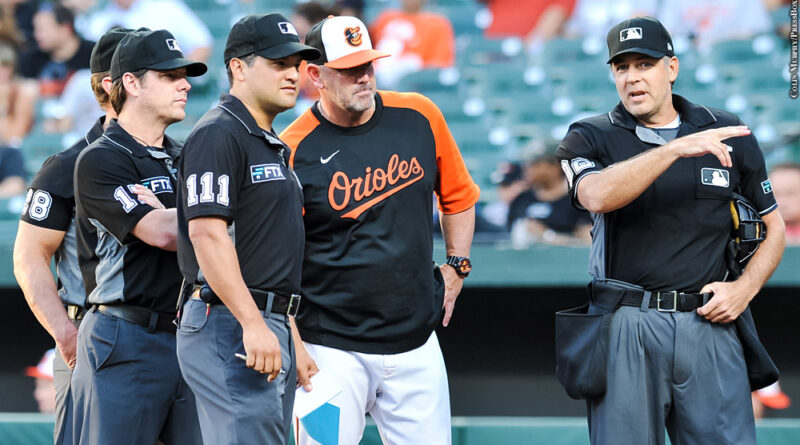
Usually what just happened was that the umpire had to stop play to inform everyone that an automatic (call it a ghost) strike or ball had been called on the hitter or pitcher. That’s the new way — we stop the game to inform everyone what happened while we were trying to speed up play. Duh!
There has to be a simpler way. We’re going to hear a lot about turning off the clock in the ninth inning, but having two sets of rules to solve one problem doesn’t seem to make sense.
There seems to be universal agreement from those in charge, and from those who are watching, that a pitch clock is a necessity, but there has to be a better way. The Red Sox can claim the loss to the Orioles was directly impacted by the fact that Rafael Devers was called out while holding the bat in his hands and eight seconds still showing on the clock.
It would be a legitimate complaint were it not for the fact that this is what MLB wants and the umpires have been instructed not to cut any slack on the issue. But what we’re forgetting here is the fact that there is a cerebral part of baseball that can dramatically affect the outcome, and the clock is going to determine a lot as the new rules are written — 30 seconds between hitters, 15 seconds between pitches with no runners on base and 20 seconds when there are runners.
Here are a couple of suggestions that might be at least a partial solution to the confusion: Whenever the hitter gets into the batter’s box he operates at his own peril, obligated to be ready unless he uses the one timeout he is allowed. If he steps out of the box to fix his shin guards, adjust his glove or merely to clear his mind, he does so on his own time. The pitcher has the discretion to throw the ball anytime after it has been deemed ready for play, and it is up to the hitter to react.
The rule about hitters “being fully engaged” with the pitcher can be easily modified. Unless time is called, being in the batter’s box is translated to mean fully engaged. Having a strike (especially the third one) called while a batter is in the box with bat in hand is not a solution, it’s a nuisance.
Even more ridiculous is the pitcher being called for a ball because he hasn’t completed his warmup pitches by the 1:30 mark of the two-minute break. He’s allowed to throw as many as he wants in that time frame, so wouldn’t it make more sense for the umpire simply to wave off addition tosses, rather than call a ball — which nobody will realize until later in the at-bat, including the announcers.
No more stopping the game to tell us what happened, just a continuation of the at-bat and the hitter is on his own. In the case of Devers, it would’ve been up to him to react to the pitch. At least there would be a pitch thrown and the umpire wouldn’t have to stop the game to tell us what should have happened, but didn’t, while Devers stood with his bat on his shoulder and time still on the clock.
A lot happens between the ears in baseball, and the astute fan realizes as much. He or she is anxious to see what will happen, not be told what didn’t. Stopping the action to enforce a rule designed to speed up the game doesn’t seem to be the answer.
Too much attention is given to so-called “dead” time. When the ball is in the pitcher’s hand and the batter is in the box, it’s in play. There’s a lot going on upstairs and it shouldn’t be controlled by a clock.
One sure way to disrupt a player is to make him do things faster than he wants. That should be more meaningful than simply making the game faster.
There’s no question the clock has a purpose and can work. The two-minute drill between half innings is proof of that. But it shouldn’t control the pace of play. Part of the beauty of baseball is that it is in the mind of the strategist.
That shouldn’t change. The clock can be fixed. Memo to MLB: Do it — or turn it off.
Jim Henneman can be reached at JimH@pressboxonline.com
Photo Credit: Colin Murphy/PressBox