

The United States men’s national soccer team’s disastrous elimination from the Copa América on July 1 has raised questions regarding the future of the team, which was once deemed to be entering a golden era of talent.
“I’m not sure what that means because when you look at a golden era or you’re looking at players, a golden era is when people win,” former USMNT member and Baltimore soccer legend Santino Quaranta said on Glenn Clark Radio July 3.
The Copa América is a tournament that has occurred every four years since 1916 between the top men’s teams in South America, although teams from North America and Asia have been invited since the 1990s.
Sixteen teams were split into four groups in this year’s tournament, with the United States placed in Group C alongside Panama, Uruguay and Bolivia. The Americans favored to win their group but failed to even finish second and advance to the knockout stage after defeating Bolivia and falling to Panama and Uruguay.
Many of the United States’ shortcomings in soccer have always been pinned on the fact that most of its best athletes play other sports, such as basketball and football. But with world-class athletes like Christian Pulisic and Giovanni Reyna now representing America, what gives?
Most of the blame has been placed on fired manager Gregg Berhalter, whom Quaranta agrees should have been let go.
“I feel like when I’m watching the team, he’s wearing high-top Jordans and the outfit is more important. It’s weird stuff,” Quaranta said. “That might sound crazy, but when I was with Bruce [Arena] and when I was with Bob [Bradley], it was about work. There was no show. It was about winning games and it was about [being] gritty [and] grinding to represent your country at the highest level. And for me, I like Gregg, but I think he’s got to go.”
Berhalter also made a controversial gesture in the United States’ 1-0 loss to Uruguay, signaling the score, 1-1, of the Panama-Bolivia match to his players before they surrendered the only goal of the match.
“I wouldn’t do that in a youth game if we went to 1-1 and we were trying to get out of the group,” he said. “I just didn’t like it.”
Another reason why this era of United States’ soccer has failed is because of the players’ mentality, according to Quaranta, who grew up in a different era.
“But there’s also something mentally like, ‘Am I doing too much? Am I not doing enough?’ Growing up where I did, that wasn’t talked about much,” he said. “They just lost a game and I saw the fitness guy running out and giving them protein drinks right on the field to make sure that they’re being hydrated after they were just knocked out of the Copa América.”
Quaranta was drafted by D.C. United in 2001, making him the youngest player ever drafted at 16 years old. The Baltimore native spent the year breaking multiple MLS age records, including the youngest to score, the youngest Player of the Week and the youngest All-Star. Quaranta made his USMNT debut in 2005 in the Gold Cup.
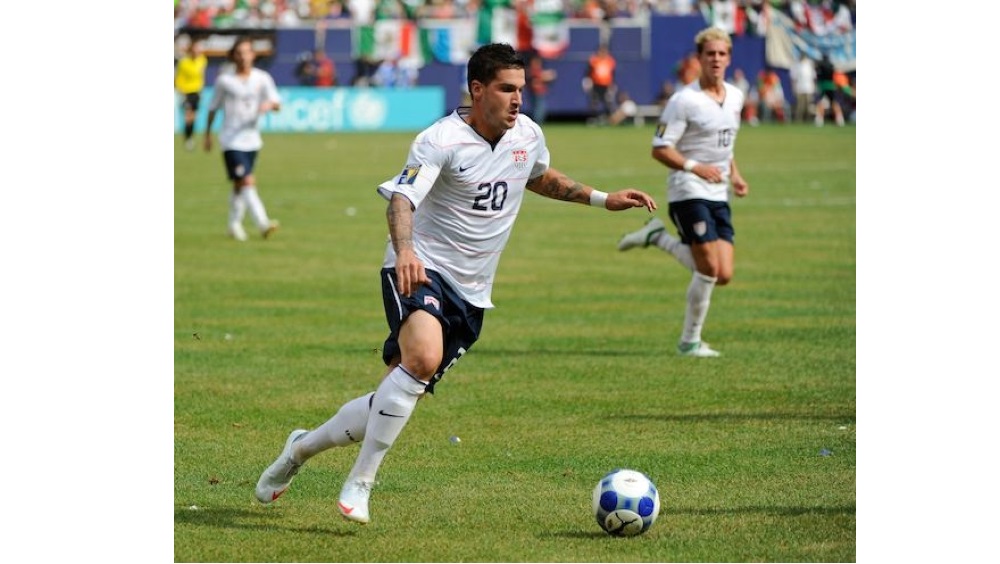
The 39-year-old credits much of his early success to his uncle Steve, who was one of the best Baltimore soccer players of his time and taught Quaranta how to train at a young age.
With the United States hosting the 2026 World Cup, it will not have to compete in the qualifiers, which may hurt an already struggling team.
“[The qualifiers are] really hard. It’s really hard at two o’clock in the afternoon when it’s 95 degrees,” Quaranta said. “It brings you together as a group. … It might hurt.”
For more from Quaranta, listen to the full interview here:
Photo Credit: Colin Murphy/PressBox