
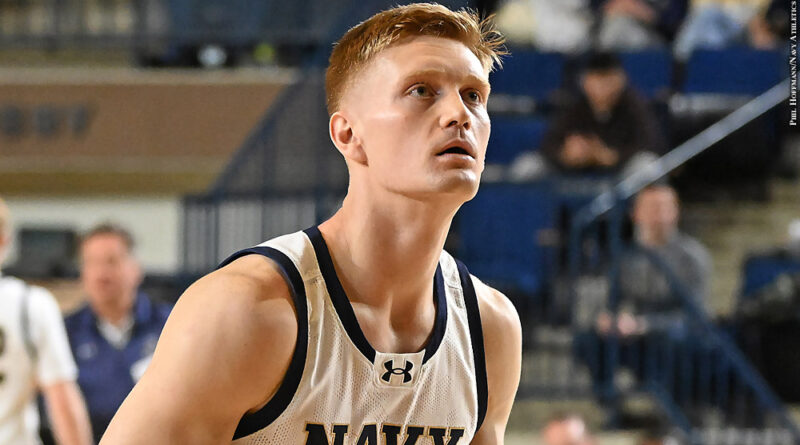
PressBox recently chatted with Navy men’s basketball senior Lysander Rehnstrom about bouncing back from a nasty high school injury, why the Naval Academy is so special and more. The 6-foot-3, 195-pound guard averaged 5.4 points and 1.6 rebounds for the Midshipmen in 2023-24. Rehnstrom is a native of Reston, Va., and graduate of Herndon High School.
PressBox: How did you first become interested in basketball?
Lysander Rehnstrom: At first I played youth hockey, but I always went to the local YMCA. My dad, [Doug], would just drop me off after school and I would play pickup ball. Youth hockey got a little too expensive, so my dad signed me up for my first basketball team in second or third grade at the local YMCA. Since then, I’ve played basketball. I played a little baseball but fell in love with basketball from Day 1.
PB: Who was the biggest influence on your game growing up?
LR: My dad made me grow up watching Larry Bird highlights, which made me a big Celtics fan, but I think also influenced some of the attitude I play with at times. … I think I try to play with a lot of energy, a little bit of trash talk, try to just have fun on the court. All those Larry Bird highlights when he’s talking trash and telling guys what he’s going to do and then he goes and does it. When I grew up, I just wanted to do that. I wanted to be that good. I wanted to idolize a player that could do whatever he wanted on the court — pass the ball, shoot the ball, rebounds well. That was really the goal when I was developing as a young player.
PB: Why did you originally choose to go to George Mason?
LR: My senior year of high school I got injured really badly. I ended up in the hospital. I really had nowhere to go. I had lost all the interest that I had from college teams because they didn’t know if I was going to be able to play again or not. That’s when I called up [then-coaches Dave Paulsen and Duane Simpkins] at George Mason. They had known me for a couple years at that point. I gave them a call. I said, “Hey, this is my situation. Let me come just try out,” pretty much. It was just to prove to them that I could still play basketball. I showed up, and I was a walk-on at first when I showed up at George Mason. I just worked hard every day to get back to where I was and where I wanted to be and just to earn the right to play college basketball.
PB: What injury did you suffer as a high school senior?
LR: I had a grade 5 spleen laceration in a basketball game my senior year. It was Feb. 4 my senior year. I go up for a layup on a backdoor cut, and the kid undercuts my legs. My rib cage landed on his foot. I was in a lot of pain, but then the adrenaline kicked in. I stood up. I remember I helped the other kid off the floor. I was walking back toward our bench and our coach is like, “Hey, are you OK? Are you OK?” I’m like, “Yeah, Coach, I’m good, I’m good.” And about a minute later I just collapsed, hit the ground. They rushed me to the hospital. They anticipated that I would need emergency surgery. The first scans [indicated], “This is grade 5, this is internal bleeding, this is really bad.”
Right before I was getting prepped for surgery, they did one last set of scans. The way it was described to me was, “If you took a water balloon and you popped it but all the water stayed perfectly still.” I think I just got lucky. It was an absolute miracle that it wasn’t worse. I stayed in the hospital for a couple days. They released me. They told me, “Hey, you’re probably never going to play basketball again. You’re not going to be able to run or do any exercise for probably nine months.” Six months later, I was playing Division I basketball at George Mason. I got pretty lucky with how that all turned out. It helped me shift my mindset, really realize how bad I wanted to be a college basketball player and how much I needed to work to get to where I wanted to be.
PB: How long did it take for you to start working out again?
LR: The doctor said don’t do anything for nine months. Pretty much without telling anybody, I started working out as soon as I felt physically capable of it. I was bedridden for a little bit and then I was slowly able to start walking and moving. After three weeks, they finally let me go back to school. The security guards at our school would walk me to class to make sure nobody bumped into me. I had bodyguards to make sure nobody bumped me because they were so scared that any little bit of contact would be enough to reactivate the internal bleeding, and then COVID hit. When COVID hit and my high school shut down, I really had nothing to do. Kind of against doctor’s orders I went right into working out and getting back to lifting. I didn’t tell anybody, which probably was not the smart thing to do. But I was pretty fortunate that I never ended up getting an injury again. Probably about a month out, I was back to lifting and running and shooting, just trying to find a way to get to college.
PB: Why did you choose to transfer to the Naval Academy?
LR: I played a year of basketball at George Mason University, and my coach was let go there, so I was kind of forced to put my name in the transfer portal. That’s when I got in contact with the staff here at Navy. They were super supportive. They took a chance on me. I didn’t really have a lot of experience with the military or the Naval Academy. It was definitely a culture shock, showing up and getting yelled at going through Plebe Summer, but I can honestly say it was the best decision I could’ve ever made. It’s changed my life. It’s helped me develop as a leader, develop as a man, and basketball has been outstanding.
PB: What’s your favorite memory from your time at Navy?
LR: My first college game where I played significant minutes was at home versus Boston University last year. I was in and out of the rotation early in the season. I really got an opportunity to play against Boston. I ended up playing [26] minutes. I don’t remember having that great a game, it was just the joy of finally being out there, having a significant role. I ended up having the game-winning block, which won us that game right at the last second of regulation, which was pretty cool. I remember just hugging that ball. [Head coach Ed DeChellis] came up to me after the game and told me I really deserved that one. I had worked really hard to get to where I was. That was my favorite memory.
PB: What’s your favorite thing about the Naval Academy?
LR: I would say it has to be the opportunity for mentorship. There’s no other school in the country where leaders are so readily available to give you advice, to help you develop and in turn no other school in the country deliberately puts you in positions to mentor others. The relationships that I’ve been able to foster with my teammates — both the guys older than me that are now graduated and commissioned officers and the guys on my team that are younger than me who I get to try and teach and develop as men — no other school in the country gives us that opportunity. I love it. I love the relationships that we build as teammates and with everybody at the school.
PB: Who’s your best friend on the team and what’s a story that underscores your friendship?
LR: My best friend on the team is Mac MacDonald, who people like to joke is my twin. We’re both red-headed guards, play very similarly. I wear No. 2. He wears 22. It really started our freshman year when we both made varsity. We would watch film, and all the staff would confuse us. One of us would make a mistake and they would yell at the other person on film because they couldn’t tell us apart. That really carried on. We have season-ticket holders, fans that sit front row. They’re at every game. And every game they mix us up, which I think is really funny. Last year when he had his giant game at Holy Cross when he blew up for 35 points, I had professors at school and some of the custodians that work with the Academy coming up to me, telling me how great a game I had. We always laugh about how similar we look and we play.
PB: Who did you look up to early in your college career?
LR: I’ll say the best teammate I ever had was P.J. Fenton, who graduated two years ago from the Naval Academy. He’s now a Marine Corps Finance Officer. By no means was he a star player. He never really played that much in his college career, but he was the hardest-working individual I’ve ever met in my life. The way he carried himself, his ability to lead on and off the court — even as a guy who wasn’t playing a lot — nobody demanded the same respect on our team as he did, on par with our team captain that year because of his ability to just outwork everybody and his love for us as individuals. That is a player and a teammate that I try to resemble in my actions every day.
PB: What advice would you give to younger players?
LR: I would say if you’re going through the recruiting process you need to be patient and you need to not be so hard on yourself. I think when I was in high school I put so much pressure on myself to become somebody I wasn’t ready to become. It took getting hurt and going through the process and really just not caring about the outcome but caring about what I was putting into the game every single day that changed my love for basketball. Instead of this relationship where I was so worried about recruiting and getting offers and achieving every goal that I put out for myself, it was just, “What can I do every day? What am I willing to sacrifice to achieve my dreams?” That’s when the recruiting and the offers really will come.
PB: What are your goals for after basketball, whenever it ends?
LR: I think physically I want to continue to challenge myself. That is part of why being a Marine Corps Officer is appealing to me. My sophomore year at Navy, I ran my first ultramarathon. That’s something that I want to keep doing. I want to run a 50-miler. I want to run a 100-miler. I want to do an Ironman. These are physical goals that I hope to pursue. I want to keep pursuing my education. I’m trying to go to grad school right now. I’m an operations research major and I love it. I think doing both — pursuing my education, pursuing the physical mission — will set me up to be the best Marine Corps Officer and eventually the best father and the best family man that I can be looking forward 10, 15 years when I’m maybe wrapping up my military career and getting ready to start the next portion of my life.
Photo Credit: Phil Hoffmann/Navy Athletics