
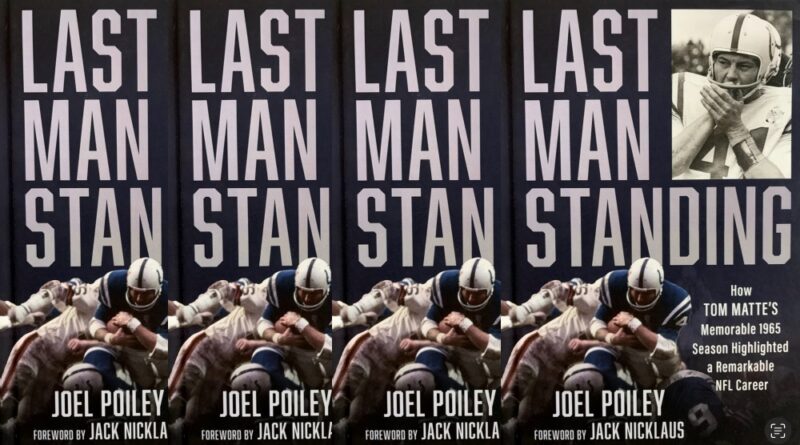
This is an excerpt from “Last Man Standing: How Tom Matte’s Memorable 1965 Season Highlighted a Remarkable NFL Career,” by Joel Poiley. The book can be purchased here.
As Tom Matte and the Baltimore Colts approached Super Bowl III against the New York Jets, Matte was at the top of his game.
He was coming off his finest season as a pro, rushing for 662 yards and nine touchdowns, and catching 25 passes for 275 yards and one score.
Matte continued to shine in the playoffs, rushing for 88 yards and scoring on three short touchdown runs as the Colts walloped Cleveland 34-0 in the National Football League Championship Game. With a glowing 15-1 record (13-1 in the regular season and two playoff victories) the Colts were paced by a dominating defense that allowed only 144 points, which ranked first in the league and tied the 1963 Chicago Bears for all-time stinginess. The opportunistic offense took advantage of short fields created by numerous defensive turnovers to score 402 points, second in the NFL to Dallas.
Small wonder the national media, coaches and league officials were coronating the Colts as one of the best teams of all time. Oddsmakers agreed, installing Baltimore as prohibitive 17.5-point favorites over the Jets.
With all the hype about the Colts, it’s as though the Super Bowl became an afterthought, a foregone conclusion. That is to everyone but Joe Namath and the Jets, who entered winners of nine of their last 10 games.
Upton Bell was the Colts personnel director at that time. He scouted Namath in college at Alabama and knew how dangerous he could be despite his penchant for throwing interceptions,
“When [Jets owner] Sonny Werblin signed him, I said, if healthy, they got one of the best quarterbacks I’ve ever seen,” Bell said. “You can talk about all those interceptions. But I warned [Colts head coach Don] Shula and other people that this is a very good football team we are playing. You would say they aren’t big but boy they’re quick.”
In addition to entering the Super Bowl playing well and with supreme confidence, the Jets also had Weeb Ewbank, who still knew many of the Colts players he coached in Baltimore from 1954-1962 before being replaced by Shula in 1963.
“Weeb knew our weaknesses,” Bell said.
Namath had been playing head games with the Colts all week leading up to the game. A straight shooter and never shy with his opinions, Namath’s famous guarantee that the Jets would win came when he accepted an award as the AFL’s Most Valuable Player at the Miami Touchdown Club.
“So there I am accepting my trophy when some jerk in the back of the room yells out, ‘Hey Namath, we’re going to kick your ass!'” Namath said in his book, All the Way: My Life in Four Quarters.
“I cut him off. ‘Whoa, whoa! Wait a minute buddy. I’ve got news for you. We’re gonna win the game. I guarantee it.’ I was pissed. The guy had interrupted me as I was accepting my award. I just said what I hoped our entire Jets team thought, except I framed it as a guarantee.”
The cocky boast made headlines the next day in the “Miami Herald.” The media used it to hype the game, which Namath, ever the showman, was only too happy to oblige when queried.
And with the Colts beginning to believe their own press clippings, Bell, and Matte, said the mounting pressure to not only win the game for the NFL, but beat the Jets decisively as the media predicted, was also a factor in the shocking outcome.
“He had nothing to lose when he shot his mouth off and said, ‘Hey, we’re number one, we’re going to beat them. I predict we’re going to win,”’ Matte said. “That irked all of us a little bit because he had a pretty cocky attitude, and we were a veteran ballclub at that time and there was a real intensity there. We wanted to stick it in his ear, but he came out there and played one hell of a game.”
Crazy bounces and bad breaks
With 18 seconds left in a scoreless first quarter, Colts cornerback Lenny Lyles jarred the ball loose from George Sauer after a completed pass and Ron Porter recovered at the Jets’ 14 for the first break of the game.
On the first play of the second quarter Matte took a pitch to the left and showed his excellent vision, slicing for 7 yards to the 6. On third-and-3, the Colts brought in Tom Mitchell and lined him up in a slot position to the left with John Mackey running a route from the traditional tight end position on the right side. This formation produced five touchdowns to Mitchell during the regular season.
It appeared a well-conceived play when Mitchell broke free and was uncovered several yards in the end zone. With excellent protection, Earl Morrall fired a pass toward Mitchell. But Atkinson got a hand on the ball and it changed direction just enough that it bounced off Mitchell’s right shoulder pad and was alertly intercepted by Randy Beverly saving a touchdown.
Capitalizing on the momentum shift, Namath engineered a sharp 12-play, 80-yard touchdown drive, with Matt Snell finishing the drive from the 4-yard-line for the game’s first score with 9:03 left in the half.
The Colts later took possession on their own 20 with 4:13 left in the half. On second-and-4, Matte ran a sweep to the right and quickly cut up inside through a gaping hole created by guard Glenn Ressler. Jerry Hill sealed off the outside with an excellent block on the linebacker and Matte ran through an arm tackle by Jim Hudson at the 30. Displaying excellent balance, he kept his feet and hit full stride down the right sideline for 58 yards to the Jets 16. That run is tied for the third longest in Super Bowl history.
“I was sitting with the coaches up in the [press] box and said, ‘Nobody’s touched Matte yet,'” Bell said. “The offensive line was opening huge holes and he was ripping them apart.”
The Colts wasted Matte’s run when Morrall telegraphed a pass over the middle and Sample cut in front of flanker Willie Richardson to intercept at the Jets’ 2-yard line.
The Colts’ defense held, forcing Curley Johnson to punt and they took over with excellent field position at the Jets’ 42 with 43 seconds remaining in the half. What ensued was the most controversial play of the game that potentially could have swayed the outcome.
Trying to get on the scoreboard before halftime, on second-and-9 Shula called for a flea flicker, a trick play which had been successful for the Colts during the season.
On the play, Morrall handed off to Matte, who sprinted laterally to his right drawing the Jets defense with him thinking it was a running play. Using his passing skills, Matte quickly pivoted and threw back across the field to Morrall. By that time Jimmy Orr, the intended receiver, was all alone on the left side of the field 20 yards behind the Jets’ defense waving his arms frantically at the Jets’ 10 to get Morrall’s attention.
The execution to that point was perfect, with the Jets’ defense completely out of position. However, Morrall never saw Orr. Instead, he threw a wobbly short pass to Hill in the middle of the field at New York’s 15 and Hudson intercepted. That was Morrall’s third interception of the half in 15 attempts.
Matte said Morrall didn’t see Orr because the Colt band’s outfits were similar to the blue and white uniforms the Colts were wearing. However, according to John Ziemann, the Colts and now Baltimore Ravens band president, the Colts band wasn’t at the game.
“That was another band wearing blue and white, but it wasn’t us,” Ziemann said with a chuckle. “Even Tom got that wrong. Times were different then. The league didn’t allow us to come to the game. We weren’t there.”
The botched play ended a stunning half of miscues by the normally precision-like Colt offense. They had driven deep inside Jets territory five times in the half with nothing to show for it. Between Morrall’s three interceptions and Lou Michaels’ two missed field goals from close range they potentially left 27 points off the scoreboard.
It was the first time all season the Colts had been held scoreless at the half.
Seeking a spark, Shula told John Unitas to prepare for possibly relieving Morrall in the second half. But the Colts miscues continued when Matte made a rare mistake, fumbling after an 8-yard gain on the first play from scrimmage in the third quarter giving the Jets the ball at the Colts 33.
The Jets took advantage when Jim Turner eventually kicked a 32-yard field goal for a 10-0 New York lead.
With Morrall still at quarterback, the Colts went nowhere on three plays and punted the ball back to the Jets at their 32 with eight minutes left in the quarter. Namath led a sustained 10-play drive that consumed almost four minutes, ending with Turner’s 30-yard field goal and a 13-0 lead.
Unitas finally entered the game, but with only 3:58 left in the quarter. Despite the Colts two-touchdown deficit, and Unitas not at full strength from his elbow injury in preseason, the mood on both sidelines suddenly changed when the legend known as the Golden Arm entered the game.
“Namath is a good friend of mine, and he said when he saw Unitas run on the field he was thinking, ‘God almighty, we don’t have enough points. He’s going to get us,'” Bill Curry said.
The crowd rose to their feet as Unitas trotted on the field in his familiar black high tops. But it was apparent his arm was weak, as a third down pass to an open Orr fluttered off target forcing the Colts to punt.
After a first down advanced the ball to the Colt 49, Namath went for the jugular, hitting Sauer behind Lyles with a perfect lead pass for 39 yards to the Colts 10 with one minute left in the third quarter. Surprisingly, it would be the last pass Namath would throw in the game, making him the only quarterback in Super Bowl history to not attempt a pass in the fourth quarter.
He didn’t have to, as Snell and Bill Mathis advanced the ball on the ground before the drive stalled at the Colt 2 and Turner booted a 9-yard field goal for a 16-0 New York lead with 13:58 left in the game.
With Matte carrying twice for 26 yards and Hill moving ahead for 12, and two short Unitas passes to Mackey and Richardson, the Colts advanced to New York’s 25 in six plays.
When Unitas tried to throw down the middle and go for the touchdown, Beverly cut in front of Orr at the goal line for the Jets fourth interception to again deny the Colts.
The Jets milked the clock on the ground, and when Turner pushed a 42-yard field goal attempt just left Unitas and the Colts took over at their own 20 with only 6:34 to play. They would need three scores to win since the two-point conversion after a touchdown wasn’t instituted until 1994.
Unitas misfired on three passes before keeping the drive alive with a 17-yard completion to Orr on fourth down. Slowly beginning to find a rhythm, Unitas hit Mackey for 11 yards, Richardson for 21 and Orr for 11 moving the ball to the Jets 2-yard line with 4:24 to play.
However, three plays netted only 1 yard, wasting valuable time. Hill finally knifed in for the score off left tackle, concluding an impressive 15-play, 80-yard drive. But the clock was down to 3:32 after Michaels’ extra point made the score 16-7.
With an obvious onside kick coming from Michaels, the Colts’ Tom Mitchell recovered at the Jets 44 after a mad scramble.
Unitas, the creator of the two-minute drill, was in his element, calling two plays in the huddle. He quickly hit Richardson for 6 yards along the sideline so he could get out of bounds and stop the clock. Unitas then hit Orr on a curl route across the middle for 14 yards. He then came back to Richardson on a sideline route for 5 more yards to the Jets’ 19 with 2:54 to play.
The crowd was on its feet, straining to see if Unitas, who barely played all season, could again work his magic and save the Colts from one of the biggest upsets in sports history.
The Jets’ defenders, though weary from having been on the field for two consecutive long Colt drives, dug in. On fourth down with 2:26 to play, Unitas attempted to hit Orr near the 4-yard line. But Jets linebacker Larry Grantham tipped the pass and it fell harmlessly incomplete near the goal line.
Many of the Colts and team personnel believed if Unitas had started the second half and had more time to dissect the Jets’ defense the outcome would have been different, despite his rustiness.
“I loved Don, but he made a mistake,” Matte said. “Earl was jumpy and nervous the whole damn game. He wasn’t himself.”
Namath, who completed 17 of 28 passes for 206 yards, earned Most Valuable Player honors, as much for his adroit play-calling in beating the Colts’ vaunted blitz as his passing numbers. Mixing the run with his accurate passes, Namath helped the Jets win the time of possession battle, 36:10 to 23:50.
Matte finished the game with 116 yards on 11 carries, with his 10.6 per rush average still the highest in Super Bowl history. He also caught two passes for 30 yards.
“Tom would have easily been the MVP if we won,” Bell said. “He was having his greatest day. That’s the thing about Matte, very rarely did he not deliver.”
The what-ifs didn’t matter, however, as Matte discovered the following week.
“It was embarrassing for me to go out to the Pro Bowl after that,” Matte said. “And man, did I get the strawberries. Man, I’m telling ya. ‘Matte, you let the league down, you did this, you did that.’ We were the first team to lose to the AFL.
“I did have a good game, but you don’t think of it that way. When it comes down to it, it’s a team game. It was a team failure as far as I’m concerned. We came up on the short end of the stick and those guys came out smelling like roses. But it was bittersweet, let me tell you. People still come up to me and say, ‘If you’d won that game you’d probably been MVP,’ and I say that doesn’t mean shit.
“Joe shot his mouth off a lot, but the thing was, he backed it up. They won the game, so you have to have a lot of respect for him.”
The ignominy of the loss would hang like a dark cloud over Matte and his beloved teammates the rest of their lives.
“All those guys took that game to their graves, and they’re all still haunted by it, nobody more than Matte,” then Colts public relations director and later general manager Ernie Accorsi said. “If you brought that game up, he talked about it like it was yesterday. He never got over it.”
Photo courtesy of Rowman & Littlefield