
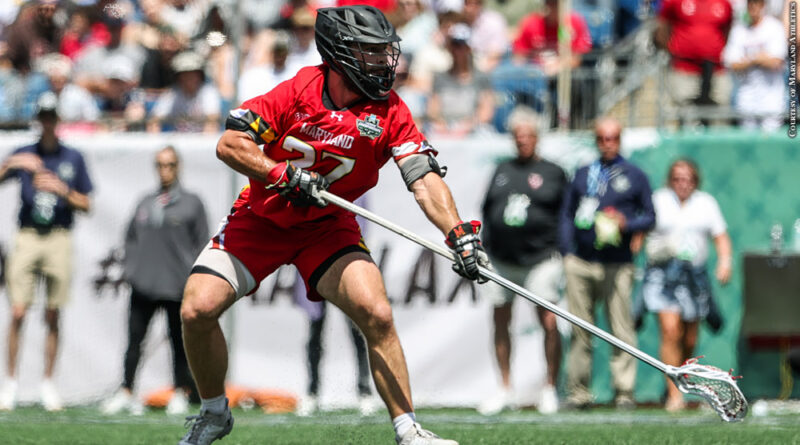
Maryland men’s lacrosse’s Will Schaller recently chatted with PressBox about making back-to-back championship games, taking on a bigger role in 2025, what he’ll work on this offseason and more. The 6-foot, 210-pound defenseman started all 18 games this past season, picking up 31 ground balls and causing 23 turnovers. A native of Bel Air and graduate of The Hill School (Pa.), Schaller has one year of eligibility remaining.
This has been edited for content and clarity.
PressBox: What was it like to experience another run to the championship game?
Will Schaller: It was an unforgettable experience. It’s great getting back two years in a row. It is. Obviously, falling a little short is tough. It’s tough on the guys, the fans, our families because so much goes into it and you want nothing more than the ball to roll your way when the final buzzer sounds. I think the important part of that run is just the relationships and the connection and the unity and the bond that we created over the 10 months. It starts in August. [Head coach John Tillman] has us come in and sit down and we talk about what we want to achieve and where we want to be at the end of the year.
Obviously, when you’re at a place like Maryland, the standard is the standard. It’s kind of been set for us, and it’s to get to Memorial Day. I’ve said this before, but I’ll hammer it home until I’m blue in the face: You’re signing up to do what it takes to get there. You’re not signing up just to go. Anyone can say they want to play in the Final Four and on Memorial Day, but understanding what it takes to get there is something I think this team really had and demonstrated this year.
PB: You started 18 games in 2025 after totaling eight starts your first two years. What allowed you to make that leap?
WS: I think it’s really twofold. One, the guys around me are fantastic. We operate as a group. [Defensive coordinator Jesse Bernhardt] is all about the team, all about that accountability aspect. You talk to him and any of us, that’s the secret sauce — just being accountable, looking in the mirror before you look outward. Having the confidence and the comfort and the connection with the group that we had this year I think allowed me to play at my best and enjoy playing with those guys.
You spend so much time together and you go through so much. [My] freshman year, [we] lose in the first round to Army, last year losing in the final game to Notre Dame — getting our asses kicked, frankly. That lights a fire under you. When you have those common goals and those common experiences with such a large group of guys that we had back this year, that just serves as a catalyst and lights a fire under your ass moving into the next year.
I’m the last person to ever make it solely about myself because it really isn’t, but I just think listening and trying to get as much knowledge and wisdom and technical items and skills and overarching themes and mentalities out of the older guys that have come before me to the best of my ability. It’s definitely a combination of those two things, but it’s been a work in progress.
PB: What can you and your teammates do this offseason to help get the team over the hump?
WS: In ‘24, we kind of had a spectacular playoff run and a lot of people did not think we were going to be there. This year was a little bit different. We weren’t all the way there. Cornell was the favorite in the final game, but we felt that much closer. And when you’re that much closer and you’re not successful, it leaves you that much more motivated and that much hungrier. I don’t think anything is going to change in terms of how we get ready for next year. We’re going to be back. I know everyone’s going to work their ass off this summer and be back in the fall because the goal doesn’t change. The standard doesn’t change for where we want to be.
PB: What do you want to work on individually this offseason?
WS: Due to process of elimination, I’ll probably be the most senior guy out there on the field with the most experience. That comes along with a responsibility of serving as that quarterback to make sure everyone understands going into the week and each day what their roles are and then come game day, orchestrating the defense. I hate to use that individualized term because it’s not just me out there. That’s why I mentioned making sure everyone’s prepared because the day of the game, if one guy tries to do too much, things start to fall apart.
If those roles are laid out prior and they’re worked on throughout the week, we’re going to be in good shape. I want to be a better leader. I know I can be better for those guys. There are always things to work on — stronger, faster, all that stuff. Just kind of serve as that backbone as best I can and show them through example what it takes to get back [to the championship game]. I know everyone on the team wants to be back there and we want to get it done.
PB: What fundamentals are non-negotiable in playing defense for John Tillman?
WS: A big phrase that gets thrown around our “D” room is, “Smart wins more than dumb loses.” That ties in nicely to that discipline aspect of playing your percentages, hedging your bets on what the right play is, making certain guys shoot shots with their right hand as opposed to taking a step down with their strong left hand, things like that. That’s knowing the game plan, knowing the scout, knowing who you’re going against and knowing yourself, kind of all wrapped into one.
… The hustle plays are huge, but if you’re just running around like a chicken with your head cut off, that’s not always a recipe for success. Everyone comes into Maryland as a big fish in a small pond. When you get here, things change a little bit and you have to understand that there’s a certain style of play that works and that’s suited for our schemes, our concepts. I think that general idea has shaped some of the best defensemen that come out of this place like [Matt Dunn, Michael Ehrhardt, Ajax Zappitello and Brett Makar].
PB: What defensemen did you model yourself after as a young player at Maryland?
WS: Guys like Brett Makar, Ajax Zappitello, Jack McDonald [and Colin Burlace]. I’ve learned a lot from Logan McNaney and how he operates and how much knowledge of the game he has. The list goes on. This is such a cool place because those older guys understand that role they take on. Understanding the impact you have on younger players is huge. Not that it’s all about the older guys showing them the way, kind of the old-school adage, but just leading by example. They really did that for me. It’s a two-way street. All that being said, you’ve got to look at those guys and see that what they have done has worked and you can choose to subscribe to that or not. For the guys that did, it usually pans out to be more successful than the other way around.
Photo Credit: Courtesy of Maryland Athletics
Originally published June 18, 2025