

Derrick Henry took the handoff from Lamar Jackson at the Ravens’ 9-yard line and blasted through a hole on the right side of the line. He got to the second level before Buffalo Bills linebackers knew what had hit them, and by the time Henry reached the 40-yard line, he had left the Bills’ secondary in the dust as well.
Henry raced down the sideline with three Bills defensive backs in futile pursuit. They never caught him, and Henry’s 87-yard touchdown run became the longest in Ravens history.
It isn’t supposed to work this way; 30-year-old running backs aren’t supposed to be as productive as they’ve ever been, and 250-pound, 30-year-old running backs definitely aren’t supposed to leave a trio of smaller, younger defensive backs in the dust.
But Henry, now 31, is like few who have ever come before him, a dazzling combination of size and speed with, as his high school coach, Bobby Ramsay, put it, “a DNA-touched-by-God element to him.”
“He’s an alien,” NFL Network analyst Brian Baldinger said. “He’s been doing this his whole life. He was always the biggest, fastest kid on the field, and at 30-plus, whatever he is, he’s still the biggest, fastest guy on the field.”
Henry also has relied on a ferocious commitment to his training to retain peak physical performance after turning 30, long perceived as a fault line for NFL running backs.
In his first season in Baltimore, Henry and Jackson in the backfield together became must-see TV for fans — and a maddening combination for opposing defensive coordinators.
Now fresh off a contract extension that has him linked with the Ravens through 2027, Henry is focused on the one thing that thus far has eluded both him and Jackson: the Super Bowl.
“You’re Not A Running Back”
Henry and Jackson have something else in common: Both appear to have been highly motivated by others telling them what they couldn’t be. Throughout the draft process, Jackson had famously heard that his NFL future would be at a position other than quarterback. Jackson scoffed at that idea, and his two MVP awards show the folly of that evaluation.
Henry, meanwhile, had heard during his college recruiting process that at his size, his future would be at a position other than running back.
It didn’t matter that Henry’s statistics at Yulee High School in North Florida were the stuff of video games: 510 yards against Jacksonville’s Jackson High — currently coached by Ramsay — and 482 yards and six touchdowns in a playoff game. In that game, he broke the all-time high school rushing record and finished his career with 12,124 yards. Eight times in 13 games as a senior, Henry ran for more than 300 yards.
Still, ESPN did not include him in its running back rankings for the 2013 recruiting class. He was labeled the No. 1-ranked “athlete.” The top-ranked running back, incidentally, was Kelvin Taylor, the son of NFL back Fred Taylor. Kelvin Taylor went to Florida and bounced around a handful of NFL teams but never played a down in an NFL game.
“One thing I’ve learned, and I learned it a lot through him, is that in the evaluation of players, there’s a lot of groupthink, a lot of stereotyping, a lot of lazy evaluations,” Ramsay said. “You sort of look at a kid and go, ‘OK, he’s this height, he’s this weight, the analytics say he’s this position.’”

“I would always get a chuckle when people would say he was too big,” Ramsey continued. “We’re not talking about economy class seats on an airplane. What do you mean he’s too big? I always use the Magic Johnson analogy. Was he too big to be a point guard?”
Ramsay recalled Henry listening to coaches who would tell him that he projected to some other position at the college level.
“He was always respectful,” Ramsay recalled. “’Yes sir, thank you for your time.’ Then that coach would leave, and Derrick would say, ‘Well, cross that school off the list.’”
“If it seems like he has a chip on his shoulder, I think it really goes back to that,” Ramsay said. “As he’s racking up these yards and putting out all this film, more and more people are saying, ‘You’re not a running back.’ And after a while, he really started to take it personally.”
Henry remembers being steadfast about being a running back.
“I was stuck on playing running back,” he said. “That’s what I was focused on. I know the norm wasn’t my size of running backs … but I was determined.”
Nick Saban and Alabama recruited Henry as a running back, and Henry knew that Mark Ingram had won the Heisman Trophy as an Alabama running back (in 2009). Henry ultimately committed to Alabama over Georgia and Tennessee.
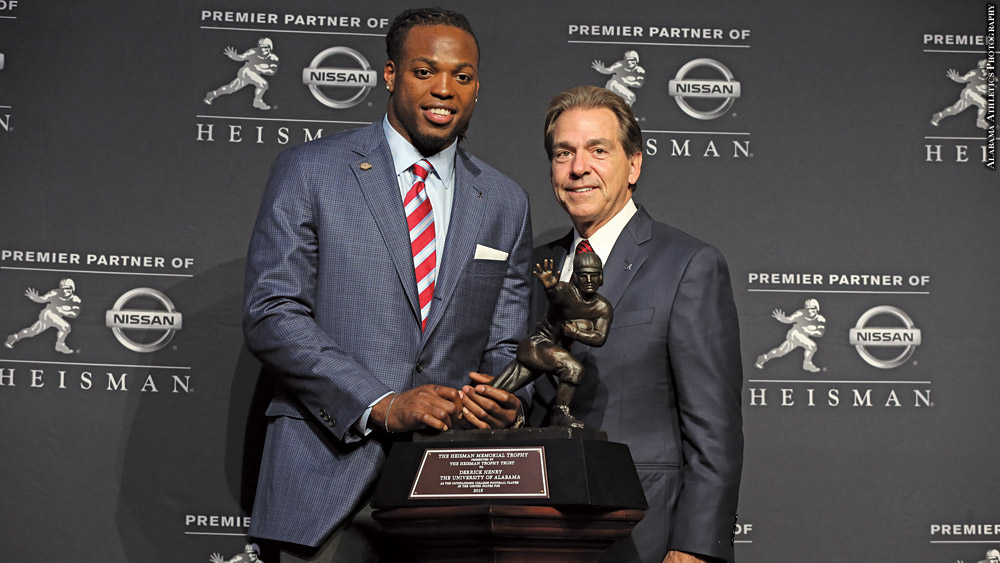
As a freshman, Henry backed up T.J. Yeldon, and it was a major adjustment getting just 3.5 carries per game. By 2015, though, Henry was rampaging over college defenses much as he had at Yulee. Henry ran 395 times for 2,219 yards and 28 touchdowns — all totals that led the nation — and beat out Stanford running back Christian McCaffrey and Clemson quarterback Deshaun Watson for the Heisman Trophy.
Henry and Ingram, in fact, are the only running backs to win the Heisman since 2006.
Longtime Ravens Target
Former Ravens general manager Ozzie Newsome has an affinity for Crimson Tide players, and current general manager Eric DeCosta has long coveted Henry. Yet the Ravens had a chance to draft Henry in 2016 — several of them, in fact — and opted against it.
With their first pick in that draft, the Ravens selected tackle Ronnie Stanley at No. 6 overall. They also had the No. 36 pick, and with Henry on the board, the Ravens traded back to No. 38. Henry was still on the board when they traded back again, to No. 42, stockpiling an additional pick. With Henry still on the board at No. 42, the Ravens drafted Boise State linebacker Kamalei Correa. Henry went to the Tennessee Titans three picks later.
Then the Ravens watched from afar as Henry ran through and past defenses — including their own. Henry led the NFL in yards, carries and rushing touchdowns in both 2019 and 2020. In 2020, Henry ran for a career-high 2,027 yards, the fifth-highest total in NFL history.
DeCosta tried and failed to swing a deal for Henry before the trade deadline in 2023. When Henry became a free agent in 2024, the Ravens pounced, signing him to a two-year, $16 million deal. At the time, Henry called it a “no-brainer” to join an offense led by Jackson and an organization positioned for a Super Bowl run.
Henry was coming off a season in which he averaged 4.17 yards a carry, the lowest of his career. He turned 30 at the end of that season, and questions about wear, tear and age predictably surfaced.
Asked at his introductory Ravens news conference what he would say to people who questioned his future production at his age, Henry said, “Tell them to keep watching.”
Instead of slowing down, Henry appeared rejuvenated last year.

With defenses also focused on the singular threat of Jackson, Henry piled up 1,921 rushing yards, the second-highest total of his career and the most in a season by a back age 30 or older. (Only one other 30-year-old back, Tiki Barber in 2005, has ever rushed for 1,700 yards in a season.) Henry also ran for 16 touchdowns, a Ravens single-season record, and averaged 5.9 yards per carry, easily the highest of his career.
Henry was rewarded with a two-year, $30 million extension, the largest deal ever for a running back over the age of 30.
No Days Off
Fresh off his extension, Henry attacked his offseason workouts with his usual ferocity.
“No days off” is a slogan coaches like to put on a T-shirt or bulletin board, but Henry lives it. He is in the gym every day, twice a day. Videos of his grueling workouts in Dallas, lifting weights or running hills with a chain dragging behind him, light up the internet each summer.
Henry’s workouts have been legendary for a long time. Ramsay recalled challenging his Yulee players to push a pickup truck on the concrete track near the field. Most pushed it 50 yards or so. Henry pushed it an entire lap.
It’s estimated that Henry spends nearly $250,000 a year on his body, a regimen that includes a personal trainer, a massage therapist and a personal chef who oversees a strict, regimented diet — no fried food, no artificial sweeteners, no gluten, and during the season, no meals before 4 or 5 in the afternoon.
In a league full of off-the-chart physical specimens, “King Henry” still stands out.
“For you to be great, you’ve got to focus on being consistent,” he said. “You’ve got to outwork everybody, and that’s the approach I try to take every single day I wake up. Even the days you don’t want to, you’ve got to find a way.”
Asked if his training habits have changed over time, he said, “If it ain’t broke, don’t fix it. So I keep doing my same thing.”

Teammates and coaches say what stands out most about Henry is that ferocious work ethic.
“My dad talks about ‘attacking the day with an enthusiasm unknown to mankind,’ and I see that in [Henry] every day,” head coach John Harbaugh said. “It’s what he does and the way he works at it and how hard he works to get better, how intentional he is about being the best player he can be.”
Hungry And Motivated
Every carry involves the possibility of punishment inflicted on the body, but Henry doesn’t get hit when he outruns everyone, and he can give as good as he gets when he squares his shoulders and plows upfield. His physicality also includes one of the angriest stiff-arms in the game.
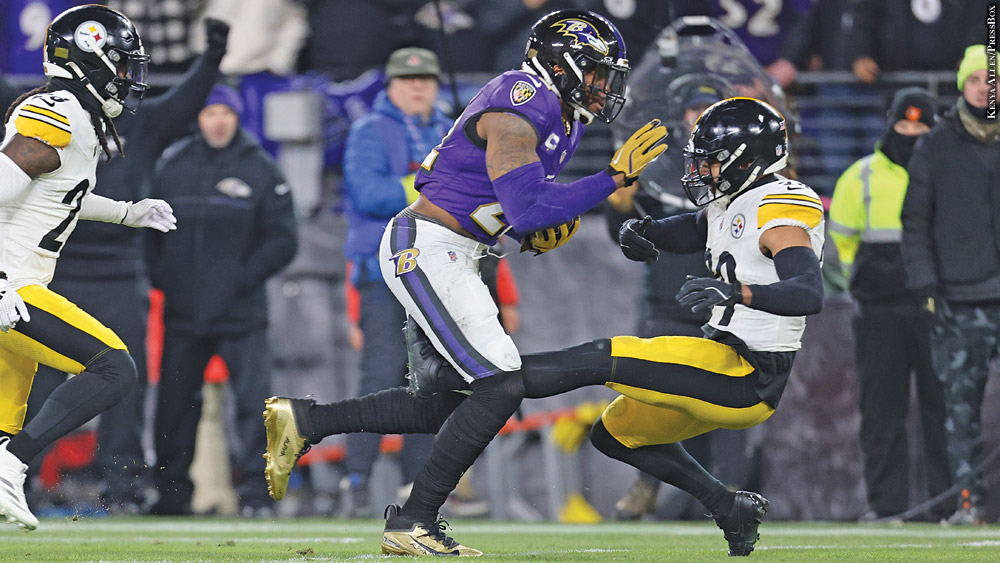
Ravens fans watched with glee as Henry stiff-armed Pittsburgh Steelers safety Minkah Fitzpatrick to the ground last year, but the Ravens have been on the receiving end as well: Henry twice shoved safety Earl Thomas aside like an inconvenience on a long run during the 2019 playoffs.
(Kenya Allen/PressBox)
“He obviously has tremendous upper-body strength and long arms,” Ramsay said, “and he realized pretty quickly, ‘Hey, this is something I can use and be pretty effective.’”
But hits are hits, and they pile up for a player who has been a workhorse since high school.
Back then, Ramsay was publicly ripped for overworking Henry, who averaged 35 carries a game as a senior and topped 40 carries in six games that season. That included a whopping 57 carries for 485 yards and six touchdowns in a playoff win.
Ramsay dismisses the criticism and says whenever Henry was on the field, he wanted the ball.
“He never got a carry that he didn’t want,” Ramsay said.
Henry’s workload eased his first two years at Alabama, but he led the country with 395 carries in 2015. Did all those miles on the tires give the Ravens and other teams pause? Is that why this surefire Hall of Famer dropped to the 45th pick in the draft?
In the NFL, he led the league in carries four times in a span of five years with Tennessee — he missed half the season the other year. Last season, Henry carried 325 times, the second-highest total in the league and the second-highest total in Ravens history. (Jamal Lewis holds the record with 387 in 2003.)
Henry begins this season ranked 32nd in career carries with 2,355. Emmitt Smith holds the record with 4,409, including 1,166 after age 30.
Will all that wear and tear finally take a toll? Will this be the year Henry reaches the so-called age-30 cliff?
“Well, I’m 31 now, so the ‘age 30’ thing should be gone now,” Henry said. “I don’t worry about it too much.”
Frank Gore is the standard-bearer for older backs. He tallied 6,033 yards after age 30, including a 1,000-yard season with Indianapolis at age 33. Gore didn’t miss a game between ages 30 and 34 and played until he was 37.
| Most Yards By A Running Back Over Age 30 | |||||
| Name | G | Att. | Yds. | Avg. | TD |
| Frank Gore | 109 | 1,548 | 6,033 | 3.9 | 21 |
| John Riggins | 66 | 1,250 | 4,530 | 3.62 | 62 |
| Emmitt Smith | 71 | 1,166 | 4,392 | 3.77 | 26 |
| Marcus Allen | 101 | 1,062 | 4,286 | 4.04 | 46 |
| John Henry Johnson | 81 | 1,076 | 3,986 | 3.7 | 28 |
John Riggins had 1,000-yard seasons at age 34 and age 35, but he sat out his age 31-season in a contract dispute, and by age 33 he had 2,038 career carries — 317 fewer than Henry has entering this season.
Curtis Martin led the league in rushing at age 31 with 1,697 yards, but he played just one more season, when his yardage dropped by more than half, to 735.
Henry doesn’t seem particularly concerned with the long view, or what his career might look like at 34 or 35. He knows how last season ended, with a divisional round loss at Buffalo, and he seems determined to change that.
“Last year, it was a lot of fun,” Henry said. “We accomplished winning the division, got into the playoffs, but ultimately, we came up short. So it’s a lot of fuel that should go into this season. Guys should be motivated, they are motivated, and hungry to get ready for the next one.”
Photo Credits: Kenya Allen/PressBox, Courtesy of Bobby Ramsay and Alabama Athletics Photography