
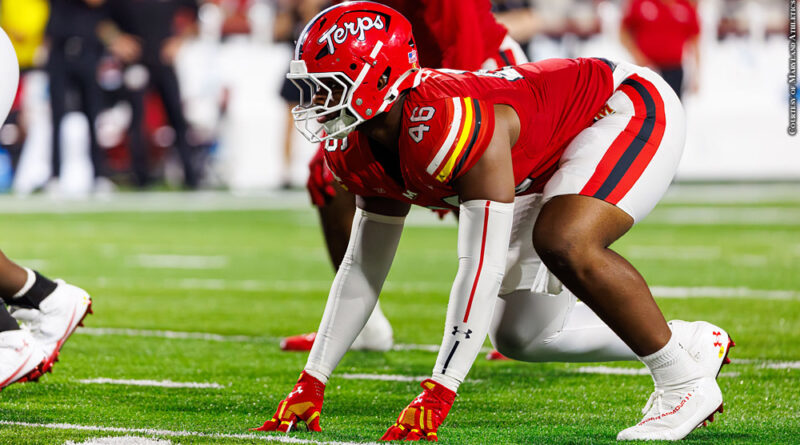
Maryland junior defensive lineman Dillan Fontus is in the midst of the best season of his college career, but he has always made an impact off the field.
Fontus has always enjoyed giving back. He credits his upbringing for inspiring that passion.
“I got into it when I was young,” said Fontus, who turns 20 at the end of October. “I’ve been part of a church since I was little, and we used to go out into the streets and hold services outside. We’d bring all types of food and beverages because we wanted people to join. I saw how it helped so many people get closer to their faith and overcome some of the problems they were facing.”
These days, Fontus packs lunches for elementary school students and their families with Brighter Bites. He reads to kindergarten, first grade and second grade classes during Big Ten Reading Week. He creates motivational videos for young athletes with Twin Bridge Sports. He also participates in charity walks and weightlifting challenges.
Several teammates have attended Fontus’ events. The defensive lineman recalled an Easter event at Zion Church in Greenbelt, Md., where they helped manage parking, passed out flyers, greeted churchgoers and attended the service.
Maryland head coach Michael Locksley is also a strong advocate for giving back to the community. College athletes’ NIL opportunities often require community service involvement, but Fontus goes above and beyond that.
“He understands giving back and helping others. He’s modeled that for our team,” Locksley said. “… There’s no doubt that for Dillan, even before [NIL and revenue share], this was something big. And it’s always been important to me that players understand we give back to the community because this community affords us the opportunity to do what we do.”
Fontus earned the Big Ten Jackie Robinson Community & Impact Award in April. The award recognizes student-athletes whose significant community service contributions align with Robinson’s legacy.
“It means so much to me to even have my name next to somebody like Jackie Robinson,” Fontus said. “He was a household name, a renowned athlete. Having my name mentioned in the same conversation or being seen as someone who did something great like him is amazing to me. On top of that, it’s a great honor. I feel like it pushed me to start doing even more.”
Fontus’ mission to give back was fueled in part by the time he spent with his mentor, Rashad Emmons. A native of Averne, N.Y., Fontus didn’t have many extracurricular activities available to him until he met Emmons in his early teens through a mutual friend.
Emmons took Fontus under his wing, introducing him to STEM programming and working out with him. Emmons didn’t help young kids for money. He simply wanted to support them and keep them out of trouble.
“We had the after-school program. I was with them every day. It was just tutoring and working out,” Emmons said. “I kept a motto with them: ‘Barbells and Books.’ I tried to build them up strong mentally and physically so they could have confidence in life and pursue anything they wanted.”
Ultimately, Fontus said Emmons showed him “what helping somebody else could do, especially if they don’t have the resources to go out and do other things,” inspiring him to do the same for others.
While giving back has always been something Fontus has enjoyed, football wasn’t. Now 6-foot-6 and 292 pounds, he didn’t start playing sports until he was 14 or 15 years old. His neighbors, who ran the Brooklyn-based football team Mo Better, saw his size and invited him to play. But he didn’t fall in love with the sport right away.
“I tried it for one day, but I didn’t like all that running, so I left it alone,” Fontus said. “I grew up out of shape. I wanted to lose some weight and start exercising, so that’s what I did and then I started to enjoy it.”
Fontus credits trips to the YMCA for putting him on a path toward physical fitness. He used to go when it was free every Tuesday, known as “Teen Tuesday,” until Emmons purchased a family membership pass so those he was helping could attend every day.
“That’s where I started working out and taking my body seriously and all types of athletics seriously because it was a free program,” Fontus said. “They had a free program on Tuesday nights where we could come and play indoor basketball. They held tournaments. Everybody got to show off their game and just be around each other in a controlled environment.”
Emmons even created makeshift weights to keep his pupils active.
“We made workout equipment,” Emmons said. “I got 2x4s, sandbags from Home Depot, and they were there with me. We were strapping it together, duct-taping everything, putting screws in it and then we made a workout bench. We went to a mechanic shop and got a dumpster tire, and we would do flips with the tire. That’s how we got all our equipment. We just built it.”
Now years removed from his health journey, Fontus has already recorded career-high totals in tackles (11) and tackles for loss (3.5) entering the Terps’ game at UCLA on Oct. 18.
“I’m not surprised where he’s at right now,” Emmons said. “The one thing I’ll tell you about him is that he had heart. If I came in for the day and had the work ready — either I’d write it on a piece of paper, the board or have it on my phone and send it to them saying, ‘This is what we’re going to do’ — he would be the last person to finish, but the one thing about him is that he never quit. He wasn’t the strongest, wasn’t the fastest, but he gave more effort than everybody.”
With one year of eligibility remaining, Fontus plans to host a youth football camp when the time is right. He believes “football builds the closest bond of any sport because it’s played with a lot of people,” and “every single person counts and matters toward the goal.”
“That’s something I fully intend to do, especially in the summertime when school’s out,” Fontus said of hosting a youth football camp. “I just want to give kids something to do outside. That used to be the most fun thing for me — just going outside and doing something, whether it was playing football for a day or being around people I’d never met before, like new kids on the block. I want to give kids the opportunity to do that — especially being coached by people they aspire to be one day. If they want to play football or any sport, they can get coached by Division I athletes.”
Photo Credit: Courtesy of Maryland Athletics
Issue 295: October / November 2025
Originally published Oct. 15, 2025