

Ever since joining the Big Ten in 2014, the University of Maryland has been viewed as an outsider geographically and, at least by some of its most diehard supporters, a sleeping giant athletically. With the recent infusion of $20.5 million resulting from the NCAA’s new revenue-sharing platform, the Terps could be better equipped to succeed than ever before.
Yet here’s a sobering thought: Is it now or never?
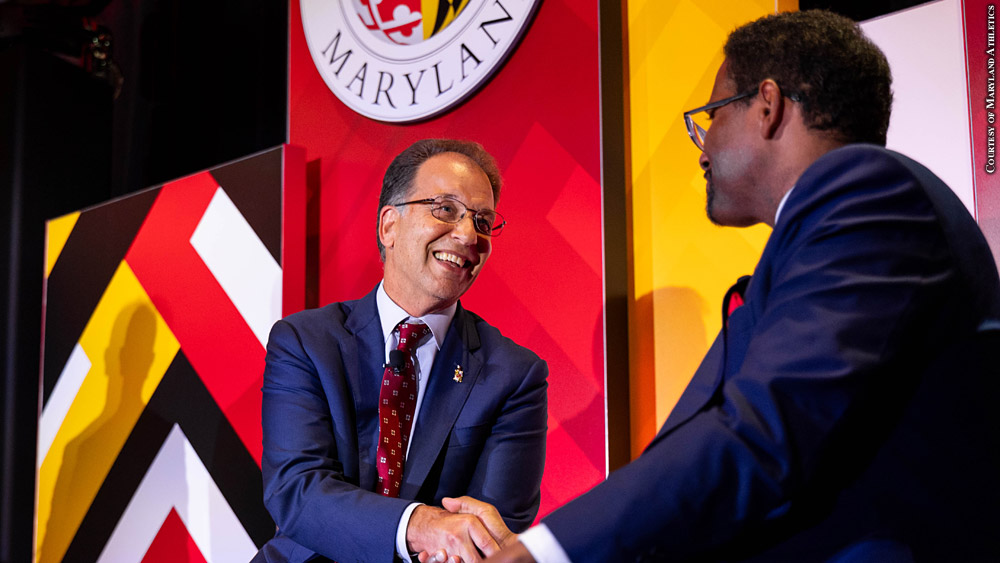
Enter Jim Smith, an eternal optimist and one of tens of thousands with the nation’s most common name, yet with a vision few outside Xfinity Center and the Jones-Hill House seem to hold for the athletic department in College Park. Having arrived in the summer, the 59-year-old Smith is trying to do something that no Maryland athletic director has been able to consistently achieve in decades.
Smith is attempting to raise the level of his department’s performance, on and off the field, while erasing the negativity that has often permeated the program and stymied any significant progress from being made. Among the biggest complaints by those who have worked at Maryland throughout the years is that new ideas were often shot down quickly, and old ones were recycled with little success.
As a result, the department’s overall morale plummeted, which wasn’t difficult for Smith to sense shortly after his arrival in July.
“I didn’t realize when I came that this is as much about change management as it was about revenue and product,” Smith said in late August, a few days before the football team opened its 2025 season. “It’s changing the mindset of what we can do, and why we belong in the Big Ten and why we should be at the top of the Big Ten. It’s a big market. It’s exciting being in a big market.”
Asked about the day-to-day approach he has brought to those in the athletic department — along with newly hired senior deputy athletic director Diana Sabau and deputy athletic director/chief revenue officer Joe LaBue — Smith said, “There’s a little more energy, but we’ve got a few new people too. So all of us are bringing a new energy, a real excitement to be here. We start with yes. We don’t start saying no.”
BREAKING THE MOLD
Before four former Pac-12 schools, including USC and UCLA, joined the league in 2024, the Terps were the only Big Ten program aside from Northwestern and Rutgers located close to a major metropolis. Though Maryland had won its share of conference and national championships since leaving the ACC, all but one — men’s basketball sharing a regular-season title in 2019-20 — came in non-revenue sports.
(Courtesy of Maryland Athletics)
The two areas where the athletic department has struggled the most are fan support and fundraising. As a result, Maryland fell behind in providing opportunities in Name, Image and Likeness (NIL) revenue for its athletes. That led, at least in part, to the awkwardly abrupt departures last spring of men’s basketball coach Kevin Willard to Villanova and athletic director Damon Evans to SMU.
Willard, who was at Maryland for three seasons, actually announced that Evans was “probably going to SMU” the day before the Terps were to play their first game in the NCAA Tournament. Two days later, Evans was introduced at a news conference in Dallas. Willard also added that Maryland ranked near the bottom of Power Four schools in NIL deals for its athletes, a fact some involved in the process have disputed.
Months later, the turmoil has quieted, replaced by Smith’s positivity. Still, it’s tempered by the seemingly insurmountable task of turning the Terps into a nationally-relevant program once again in men’s basketball and more of an attraction to their own fans in Big Ten football. Smith doesn’t believe that being situated between two NFL cities dilutes the fan base in the fall, yet he understands that the product has to be attractive enough to fill the seats at SECU Stadium.
“We have this giant market and if we can have a good product for fans to come to before and during [the game], we’re on our way,’” Smith said the morning of the opener, walking around Jones-Hill House for the inaugural indoor FanFest. “Time is what we compete with the most, people’s time. In order to compete for people’s time, you have to have a compelling experience throughout.”
Smith witnessed that in Atlanta, where before coming to Maryland he had spent the latter part of his career working for both the Falcons and Braves. Along with increasing ticket sales and corporate sponsorship, Smith also oversaw the building of and bidding for the naming rights to the $1.6 billion Mercedes-Benz Stadium.
“The Falcons sell out, you have Tech and Georgia, we just have Maryland,” Smith said. “We can own Saturday, and the Ravens and Commanders can own Sunday. We can co-exist. We can share fans, as long as we all have a compelling product. It’s a bit of a culture change. … We can become a Saturday destination. To me it’s an opportunity, not a threat.”
Don Rovak, who came to Baltimore in January as the chief revenue officer of the Orioles, watched Smith closely for more than a decade working together in Atlanta. Rovak said the Baltimore-Washington corridor might be a different kind of market, but Smith can use the same skill set that worked during their time in Georgia.
“Jim is someone that understands leadership,” said Rovak, who speaks to Smith several times each week. “He’s not afraid to break the mold and to think outside the box and be as creative as anybody to do whatever that initiative is. Whether it’s landing events or changing culture or servicing fans, he is a true visionary.”
Rovak said that Smith’s upbeat nature — and confidence — is contagious.
“He’s optimistic by nature and won’t get bogged down in the immediate hurdles in front of him,” Rovak said. “That optimism resonates to his staff, to allow people not to think about the things they can’t do but figuring out what they can. When I met him 15 years ago, he instilled in me, ‘Start with yes and if it can’t happen, it can’t happen. But start with the yes, not with the no.’”
Tom McMillen, who went from being a basketball All-American and Rhodes Scholar at Maryland to playing 13 years in the NBA and serving three terms as a U.S. Congressman, believes that Smith is the kind of hire that has long been a rarity among colleges looking for new athletic leadership.
Smith being the only current Big Ten athletic director to come directly from pro sports makes Maryland unique, McMillen said. Citing Robert Frost’s epic poem, “The Road Not Taken,” McMillen praised university president Darryll J. Pines for not making a more traditional hire.
“It’s bold, there’s no question about it,” said McMillen, who stayed in close touch with the changing landscape of college sports before ending his eight-year tenure as president and CEO of LEAD1, an organization that helps support the 136 schools playing BCS football. “If you’re looking at it from afar, it’s really pretty inspirational. To be the first in your conference to do something is pretty amazing.”
Most of Smith’s career was spent working in professional sports, in everything from the NFL, MLB and Major League Soccer in Atlanta to prior stints with the World Wrestling Federation and the Professional Bull Riders. Smith’s decade or so at Ohio State, first as a graduate student and then working in the athletic department, comes in handy now.
“You understand how a university works within a system,” he said. “Plus I’m used to a lot of change and this is a time of enormous change in college athletics. And nothing is static in the pro world. It’s changing every year.”
TALL TASK
If there’s any skepticism about whether Smith can be successful, it comes from long-suffering Maryland football fans who have watched the Terps fail or underachieve in many more seasons than they have prospered. Before a run of three straight winning seasons (2021-2023) that gave some hope of a turnaround under Michael Locksley, Maryland had only five winning seasons in 17 years.
(Courtesy of Maryland Athletics)
Last season’s 4-8 record was not only a disappointment, but part of a trend that stretches back even to Ralph Friedgen’s tenure from 2001-2010. Friedgen’s teams won 31 games his first three years, then went 5-6 each of the next two seasons. The beloved Friedgen, an alum, also had a 2-10 season before going 9-4 and earning ACC Coach of the Year honors in his final year.
“The product itself has never been seen as a true dominant Power Five football program,” said Glen Burnie’s Brian Flam, who attended Maryland for three years in the early 1990s. “They’re not going to be like Miami, where you have people lining up to throw money even when they’re bad. You don’t have that history here. … Here it’s not a religion.”
Tom McCausland, a 1978 graduate who has been one of the football team’s biggest boosters the past two decades, said that Smith’s job could even be more difficult as the Big Ten expands and the uncertainty of how NIL will work lingers.
“I have looked at the task that they have taken on and I’ve thought to myself, ‘How tough is this job going to be?’ I think it’s going to be enormously difficult to get the fans back like we had with Ralph Friedgen,” McCausland said as he tailgated before the season opener. “Secondly, what type of person in that part of their career is willing to take that on?
“Jim Smith was in a very comfortable position. Joe LaBue was in a more comfortable position because he was working for [Carolina Hurricanes owner] Tom Dundon, who just bought the Portland Trail Blazers. But they chose to come to Maryland. Any rational person is going to evaluate, ‘Can I do this job, can I make this turnaround?’ They must have thought they could.”
Maryland has not had any consistent leadership from its athletic director since the departure of Debbie Yow in 2010 after 16 years. There had only been two athletic directors since Yow, a polarizing figure in her own right, before the hiring of Smith. The tenures of both Damon Evans and his predecessor, Kevin Anderson, were often filled with upheaval and discord.
It was hard not to link some questionable hires — Randy Edsall, anyone? — to the lack of athletic success, fan interest and financial stability. Tom McMillen said the financial pressures that forced Anderson into cutting seven sports back in 2012 and ultimately led to Maryland joining the Big Ten resulted in a state of inertia within the athletic department.
“I always thought there was a boldness constraint at Maryland,” said McMillen, who highlighted Smith, Sabau and LaBue as strong hires. “… They’ve really peopled up on all fronts. I don’t think they’ve done that before.”
It could mean that Smith, whose lengthy and varied resume includes working under former Maryland athletic director Andy Geiger at Ohio State from 1994-2000, doesn’t have a high bar to scale in order to win over those who felt that neither Evans nor Anderson nor even Yow took their suggestions seriously.
Smith hopes he can be the same kind of leader that Geiger was during their time together in Columbus.
“He was a legend and I think Ohio State is where it’s at today because he had a vision, and he taught us all about having a vision,” Smith said. “When you really look at what happened during his time there, he set Ohio State to be 20 years ahead of the SEC. To be resourceful in accomplishing the mission is what he made sure we all understood.”
CHANGING THE CULTURE
Sitting in the press box at SECU Stadium a few days before the football team’s season-opening win against Florida Atlantic, Smith displays a much different persona than either Evans or Anderson. His confidence seems more natural than forced, based on past results rather than rhetoric. He sounds both overly and cautiously optimistic at the same time.
Asked if it’s realistic to believe Maryland can compete with schools like Ohio State in all sports — including football — Smith said, “I don’t see why we can’t. All our sports have, even football has competed at the higher end of the Big Ten. I don’t believe there’s the right context around what the competition can be and what Maryland can be. But that’s part of my job, providing the resources for the coaches to be able to go out and compete on an equal level. I don’t think we’ve been equal in the last couple of years.”
Diana Sabau, who spent more than 25 years at Ohio State and eventually rose to the No. 2 person in the athletic department under Gene Smith, said that “it starts with a belief, especially within our athletic department. We all have to believe that we deserve to be there. Why not Maryland? Every day, if we can lead with energy, if we can make our fan base that much more excited.”
Sabau finds an interesting source of inspiration coming from the man who coaches one of the two teams she oversees.
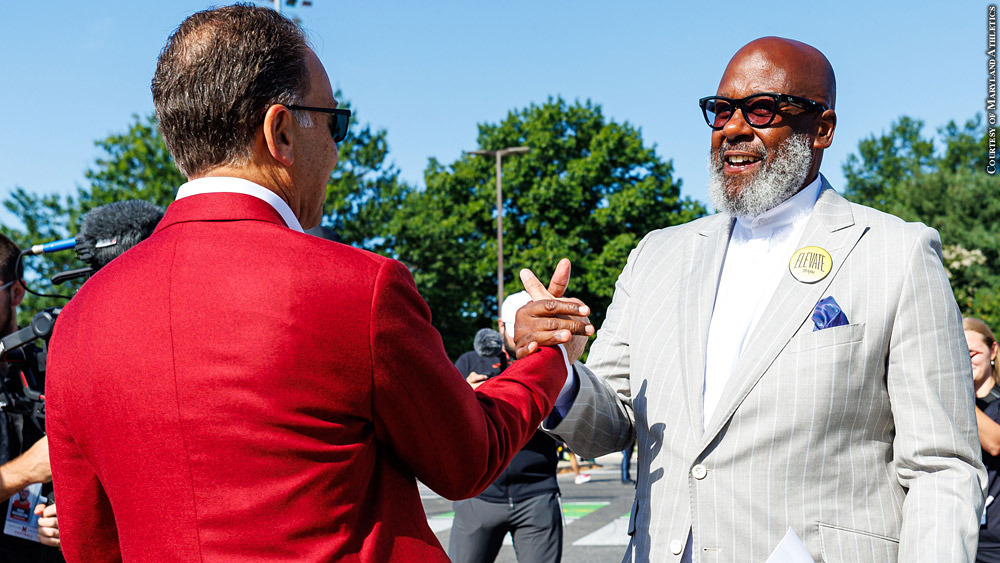
“Michael Locksley always says he wants to elevate this program and I couldn’t agree with that more,” Sabau said. “If we can elevate the brand, if we can elevate the support that our fans provide to football.
“Then it goes back to, ‘How can we as an athletic department increase our fan experience? How can we provide entertainment and opportunity for your family so we’re creating memories for you every weekend?’ That’s part of the belief structure in changing the culture.”
Smith believes that Sabau and LaBue are just as vital to Maryland’s success as he is in making progress.
“Comfort’s nice, but really I brought in people that are smarter than I am,” Smith said. “I think you always have to accept that’s how you’re going to move forward fast is to bring in a team with great experience and [they] have things that you don’t have.”
Gene Smith, who followed Geiger as Ohio State’s athletic director in 2005 and remained in the position until he retired last year, will provide a sounding board for Maryland’s new leadership team. It was Gene Smith who convinced Sabau to leave Utah State, where she had been vice president and athletic director the past two years, to come to College Park.
“Adding Gene to the mix, the guy’s done it all in this sport,” Jim Smith said. “It’s nice to have an adviser who you can lean on and say, ‘Hey, what do you think of this concept? How can we move forward fast in this area? What’s the industry doing that I might not know of?’”
LOOKING AHEAD
While not an unprecedented situation, Jim Smith is likely free of having to make any major coaching changes immediately. Smith inherits a group of coaches that features some of the best in the field, including Sasho Cirovski (men’s soccer), Brenda Frese (women’s basketball), Missy Meharg (field hockey), Cathy Reese (women’s lacrosse) and John Tillman (men’s lacrosse) as well as newly hired men’s basketball coach Buzz Williams.

“I think our coaching is outstanding,” Smith said. “Let’s talk about lacrosse and soccer and field hockey and women’s lacrosse and women’s basketball. Baseball had a great run just two years ago. To have stayed here this long and not had the resources and still had the success, tells you about the coaches we have.”
Along with the $150 million Jones-Hill House, which is still considered a state-of-the-art football practice facility, Smith also inherited the newly opened $52 million Barry P. Gossett Basketball Performance Center. Maryland was the last Big Ten school and among the last Power Four schools to have a separate practice facility for men’s and women’s basketball.
Smith called the hiring of Williams, coming just two days after Willard left and a few days before NIL payouts for 2025 had to be finalized before the NCAA legislation took hold, a “tremendous move” by Pines, the university president.
Williams, who signed a six-year deal after coming from Texas A&M, will have a honeymoon period to start the season at Maryland. But some believe this is a make-or-break season for Locksley, whose overall record of 32-36 going into the season included a 15-35 mark in the Big Ten.
Led by true freshman quarterback Malik Washington and a defense revitalized by new coordinator Ted Monachino, Maryland won four of its first six games this year. The Terps could still benefit by not having to play Ohio State or Oregon this season.
Even before the season began, Smith’s immediate impression of Locksley was positive, not only for his ability to bring in Washington, a four-star prospect from Archbishop Spalding, and get a verbal commitment from five-star edge rusher Zion Elee from Saint Frances, but also for the coach’s passion for the school and his popularity throughout the area.
“He bleeds Maryland,” Smith said of Locksley.
Smith said that he looks at all his coaches, Locksley included, through the same lens.
“The [recent] history is not as important to me, the past is the past,” Smith said. “We’re looking at it from where we are today, where we’ve invested in the programs, how we provide the resources for our coaches to be successful and then we’ll evaluate as we go forward. Looking into the past, I don’t find it incredibly helpful.”
Locksley, a Washington, D.C., native who played football at what was then Towson State, said he doesn’t feel any pressure trying to impress his new boss.
“I’m 37 years into coaching,” Locksley said a few days before the opener. “I’m very comfortable with who I am. If it’s good enough, it’s good enough. If not it won’t be. I care about Maryland. I care about trying to put the best product on the field. I feel that I got a guy, like Damon [Evans], who tried to help bring the resources to give me a chance. That’s all you can ask for.” •
Don Markus covered Maryland athletics extensively over a 35-year career at The Baltimore Sun. He is the author of “100 Things Maryland Fans Should Do Before They Die” and co-produced a podcast, “Len Bias: A Mixed Legacy.”
Photo Credits: Courtesy of Maryland Athletics