
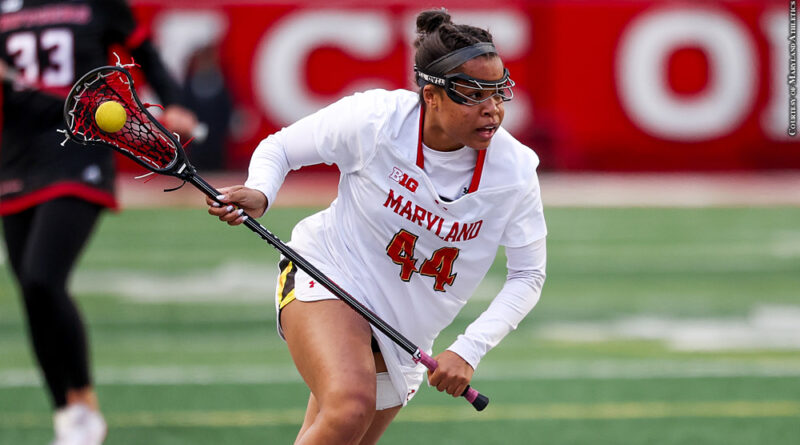
Maryland women’s lacrosse graduate student Kennedy Major recently chatted with PressBox about playing with Type 1 diabetes, recovering from a torn ACL and more. The 5-foot-2 defender picked up 17 ground balls and caused 10 turnovers for the Terps in 2025. Major is a native of Hampstead and graduate of Gerstell Academy.
PressBox: How did you first become interested in lacrosse?
Kennedy Major: I actually started out playing soccer. A lot of my teammates on my soccer team also played lacrosse. I would say third or fourth grade is when I first picked up a stick. I’ve always kind of had the speed aspect, so my neighbors were like, “You should try picking up a stick. I think you would enjoy this, just the running aspect of lacrosse.” It took a few tries for my neighbor. I was always like, “No, I’m playing soccer. That’s all I want to play.” I tried out for my local travel team and then I was like, “Oh, I really enjoy this.” And them from there I continued playing. That became my first love, and then I pursued it further.
PB: Who was the biggest influence on your game growing up?
KM: I have a few. I would say my dad, [Kevin]. He always encouraged me to be my best, and I think that’s why I always go into everything I do headfirst. Lacrosse was no different. He always told me to be the best, and then I found that I was actually kind of good at it so it just came naturally. I had this coach. His name was John Webster. He saw a lot in me. I think his encouragement is why I am where I am now. He’s taught me so much.
PB: What are your favorite memories from playing lacrosse growing up in Hampstead?
KM: I would say playing alongside my best friend Emily Messinese, who did attend the Naval Academy, and her sister, Lauren Messinese, who went to Rutgers University. We always played together, and she’s the reason I became so competitive as well. Playing for Sky Walkers going into my freshman year of high school … every club tournament we won. That’s something that I’ll always remember is just being the best because it took some time to get there. Beating all the teams like M&D and Hero’s was always so fun. Being the best amongst them is something that I’ll always remember.
PB: When were you diagnosed with Type 1 diabetes?
KM: It was December of my freshman year of high school. I was just really tired. I was using the restroom a lot. I was consistently drinking numerous fluids. I was falling asleep in class, which is something that I never did. One day I told my principal I need to go to the doctor, so my mom picked me up. We went to my pediatrician and they told me that I need to go to the ER and that I had Type 1 diabetes.
PB: What is it like to play lacrosse with Type 1 diabetes?
KM: It hasn’t been easy. It’s not really an easy thing to handle. It took some time getting used to it, but once I did, it was like nothing really changed, especially regarding sports. I think that it is important to speak up about it because I feel like there are so many people that have Type 1 diabetes. I didn’t notice until I was diagnosed, so it’s just been cool being, I would say a role model for certain people. I feel like over the years, or just since last year, I’ve gained a few followers on Instagram — just young girls with Type 1 diabetes. I think if they can see that [sophomore midfielder Kayla Gilmore] and I can both play with it at such a high level that they can also do that, it’s been rewarding in some ways because it has taught me not to take certain things for granted going from being, I guess you would say normal to having Type 1 diabetes. I think you do take certain things for granted, so it just showed me to be more grateful for things, especially lacrosse and being able to play the sport that I love alongside my best friends.
PB: Has it changed how you go about playing lacrosse?
KM: I wouldn’t say it’s changed my play as much. It’s just I have to be more aware of my blood sugar, how I’m feeling, so I wear a continuous glucose monitor and I wear a pump, an Omnipod. Before games, I’ll put it into activity mode, which allows me to stay a little bit higher with my numbers throughout the whole game. Sometimes I do have to check it. If I’m feeling well, I’ll check it before a game or halftime, but I’ve been blessed enough not to have to worry as much about lows while I’m playing. It’s not something that I worry about as much. If I am low I’ll go to Allie Boll, our trainer. She’ll give me some sugar tablets, but it’s not really anything that’s hindered my playing abilities.
PB: How did you suffer a torn ACL as a senior in high school?
KM: It was the last game I ever played for my high school team, last two minutes. I played midfield for my high school, so I was dodging and it was like, “I’m not supposed to be doing that, so what the heck.” I was going to cage and then just tore it. I sat out my freshman year [at Maryland].
PB: What was recovery like?
KM: I would say it was a blessing in disguise. I got to learn so much while I was out while becoming a little bit stronger and I get this fifth year with my best friends. I was [behind veteran defenders like] Abby Bosco, Grace Griffin, Torie Barretta. That year I got to learn so much from them. I called Torie Barretta “Auntie.” She was someone I really, really looked up to. I got to learn so much just from sitting out. Yeah, it sucked tearing my ACL and that recovery was rough. It was challenging, but it’s made me a better player. It’s made me more grateful for what I’m able to do. That whole year it was hard sitting out, but I learned so much so it wasn’t too bad.
PB: You’ve made every start since then. How do you keep your knee in the necessary shape to play at a high level?
KM: You’ve got to go to Allie Boll, our trainer. If you’re feeling anything, you’ve got to let her know. A lot of us believe in prehab, so we’ll go in there, we’ll stretch out, we’ll roll out, we’ll ask for certain exercises. There are times when the coaches will mandate ice baths or recovery aspects that we all need to do. We all just think it’s very, very important to go into training room and stretch out. I’m considered old, so it’s harder. I have to go in earlier than other people. The freshmen just go out there and run, which is annoying but it’s just making sure that you’re keeping up with your recovery.
PB: Why did you choose to go to Maryland?
KM: Right when I stepped on campus I knew it was the place for me. The campus was amazing. It offered me so many different majors, so many different directions I could’ve gone in. The coaching staff really, really helped me. I think Cathy Reese, [Lauri Kenis and Nadine Hadnagy] … I just knew I wanted to play for them. I knew that it would be the best fit for me. I think that having Type 1 diabetes and having Cathy, [whose son has Type 1 diabetes], here played a big role in that. And it’s not far from home, so I’m not too far from my parents if I miss them but it’s also not too close where they can just show up. It would seem as though it was more of a home aspect. I think it was mostly the coaching staff and family atmosphere of the team that really, really drew me in.
PB: What’s your favorite thing about College Park?
KM: I genuinely think it’s my best friends. The people really make the place. I love College Park. I love everything it has to offer, but the people that Cathy Reese recruits, I know I’m going to be best friends with a lot of them for a really, really long time, so I think that’s what I’m most grateful about from College Park.
PB: Who’s your best friend on the team and what’s a story that underscores your friendship?
KM: My best friend was Celia Pell. She is now [director of operations] at UVA, but she was roommate for four years. We’re both from Maryland, but we had never really talked so we were both nervous going into freshman year but she’s my best friend. She’s the one I’ll always go to for anything and someone I really, really miss right now, but she’s a great friend.
PB: Who was a player you looked up to when you first got to Maryland?
KM: It would have to be Abby Bosco and Grace Griffin. Coming in they were a little bit intimidating, but once you got here you’re just like, “They know so much. They’re so knowledgeable with everything.” And they’re so welcoming. That’s someone I really, really wanted to [model myself after].
PB: What advice do you have for younger players going through the recruiting process?
KM: I feel like I hear a lot of people are stressed about the whole process, but I feel like it’s something that you’re supposed to enjoy. So just take your time, make sure that you choose the school that’s the best fit for you. Going into every tournament you should be competitive, trying your best. It should be fun, though. That’s the thing that I always go back on. As a young player and as a college player, you should be having fun. It shouldn’t feel like a job. It should feel like something I am so excited to do every morning. That’s something that I feel like everyone should keep in mind when they are going through the recruiting process.
PB: What are your goals for after lacrosse?
KM: I want to travel so much. I see a lot of my friends that don’t play sports, they study abroad, so it’s something I really, really want to do. Just travel for some time and of course get a job. I got my bachelor’s in public health and I’m getting my master’s in business management, so just finding something that suits me that I also enjoy that will fill the hole that will be left when I have to stop playing lacrosse.
Photo Credit: Courtesy of Maryland Athletics
Issue 297: February / March 2026
Originally published Feb. 18, 2026