
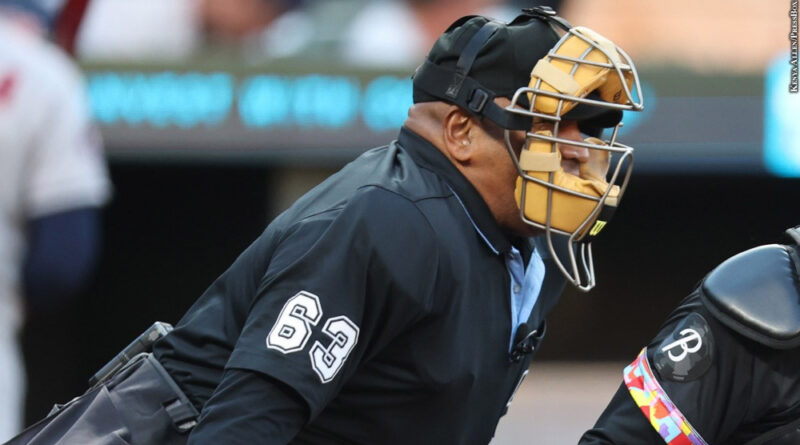
I was recently reading a story with the headline, “Ex-ump Garcia worries about impact of overturned robot ump calls.”
I was chortling just at the headline. Richie Garcia, the umpire who missed fan interference in the 1996 ALCS between the Orioles and Yankees, told the Associated Press that he worries about the embarrassment factor for umpires being overturned.
On my bingo card of worries about the newly implemented Automated Ball-Strike Challenge System, the issue of embarrassing an umpire wasn’t even on my card. Calling balls and strikes is an immensely difficult task and always has been. Many pitchers now throw close to 100 mph and have worked to increase spin rates, making the job behind the plate an almost impossible task for umpires.
This isn’t really about competence. It’s all about this age of technology where viewers at home can see with their very own eyes just how many calls are incorrect.
Sure, MLB had to get a sign-off from the umpires’ union to allow this and guarantee jobs for its members. There was never a serious discussion of dropping umpiring crews down from four to three, even if all balls and strikes would be called with an automated ball-strike system.
So, now after years of discussion and waiting for the technology to reach a point where it can get all the calls right, MLB in its infinite wisdom decided to make a mockery out of getting all the calls right.
Instead of having balls and strikes called via technology and the result relayed to umpires instantly, the geniuses at MLB decided to create a challenge system where each team gets two incorrect challenges per game. Yes, the challenging team doesn’t lose a challenge if it wins its challenge.
The average MLB game features about 300 pitches. And for this, teams get two stinking challenges each. That is a total of four challenges if all are incorrect. What about the other 300 pitches?
You may be reading this and asking, what is the big deal on a missed ball or strike? Well, it is a big deal, because a hitter is more likely to reach base if he gets ahead in the count than if he falls behind. That can change outcomes of at-bats and more importantly change the course of games.
The human element is gone in so much of sports today. The notion that calling every pitch via robot umps would diminish the game is inaccurate. It would enhance the game.
All the efforts to speed up the game could be even better with automated balls and strikes. Who would a batter, catcher or manager argue about?
If I were an owner of a team that just guaranteed a high-end starter north of $200 million, why would I want him to have to work around an unpredictable strike zone from game to game, depending on the whims of who is behind the plate?
How many more pitches does a pitcher have to throw when there is a missed call that would strike a batter out? Say that hitter then fouls off several pitches, walks with two outs and the next batter has a long at-bat. That can take a 15-pitch inning and suddenly turn it into a 35-pitch inning, all based on human error.
As for Garcia’s worries about embarrassment for umpires on overturned calls, how do you think Andy Fletcher felt on April 1 in a game between Minnesota and Kansas City? With the Royals ahead, 12-1, the Twins became very aggressive with the system. They challenged nine calls and were right eight times.
Think Fletcher would be less embarrassed if all the balls and strikes were called correctly for him by the robots?
The average umpire makes more than $300,000 for the season. Nobody is saying they don’t do a good job in every other facet of the game. I have to laugh at the unintended consequences of the video replay system. If a player attempts to steal a base and is called safe but his toe comes off by an inch and the infielder has the smarts to keep the tag applied, he is now out.
That’s OK, but taking away the human element from balls and strikes when they impact the game much more significantly isn’t OK? That makes so little sense to me.
We all witnessed the situation in the Orioles’ April 4 loss in Pittsburgh when Ryan Helsley wanted to challenge what would have been a called third strike on Nick Yorke of the Pirates. The Orioles were out of challenges because Coby Mayo and Gunnar Henderson used up the Orioles’ two incorrect challenges on emotional challenges. Yorke drove in the game-winning run on Helsley’s next pitch.
I am passionate about this because MLB has acted in bad faith. What is the purpose of doing this half-assed when you can get every pitch correct in every game?
Photo Credit: Kenya Allen/PressBox
Originally published April 15, 2026