
Mark Twain once said “it is never the wrong time to do the right thing,” which reminds me that this is the right time to say that Mark Twain never actually said “it is never the wrong time to do the right thing.”
That’s an internet myth. You know, the type of thing that everyone has just accepted as fact even if it isn’t. Sort of like “eating after 9 p.m. is worse than eating at any other time” or “Raymond Berry was great because Johnny Unitas was his quarterback.”
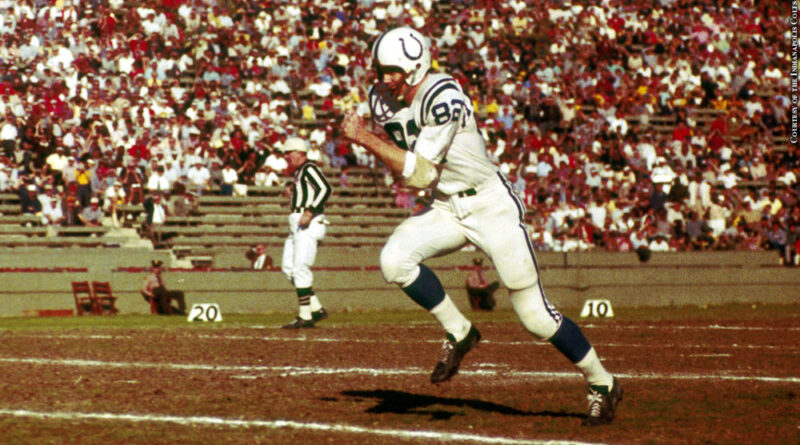
Berry’s recent passing at the age of 93 provided at least a brief moment to educate young football fans about the greatest receiver in our city’s history. He was destined for such greatness. As the incomparable Frank Deford said in 2010, “Berry had to almost construct himself by the hard work, devotion and dedication.” What he lacked in natural ability — he was just a 20th (!) round pick in 1954 — he overwhelmingly made up for with intelligence and effort.
Berry’s commitment to film study is the stuff of legend. In 2009, he joked to The Baltimore Sun that he “must be the only player whose contract included his own Bell and Howell projector.” He and Unitas would not only thread the film in order to study it and pick up on tendencies, they would then work tirelessly before and after practices to perfect not only routes but the specific types of catches Berry would need to be able to make.
It paid off most famously with Berry’s 12-catch, 178-yard performance in the Colts’ victory in the 1958 NFL Championship Game, which put both the league and Baltimore at the forefront of the national sports conversation.
Berry wasn’t just a great receiver who finished his career with the most receptions in league history. He wasn’t just a brilliant football mind, which helps explain why he was able to make the rare successful transition from Hall of Fame player to Super Bowl-caliber coach. He was a football revolutionary. And as Johnny’s son Joe concurred when I talked with him on WBAL Radio after Berry’s death, Berry was just as responsible for Unitas’ legend as Unitas was for him.
As much sadness as there was regarding Berry’s death specifically, there is greater sadness surrounding the loss of one more Baltimore Colts great. Of the eight Colts Hall of Famers celebrated in the Ravens’ Ring of Honor, Berry’s death left only Lenny Moore and Ted Hendricks still with us. And Hendricks is far better remembered for his time with the Raiders after spending just five seasons in Baltimore.
Berry’s connection with our city did not remain as deep as some of the other Colts legends because his coaching career took him away from Baltimore. But his return visits and public appearances — like presenting the Vince Lombardi Trophy at Super Bowl XLVI — provided a reminder of the joy so many of us (or you … or our fathers and grandfathers) experienced because of those legendary teams.
Uniquely, Berry was the only one of the iconic Colts to ever truly continue to embrace the Colts franchise after the move to Indianapolis. That decision irked some of the other former Colts and many Baltimore Colts fans, but it was definitively his right. Berry maintained a relationship with late former Colts owner Jim Irsay, who cultivated that relationship. What Raymond Berry gave to the city of Baltimore was more than enough to be given grace for maintaining a relationship with the franchise even if it was stolen from our city.
But make no mistake, the grace Berry showed to Indianapolis does not make it OK that the history and records of the Baltimore Colts are still held captive by that city and franchise. Raymond Berry was not an Indianapolis Colt.
That brings me back to that thing Mark Twain didn’t say. Carlie Irsay-Gordon (along with her sisters Casey Foyt and Kalen Jackson) now run the Colts. Foyt was actually born in Baltimore just a year before the franchise’s move. With more and more Colts legends and fans now gone, the conversation has been muted. It’s easier to avoid the topic altogether. But the opportunity is still there. The right time to return the history and records of the Baltimore Colts was immediately after the team’s move in 1984. We’re 42 years past that. But there is no wrong time to do the right thing. And for the granddaughters of Robert Irsay, this remains just as good a time as any.
Photo Credit: Courtesy of the Indianapolis Colts
Originally published June 24, 2026