
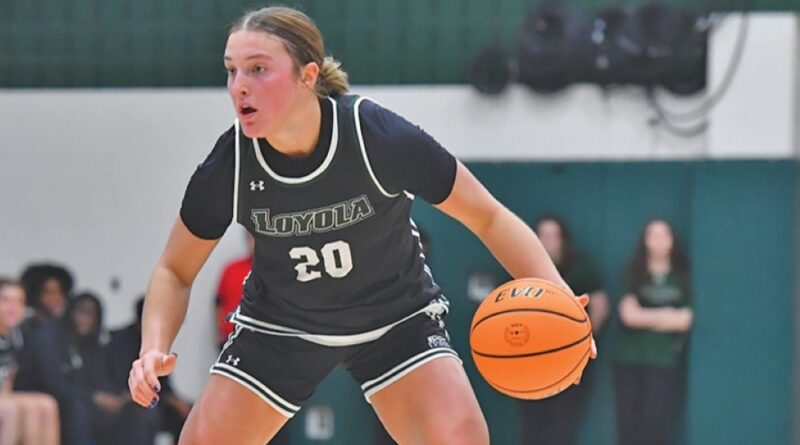
Loyola women’s basketball senior Kailey Kalet recently chatted with PressBox about the major knee injury she suffered as a freshman, the challenges posed by rehab and more. The 5-foot-8 guard averaged 20.5 minutes per game for the Greyhounds in 2025-26. Kalet is a native of Union Springs, N.Y., and graduate of Union Springs High School.
PressBox: How did you first become interested in basketball?
Kailey Kalet: Actually from a really, really young age my dad, [Andy], coached men’s basketball. When I was like 4 or 5, I was always going to his high school practices. That’s when I first picked up a ball. I kind of just fell in love with the game. I always went to all the different camps and stuff like that. In high school, I played a lot of different sports. It wasn’t until my freshman year until I realized that I wanted to take basketball really seriously because I liked it so much. My parents supported me. They put me in situations where I’d be super successful.
PB: What other sports did you play? How did that help with basketball?
KK: I played volleyball and then I also ran track. Volleyball I just played for fun. I went to a really small school, so we tried to play all the sports in all the seasons. Track definitely helped me with my speed and quickness and stuff like that. Staying in shape in the offseason definitely translated to basketball, especially for AAU time and all of that type of stuff.
PB: Who is the biggest influence on your game growing up?
KK: Definitely my dad. He’s the one who put the basketball into my hands. I always looked up to him. He coached me all the way through high school. I had a different coach for AAU, but coming to college was the first time I had a different coach other than my dad. I think definitely my dad was my biggest influence growing up.
PB: Do you have any moves you got from your dad?
KK: I would say either an in-and-out crossover or a spin move. Those are normally my two go-tos.
PB: Why did you choose to go to Loyola?
KK: When I stepped on the campus, I knew right away [it] felt like home. Obviously the coaching staff was awesome. My teammates are great. I knew as soon as I got here that it didn’t feel the same anywhere else.
PB: What’s your favorite thing about Loyola?
KK: I would just say the community aspect of it. Everybody is so close and so helpful here. You never feel alone. Loyola is just such a good place in that aspect. You feel supported all the time, 24/7.
PB: What injury did you suffer as a freshman in 2023-24?
KK: My freshman year I tore my ACL and both of my meniscuses [in my right knee]. That really stunk, but I think it definitely made me an overall better person and athlete because I went through it. … It’s a whole sequence of events. I was going down the court. I was on defense and I got a steal, and I was going in for a layup. I jump-stopped. I felt something weird happen. I was like, “Oh, I tweaked my knee,” or, “I hyperextended my knee.” I didn’t think anything of it. It was sore, but I kept playing. I sprinted back down on defense and I was trying to slide my feet and I couldn’t move laterally, but there was no stoppage of play. We went back down on offense. I got the ball on the wing and I ripped to go baseline for a layup and I felt my knee pop. I think what happened was with the very first layup I think I [tore] my meniscus, both of them, and that last one I heard my ACL pop.
PB: How challenging was rehab?
KK: I took rehab really seriously. I pretty much did something every single day. At first I had a really hard time balancing. I always felt like I wasn’t doing enough. In my head I was always like, “There’s more I can do. I need to come back. I need to be as good as I was when I come back. I need to get all of this muscle back.” I was honestly trying to do too much and I wasn’t giving my body the rest it needed. But in my head mentally I was having such a hard time depicting what was enough to make me feel like I did accomplish what I needed to and on the flip side what was enough to actually give my body rest and allow it time to heal. For a while, that was I would say the biggest struggle — finding that balance of feeling satisfied that I did enough and that I’m on the right track to coming back and getting everything back to how I was before but also allowing my body that time to actually heal, rest and recover and that type of stuff. I would say that was definitely the hardest part about going through my ACL journey. I would say that I learned a lot from it about myself because I think basketball was my whole identity. I lived and breathed it. When it was taken away, there were some days that were really, really hard. I’m grateful that I was able to realize a lot about myself in that time, even though obviously I was making light out of a really tough situation but I’m happy I was able to do that.
PB: What was it like getting back on the floor?
KK: It was full of so many different emotions. I was so, so happy to be back. It’s what I had been waiting for this whole time, but I had set such a high expectation for myself that when I stepped on the court the first time I was going to be the same exact player that I was 9, 10, 11 months ago. It isn’t possible. There were so many things … that I hadn’t done in a while. You have to pick up a basketball a lot to stay where you were. It’s not something that you can step away from very easily without having to make up a lot of ground. I think that I was struggling in that aspect. I was expecting myself to be the same player that I was, not realizing that it was going to take time. There were days when I would be so frustrated, but then at the same time I was just so grateful to be back that I was feeling so many different things. I also am super, super hard on myself. I’m overly critical of myself because I just think I need to be perfect. That also wasn’t helping. [Those were] the hardest challenges just coming back. I was just expecting to be the same player that I was. It took time to get back to that. That was not easy at first, at all.
PB: Entering your senior season, do you feel as good physically as you have in a long time?
KK: Yes, definitely. I feel completely normal physically, even sometimes a little bit stronger. I feel like mentally, my confidence in the game has grown a lot over the last year, year and a half.
PB: What has to happen to make 2026-27 a career year?
KK: I think personally I need to just keep being kind to myself. Like I said before, I’m really hard on myself. Last year I think I got in my head a lot. I think I need to keep my confidence up and just play the game the way that I know how and the way that our coaches are asking me to. I think this summer I really started to sit down and think about it in that aspect. I’ve found that it’s been working really well for me and that I’ve kind of allowed myself to … not be so hard on myself and just play free. It’s had really good results. For my team, I think I just need to be a voice and be a leader. With so many new players and younger players, just be there for them and talk them through stuff. The point guard on the court is kind of the main voice, so [I need] to be a leader and do whatever the team needs and I’m willing to do whatever that is.
PB: What point guards do you enjoy watching?
KK: I really enjoy watching Olivia Miles. She’s awesome. I would say I’ve been watching her a lot in the WNBA recently.
PB: Who’s your best friend on the team and what’s a story that underscores your friendship?
KK: My best friend on the team is [wing Amandine Amorich]. We actually are both seniors. Our freshman year, both of us tore our ACLs about a month apart. Since then, we’ve lived together. We’ve been roommates. We’re pretty much inseparable. Tearing our ACLs our freshman year and just going through that whole process together and coming back together and then being able to play together and all of that type of stuff has really made our relationship something special.
PB: What advice would you give to younger players looking to play in college?
KK: I would say just work hard. Working hard will beat talent any day. Being able to trust the work that you’ve put in when it comes time [for] a game is one of the best forms of confidence that you can have. If you can tell yourself that you’ve put in the work and have done everything that you need to do to be successful, it’s all going to work out. But if you don’t work hard and things are going to be given to you, they’re not — especially at the next level where everybody is a good basketball player. You have to outwork people. I think the biggest thing is just being a competitor and showing up to practice ready to work hard every single day.
PB: What are your goals for after basketball, whenever it ends?
KK: I think after basketball, I want to go to PT school and become a physical therapist. That’s my goal. After I hurt my knee, I kind of knew that that’s exactly what I wanted to do.
Photo Credit: Courtesy of Loyola Athletics