
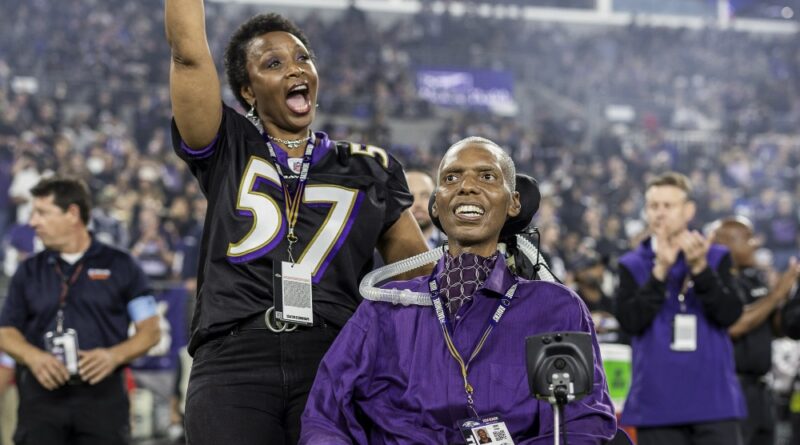
It is impossible to grasp the overwhelming courage of O.J. Brigance.
The best that one can do is listen to the people who knew the former Baltimore Ravens linebacker and special teams star — people who received guidance from him, and who felt themselves changed by him.
As many Ravens fans know, Brigance — who lived 19 years with ALS, a motor neuron condition that robs a person of their physical autonomy while their mind remains wholly alert — died in August, at age 56.
Former Ravens linebacker Jameel McClain now performs the job that Brigance helped pioneer in player engagement, also referred to as player development. When McClain joined the team in 2008, Brigance was experiencing the effects of ALS. But immediately, McClain felt Brigance’s welcome.
“O.J. represented what it meant to live and lead with purpose,” McClain said. “His approach went far beyond football. For instance, I don’t think I ever talked X’s and O’s with O.J. in my entire career. It was always about life. O.J. was always about checking in with people consistently. For me, it was seeing what real strength looked like.”
McClain faced his own serious adversity when he sustained a spinal cord injury in 2012, the season the Ravens won their second Super Bowl. It took him off the field for 11 months and put him in that lonely place injured athletes know as physical rehabilitation, uncertain whether he would ever play again.
“So, there I am working out every day [at the Ravens’ practice facility], trying my hardest to get back as the other players are going out to practice. And every day, O.J. would also go out to watch them. And every day O.J. would pass by where I was. And later, he would email me, ‘Keep working, keep going,’ Those emails motivated me because every time I felt like things were dark for me, I’m seeing a man who is fighting something that I couldn’t even imagine. It motivated me and it kept me on the up-and-up.”
McClain did resume his playing career and actually enjoyed his most productive year in 2014, which was his final season, with the New York Giants.
“A Brilliant Move”
Brigance’s story was about optimistic perseverance just about every step of the way. The Houston native played center in high school, but his “measurables” — size and speed — were not extraordinary. However, Brigance’s dogged tenacity became evident at prestigious Rice University, where he transitioned to linebacker and went on to become the school’s all-time leading tackler, a distinction he still holds.
His dream, of course, was the NFL. But at 6-foot and 235 pounds, he instead found himself in the Canadian Football League playing for the British Columbia Lions. When the CFL took a brief expansion fling to the United States, Baltimore, absent an NFL franchise, seemed like fertile ground for the new Stallions. Brigance saw an opening.
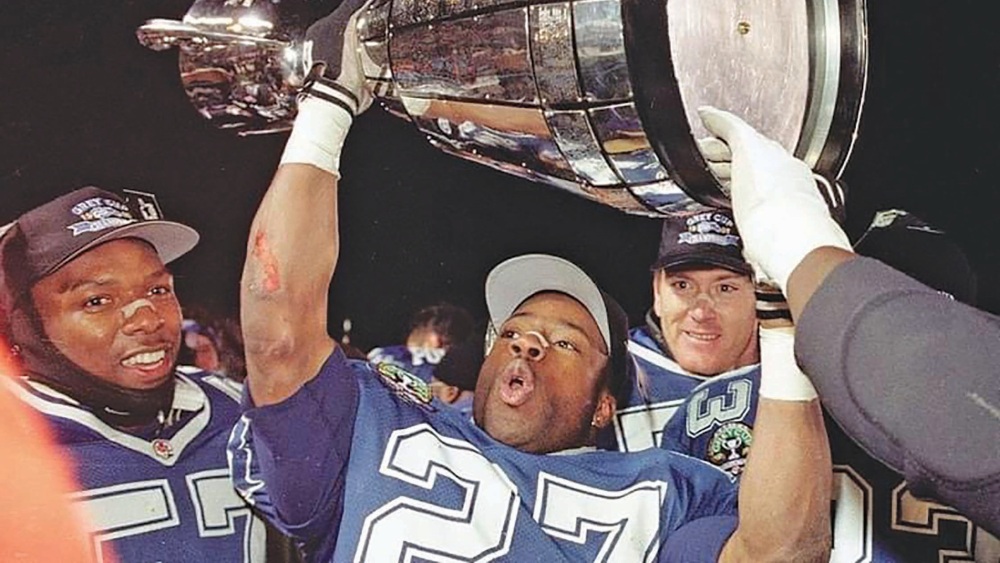
(Courtesy of Mike Gathagan)
“It was a brilliant move by O.J. to join the Stallions,” said Mike Gathagan, who handled public relations and other duties during the Stallions’ two seasons in 1994 and 1995.

(Courtesy of Mike Gathagan)
“We had 12, 13, 15 NFL scouts at every game at old Memorial Stadium. It was a lot easier to send scouts to Baltimore than Vancouver,” said Gathagan, now the senior associate athletic director for communications at Towson University.
But even though the Stallions won the Grey Cup in 1995 and Brigance was an All-Star in the championship season, there was still no real interest from the NFL. Brigance asked Gathagan for the contact information of every NFL team.
“He sat down and called every one of them. He was just looking for that one opportunity and he wasn’t going to take no for an answer,” Gathagan said.
Also persistently nudging Brigance was his wife Chanda, who would be by his side every step of a far more daunting journey years later coping with ALS.
“I think when you’re calling all those NFL teams and you’re getting, ‘No thank you, no thank you,’ it’s tough,” Gathagan said. “But she encouraged him to keep going, telling him, ‘You’ve got to call and just get your foot in the door and then outwork the next person.’ And that’s what he did — and that’s what he did every single day of his life, he outworked everybody.”
“A Great Opportunity”
Brigance’s NFL career was a constant battle to prove himself on every play in every game. He got a break as a 27-year-old NFL rookie with the Miami Dolphins. He spent four seasons in South Florida and then in 2000 at age 31, he returned to Baltimore just in time for the Ravens’ first Super Bowl season.
Brigance made the first tackle on the opening kickoff of Super Bowl XXXV, a textbook takedown of Giants returner Ron Dixon. The tackle is frozen in Baltimore fans’ recollections as Brigance, on one knee, celebrated in six-shooter fashion. The Ravens went on to hoist their first Lombardi Trophy.
In the regular season in 2000, he had 25 special teams tackles, served as special teams captain and added four special teams tackles in the Super Bowl. His final two seasons, in 2001 and 2002, were spent with the St. Louis Rams and New England Patriots. Combined with his CFL seasons, Brigance played 12 years of professional football with six teams.
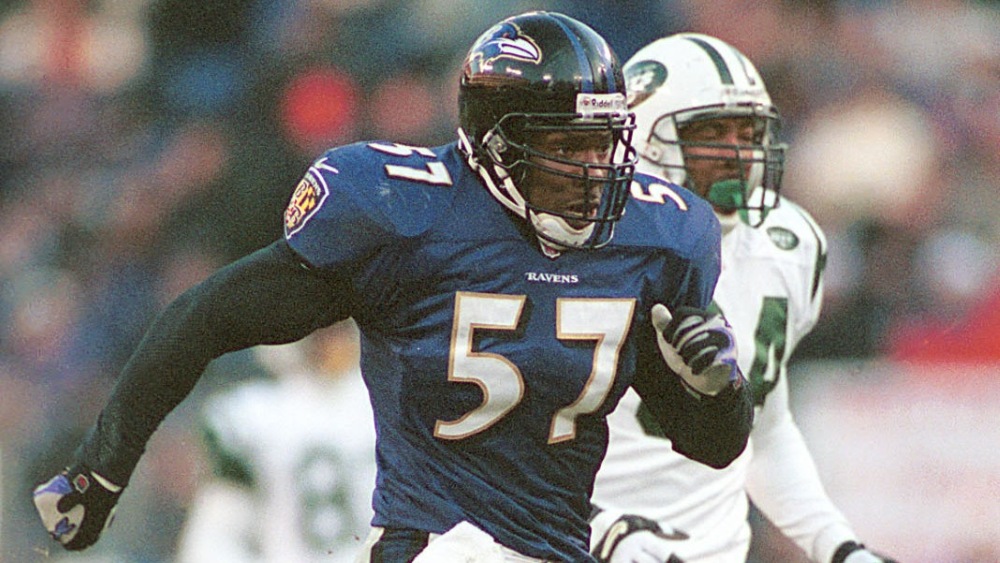
However, the heroics Brigance flashed hurtling down NFL fields covering kicks and making big hits across seven seasons were about to be eclipsed by the heroism he was destined for just a few years after he left the game as a player.
In 2004, he rejoined the Ravens in a new capacity as director of player development. It was a job relatively new in the NFL universe.
“He reported to [general manager] Ozzie Newsome. Ozzie thought he would be a great addition,” said Dick Cass, team president emeritus. “Not every team had such a position and O.J. made the job what it became, which was to get to know our players, make sure they could have all the information they needed about living in Baltimore.
“If they had a family, helping them with schooling. If they’re going to have a baby, helping them figure out where to go to have the baby delivered. And also, it meant getting to know their significant others, whether it was a fiancée or a wife. And O.J.’s wife Chanda also got involved in helping with the families. But obviously O.J. came to the office every day, keeping in contact with the players.”
It was just a few years into his new life’s work that Brigance received his ALS diagnosis. Super Bowl-winning head coach Brian Billick, who was still the Ravens head coach at the time, described to Glenn Clark Radio how he found out from Brigance.
Billick explained he was getting ready for a new season and was busy in his office when Brigance walked in and started telling Billick that he had a new “opportunity.” At first, Billick thought Brigance was referring to a new job elsewhere and a distracted Billick simply wanted to congratulate him and move on.
That’s when Brigance said, “I have this great opportunity that I have ALS and I have this great opportunity to overcome it.” The coach was stunned.
“That just brought me to my knees,” Billick said. “That’s what O.J. was — the minute that adversity hit, something that none of us could fathom, his first thought was, ‘OK, this is a challenge I’m going to overcome.’ And he carried that out for the next 20-some odd years.”
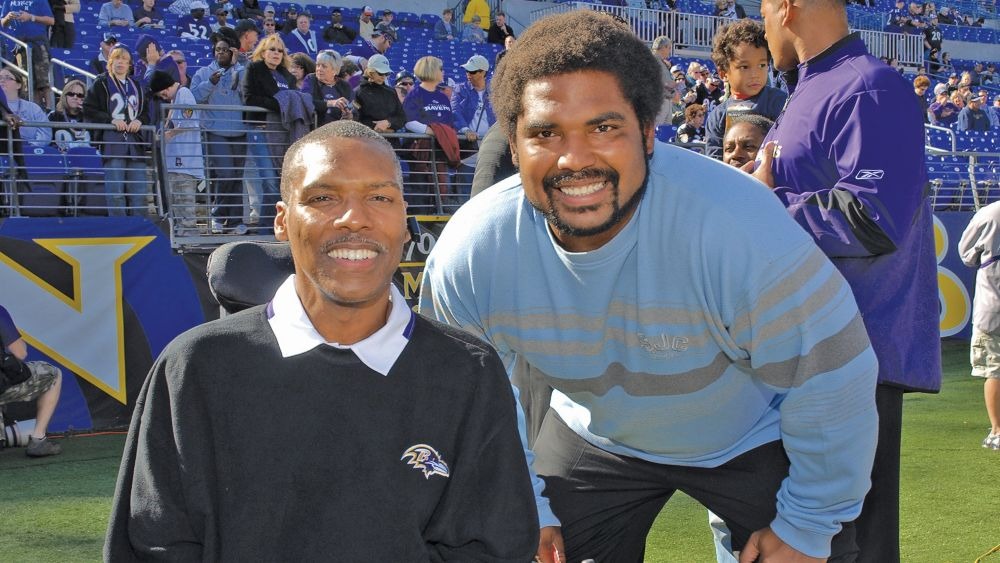
(Courtesy of the Baltimore Ravens)
The Mission Continues
O.J. Brigance was just 37 when he received his diagnosis with a typical life expectancy being three to five years. Brigance survived with ALS for 19 years.
Others echoed what Billick recalled.
“I think he told me the same day he told the Ravens,” said Gathagan, who had become close friends with Brigance. “And he tells me, ‘I’m going to be the first person to beat ALS.’”
Gathagan also took on a role as one of the founding members of the Brigance Brigade, an organization, started by O.J. and wife Chanda, devoted to raising money, not for Brigance himself, but for families who have a loved one living with the condition.
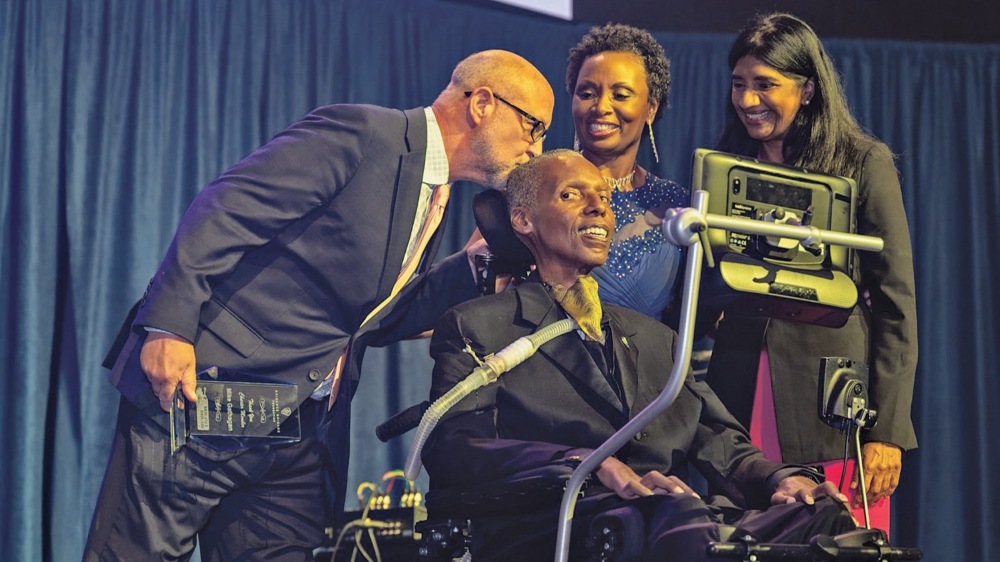
The Brigance Brigade’s mission statement is forthright, which is “increasing access to caregiving services, equipment and in-home accessibility for people living with ALS.” It was started in 2008 and quickly began holding events, such as runs, dinners, and golf tournaments to raise money for those needing assistance coping with the daily challenges an ALS family faces.
Current Brigance Brigade executive director Drew Vanlandingham empathizes with those types of challenges. His former husband suffered with a brain disease and Vanlandingham was his caregiver.
“ALS is very, very expensive. So, what the Brigade does is it bypasses insurance because insurance only covers so much and we give the money we raise directly to our families because they need it now. They don’t need to wait six months when they’re approved [by insurance]. So, that’s what our grants program does,” Vanlandingham said.
Since the Brigance Brigade’s inception, it has raised and distributed millions of dollars to ALS families, typically in $5,000 grants and usually twice a year. That grant money is used for whatever can make life a little easier for the ALS patient and their family, such as wheelchairs, lifts and ramps. Vanlandingham calls the folks who receive assistance the foundation’s “pals.”
“An example is one of our pals who wanted to use the money to build a ramp,” he explained. “She had two kindergartners and an older child and she had not seen her kids go to the first day of school, but we gave her that grant where she could build a ramp and then she could go see them off to school, or go to their soccer games, or to their cheerleading.”
The organization’s website lists a busy calendar of fundraising with some 2026 events yet to be held including a tailgate in November and a holiday-season online giving drive. The annual marquee event has traditionally been a fancy dinner with music.
O.J.’s wife Chanda has been a driving influence during their life together, and they shared an intense ambition in dealing with ALS.
“We did not know anything about the disease and just after doing a little research to find out about ALS, we found that there’s no cure for this. But then you have this disease that there’s not enough awareness about it — there’s no cure for it, there’s no medication really for it, and then on top of all that, it’s going to cost about $250,000 a year,” Chanda Brigance said.
“So, that’s where O.J. and I said ‘Oh my God, how can just the average working citizen be able to really afford $250,000 a year,’ and that’s when we got the idea. No. 1, what can we do to help others be able to navigate through this type of disease? No. 2, how can we help to bring more awareness to it? But most of all, how can we help others be able to afford to live with this disease, because it costs a lot.”
“Today Is Your Moment”
As a result of O.J. Brigance’s work on behalf of others, he has been honored with several awards, including the George Halas Award (2014) and the NCAA Inspiration Award (2016).
Along with Brigance, another former player, ex-offensive lineman Harry Swayne, also worked in the area of assisting players with off-the-field issues for the Ravens. Many NFL teams have followed that example.
Brigance and his wife are devout, and he felt his fate was guided by a higher power.
“I once had a discussion with him and asked if he was going to get an operation to prolong his life,” Cass recalled. “He said it’s God’s will. ‘If I’m unable to breathe someday and someone is there to give me help and I’m able to get help and I can breathe, then that was God’s will and I will continue to live.’”
Just a few years into his diagnosis, Brigance had to rely on a machine that enabled him to vocalize his thoughts. He remained insightful and witty despite losing control of his muscles.
Gathagan recalled spending a St. Patrick’s Day at the Brigances’ home after the former Raven had begun using a computer to vocalize his thoughts.
“My daughter and O.J. must have spent an hour just experimenting with different voices, like an Irish woman or a Russian male. They were laughing and having great fun. It was certainly a memory I’ll never forget,” Gathagan said.
It is unmistakable the impact that Brigance has had beyond football.
“He inspired people throughout the Baltimore community,” Cass said. “So, he was really a community leader and inspiration for our community and someone who knew adversity. I mean, we know that athletes talk about adversity all the time. But he really knew what adversity is.”

Yet, all who knew Brigance noted that a constant about him was his smile.
“I mean, if you were having a rough day and you’re going into the cafeteria to have a meal and you’re feeling sorry for yourself and there O.J. would be — and he was always having a rough day, obviously — but he still always had a smile,” Cass said. “I think he was greatly helped by his faith.”
Chanda underscored the importance of faith in the couple’s lives and its importance in guiding their path.
“We all believe in whatever it is that we all individually believe in and that’s everyone’s right,” Chanda said. “But for O.J. and I, yes, we believe in our heavenly Father. We believe in God, and that’s the center of our lives and we believe the Father wants us to help others. You know, to whom much is given, much is required. And we have been extremely blessed to be able to do what we’ve done, and it’s just wanting to see others be able to enjoy some of those things.”
And most importantly, Chanda said, the foundation’s work will go on to continue the search for a cure so there’s a “world without ALS.”
Shortly after his diagnosis, Brigance had a message that seemed directed at the disease itself.
“I know it’s life-threatening,” he said, “but it’s not life-ending.”
In later years, he had a message for others.
“Time is never promised, only granted,” he said through his computer. “So, don’t miss your moment. Today is your moment. Today is your time. Take full advantage of it.”
Photo Credits: Courtesy of the Baltimore Ravens, Mike Gathagan and Kenya Allen/PressBox