
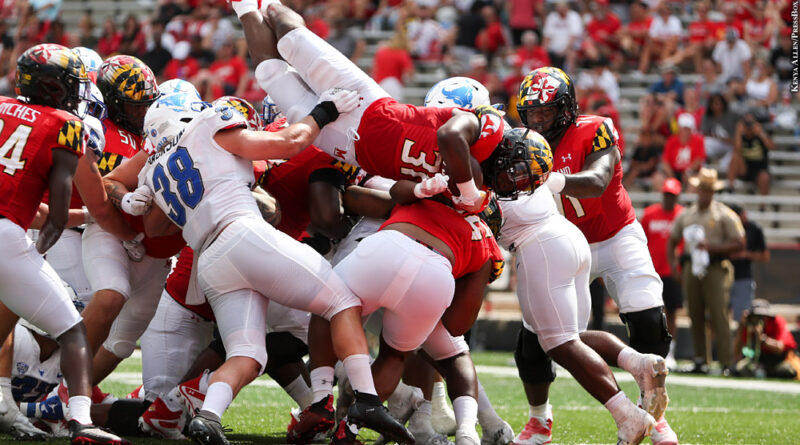
The Maryland football team defeated Buffalo, 31-10, on Sept. 3 in the season opener for each team. The Terps have now won 12 consecutive nonconference season-opening games. Maryland was in control of the game from the opening kickoff and didn’t look back. The Terps will look to improve to 2-0 on Saturday, Sept. 10 when they take on Charlotte.
Here are four takeaways from the Terps’ home victory:
1. Penalties are still a problem.
Maryland finished the game with eight penalties for 82 yards, not including a pass interference call that would have put Buffalo in Terps territory had it not offset. Buffalo finished with three penalties for 30 yards.
Maryland head coach Michael Locksley appreciated the competitive nature of the penalties in the defensive backfield. However, he believes his team must clean up noncompetitive penalties such as offsides and illegal procedure.
The Terps finished the first half with six penalties for 57 yards, including a 15-yard holding penalty that knocked the Terps out of the red zone momentarily. Maryland was also hit with an offsides call on a missed field goal that gave Buffalo a fourth-and-short. However, the Bulls did not end up scoring after the penalty, as the fourth-down play went nowhere.
“It’s very important and we try to harp on that every day,” junior safety Beau Brade said about cleaning up penalties.
2. Maryland’s defense played well but left some opportunities on the field.
Locksley has mentioned the depth of his defensive line, and that came to pass in the first game of the year. Maryland held Buffalo to 74 yards rushing on 21 attempts in the first half. The Bulls finished with 108 rushing yards on 38 carries.
The Terps also pressured Buffalo quarterback sophomore Cole Snyder a fair bit, making him scramble out of the pocket. The Terps finished with four sacks and seven tackles for loss.
“I think the big thing is they pushed that pocket back into the lap of the quarterback,” Locksley said. “We created some depth to where we can rotate and [have] first-time players play meaningful snaps.”
“Whenever you have a great defensive line they just make the defensive backs look way better,” Brade added. “We’ve got some monsters up there. All of them.”
Senior cornerback Jakorian Bennett finished the game with five pass breakups. Locksley was impressed with Bennett but would’ve liked to have seen him finish one of those plays.
“We need to see him create turnovers and he had a couple of opportunities, including a dropped interception that would’ve been a huge play for us,” Locksley said. “He had a good game for us to have five breakups, but for him and for us getting those interceptions will be really important as we move forward.”
Bennett was pleased with the defensive effort on the whole.
“Good rush and good coverage, we’ll have a great chance of coming up with the successful play,” Bennett said. “So we have to continue to build on that, be consistent and we’ll be cooking with grease.”
3. The Terps’ new-look backfield produced.
Redshirt freshman Roman Hemby got the start against Buffalo and rewarded Locksley’s faith in him. Hemby ran for 114 yards and two touchdowns, with his second rushing touchdown coming on a 70-yard sprint from Maryland’s own 30-yard line.
It was the longest rushing touchdown by a Terp since Anthony McFarland Jr.’s 80-yard touchdown run against Rutgers in 2019.
“I took the steps that I normally take on that play and I came through the mess and saw nothing but daylight,” Hemby said of his 70-yard touchdown run.
Hemby averaged 16.3 yards per carry, while redshirt freshman Antwain Littleton II averaged 5.7 yards. The Terps averaged 5.7 yards per carry as a team.
Littleton scored two touchdowns as well. His first touchdown run put Maryland up 14-0. Just prior to that, he had a 21-yard rush in which he broke tackles on his way to putting the Terps at the Buffalo 2-yard line before hammering it home.
“Because we’re all young and have something to prove I feel like whoever has the hot hand on any given day can go out there and do whatever we plan to do,” Hemby said. “Seeing [Littleton] make some runs wasn’t really new to me because he does it all the time through the week.”
“It means a lot,” senior receiver Dontay Demus Jr. said of the balance between the rushing and passing game. “[There are] teams out there with good front sevens, so having a good running back room and having the [defense] key in on them makes it easier as an offense.”
4. Maryland’s receivers didn’t get in the end zone, but they still produced.
The Terps’ wide receiver corps showed fans why this is considered such an exciting group. Quarterback Taulia Tagovailoa completed 24 of 31 passes for 290 yards and one interception. Tagovailoa didn’t throw any touchdown passes, but sophomore tight end Corey Dyches’ would-be touchdown was ruled out of bounds at the Buffalo 1-yard line.
Junior Rakim Jarrett led the way with six receptions for 110 yards, the fifth 100-yard game in his career. Jarrett kicked off Maryland’s opening drive with a 25-yard jet sweep. That led to a 14-yard reception by redshirt senior Jeshaun Jones, who finished with 70 yards on four receptions. The five-play, 78-yard drive was capped off by a Hemby touchdown.
Demus returned from last year’s season-ending knee injury and finished with three receptions for 23 yards.
“It means a lot after not playing football for almost a year,” Demus said. “Going out there and executing with my brothers means everything to me.”
Photo Credit: Kenya Allen/PressBox