
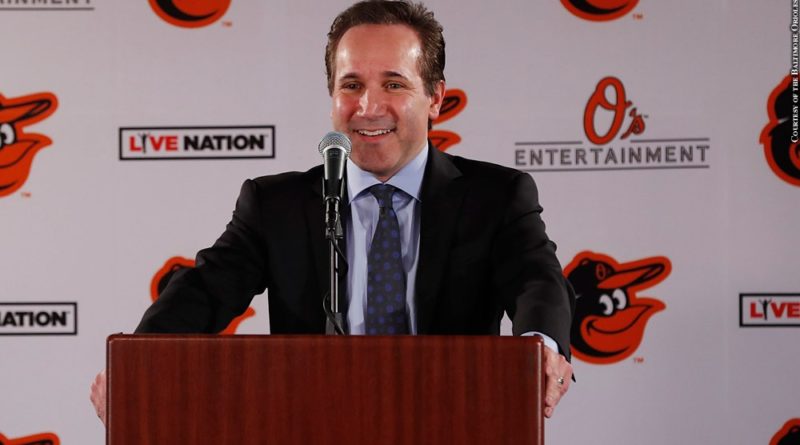
I appreciate John Angelos speaking with the media in Sarasota this week.
Sure, many of you are bothered by any number of things that the Orioles’ chairman and CEO said during his conversation with reporters at spring training. I’m not sure anything he said could be viewed as “comforting” to Orioles fans, to be honest. But I’m still appreciative that he took the time.
Of everything Angelos said, nothing stood out to me more than one particular sentence.
“I would be disappointed if we’re not the next Tampa, which means being sustainably competitive and relevant.”
More than any answer about the lease or Brandon Hyde’s future or the impact of the pandemic or payroll predictions, this particular answer fascinated me. This seemed to be the only answer in which we truly learned something. That’s because it provided an answer to a question that was different than what I believed the answer to be.
The question of course is, “Which franchise are the Orioles most trying to emulate?” Before Angelos spoke to reporters, I would have assumed that answer was the Houston Astros. From the moment the rebuild officially began, the Astros were the obvious model for what the Orioles might attempt to accomplish, so much so that they, you know, literally pried away two of Houston’s top decision-makers (Mike Elias and Sig Mejdal) to lead the replication.
It appeared a simple concept. Strip the organization down to the studs, accept a historic stretch of losing, acquire top draft picks, stockpile the organization with talent and then spend money when necessary to close the gap and become a World Series contender. It went perfectly to plan in Houston, so why would the Orioles do anything different?
The most likely answer is, of course, the most obvious. While making eight playoff appearances across the last 15 years, the Rays have never moved beyond the bottom third of MLB in terms of payroll. The “Wall Street” approach to baseball has been equally frugal and successful. They’re a McKinsey consultant’s sporting dream. Of course Angelos, running a smaller-market baseball team without the same personal wealth of some other owners around baseball, would view the Rays as the ideal model.
And there’s a lot to like about the idea of the Orioles attempting to reproduce what the Rays have managed to do in terms of “being sustainably competitive and relevant.” Their eight postseason trips in a decade and a half have included two World Series appearances, four Rookies of the Year and two Cy Young winners.
Instead of creating a particular window for success, the Rays have comfortably managed to prevent the window from ever being completely shut. Ignoring the wild difference between the economics of the NFL and MLB (and the fact that they’ve come up short in terms of hoisting the biggest trophy), the Rays’ strategy is more or less baseball’s version of the Ravens.
Yet … it makes you feel kinda uneasy, doesn’t it?
The Rays have had myriad troubles in terms of establishing a passionate fan base in Florida. Their stadium is not only well outside of Tampa, it has all of the charm of your grandparents’ basement. But it’s not just the stadium. While some players (Evan Longoria, Ben Zobrist and Kevin Kiermaier notably among them) have managed to stick around for the better part of a decade, fans in Tampa have regularly been forced to wonder if their favorite young player might not be long for the franchise because the team might decide to move them in order to best maximize their value.
If I’m being fair, it’s not necessarily the wrong way of doing business. The team’s success suggests the exact opposite. But it’s complicated, right? In the aftermath of Manny Machado, this fan base remains fragile. Many Orioles fans, while intrigued by what the team has built, will still suggest a reluctance to fully buy in. “Adley Rutschman will probably be a Yankee in five years anyway” is an unfortunate refrain.
As the franchise tries to re-engage the fan base, the value of establishing tent-pole players likely to be “career” Orioles goes far beyond the nuts and bolts of analytics and constantly maximizing value. Be it because of the summer weather or sheer numbers of games, we know baseball is a far more romantic sport. We want to fall in love with the players we’re going out to the ballpark to watch.
Still, there’s no blanket statement to make about whether following the Rays’ lead is necessarily a “good” or “bad” strategy. It is logical. And we’d absolutely love going out to the ballpark for frequently meaningful late season and playoff games. We’d definitely sign up right now for Gunnar Henderson to be the Orioles’ version of Evan Longoria because 10 years is four more than we might otherwise expect.
There’s no justification for constantly keeping the payroll as low as Tampa’s. The Astros have sustained success despite having a top-five payroll just once since moving out of their own rebuilding plan. The Orioles are receiving $600 million in public money. That doesn’t mean they should be required to turn around and recklessly spend $600 million on payroll, but it matters.
The goal should be to replicate Tampa’s success, but this fan base shouldn’t be asked to accept such premeditated frugality.
Photo Credit: Courtesy of the Baltimore Orioles