
Welcome to our ninth season of fantasy baseball coverage as we help you get ready for your drafts and prepare for the upcoming season so you can become a champion.
As a refresher for those who have followed our coverage throughout the years and to any new readers, in fantasy baseball there are different league formats that are used, but the traditional is the five-by-five rotisserie league format, and that is what I will base my advice on.
For those who are not familiar with what that means, there are five hitting categories — consisting of batting average, home runs, runs scored, RBIs and stolen bases. For pitching, the categories consist of wins, strikeouts, ERA, walks plus hits per innings pitched (WHIP) and saves.
On-base percentage (OBP) continues to become more popular as a replacement to batting average, so I will refer to that stat as well since it could change how we evaluate certain players.
I personally feel fantasy baseball is at a crossroads with the current format. Major League Baseball teams are not valuing starting pitchers and closers anymore, and we need to adjust as an industry. Unfortunately, this hasn’t happened yet.
Even though roto leagues are still the standard, I encourage commissioners to think about implementing head-to-head formats along with total points. By adding more categories and creating the fantasy football feel of going against an opponent every week will only help enhance the fantasy baseball experience.
Here is part two of my 2023 fantasy baseball draft guide. Part one can be found here.
WINS AND SAVES
Two of the main pitching categories are wins and saves. It’s becoming increasingly more difficult to achieve both in fantasy baseball. During the 2019 season, 26 starting pitchers had 14 or more wins. That number decreased to 13 in 2021. There was a slight increase in 2022, as 19 pitchers hit that mark.
A lot of this can be attributed to pitchers just not pitching deep into games. Starting pitchers, on average, recorded just a little more than 15 outs per game in 2021 and 2022.
In order to earn a win, a starting pitcher must pitch five innings. In order to qualify for a quality start — a popular category — pitchers must throw six innings and allow three earned runs or less. Both of those categories have been hard to reach in recent years.
As a result, the thought process is to draft one of the stud starting pitchers early. However, I will continue to recommend the strategy of waiting on starting pitchers and finding value later.
This has worked as recently as last year, when Rays starting pitcher Shane McClanahan was a strong recommendation. The left-hander was drafted as the 31st starting pitcher, according to FantasyPros, but finished as the 10th-best starting pitcher, according to ESPN Player Rater. McClanahan is now being drafted as the eighth pitcher. There will be another McClanahan, and fantasy managers need to trust that they will be able to find a quality pitcher later in drafts.
For commissioners, I would recommend eliminating the win and quality start stat. Add another category like strikeouts per nine innings.
As for saves, this is always a category we chase on the waiver wire since the position is extremely volatile. Teams aren’t relying on one pitcher to close out wins anymore. There were 67 pitchers who recorded at least one save in a shortened 2020 season. In 2021, there were 116 pitchers who recorded at least one save, and just nine pitchers finished with at least 30 saves. In 2022, the number of pitchers with at least 30 saves increased to 10. However, 131 pitchers finished with at least one save.
To put this in perspective, 21 pitchers finished with at least 30 saves and 84 pitchers finished with one save or more in 2015. It only took seven seasons for a huge shift to occur. Fantasy baseball has yet to catch up.
Our strategy has stayed the same in recent years, and we recognized this trend early. There’s no need to reach, but we like to draft a closer on a good team who has their role solidified. We will attack the waiver wire throughout the season and ride the hot hand in order to compete in the category.
I can’t stress enough that this is a category that should be gone. Fantasy owners should add holds plus saves to expand the player pool for targeting the category.
THE RETURN OF STEALS
The game of baseball as we have become accustomed to at the major league level in recent years is about to undergo a huge change, and we need to be prepared for it. Major League Baseball has implemented a pitch clock, limited the amount of times a pitcher is allowed to attempt a pickoff, banned the shift and increased the size of the bases.
The pitch clock won’t have a big impact on fantasy baseball, but the three other changes most certainly will. The shift should increase the number of runners on base, which will help improve the batting average category and hopefully the RBI category as well.
Pitchers are only allowed to attempt two pickoff throws per at-bat, which in theory should allow baserunners a better opportunity to time their jump in terms of stealing bases. The size of the base increasing by 3 square inches should also help.
In 2021 and 2022, there were only six players who had 30 or more steals. I believe we will see at least 10, if not more, pass that number this season. The most notable increase should come in terms of players stealing 15 to 25 bases. There were 32 players who had at least 15 stolen bases in 2021 and 40 in 2022. I would predict that number will be more than 50 in 2023.
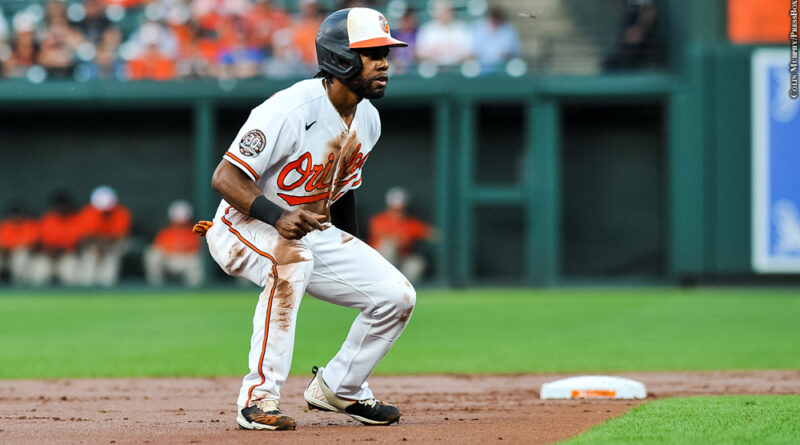
A player like Orioles center fielder Cedric Mullins has proven he can steal bases. It would not be a surprise to see him finish with 40 steals for the first time in his career.
Photo Credit: Colin Murphy/PressBox