
For well more than a century baseball has prided itself on the fact that “the game never changes.” We might have to dust that one off this year.
Not since 1893, when the pitcher’s mound was moved to the confounding distance of 60 feet, 6 inches (bonus points if you know how that happened), has baseball made the kind of drastic changes in store for the 2023 season. Granted, most of the changes qualify as gingerbread for the hard-and-fast rules, but these changes are designed to be as noticeable to the fans as they are to the players.
If they work as expected, then games will be shortened by an average of 20-25 minutes — and commissioner Rob Manfred’s legacy will be secured.
But there is a lot of work to do and habits to break, and it shouldn’t come as a shock to learn a lot of these changes bring a whole new element to the job of umpires. For one thing, somebody’s going to have to do the bookkeeping, and I haven’t read anything about that yet.
For openers, anybody who has been paying attention knows the defensive alignment known as “the shift” is now part of history. There must be four fielders in the infield (i.e. on the dirt) with two on each side of second base — and no shifting of defenders from one side to the other depending on whether the hitter is left-handed or right-handed. A team can use five infielders, but four outfielders is a no-no. And, yes, the catcher is still the only player allowed to be positioned in foul territory.
I’m guessing that’s the second base umpire’s job.
Then there is the rule that, with a runner on base, the pitcher can make a pickoff throw or step off the mound only two times. A third attempt is allowed only if the pickoff is successful — otherwise the runner advances a base. This rule resets after each hitter.
This no doubt is an equal opportunity job for all three base umpires.
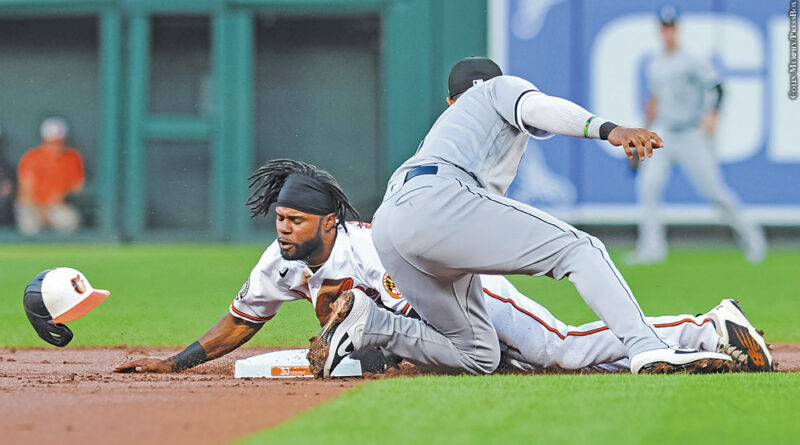
The dimensions of home plate remain the same (presumably so does the strike zone, though there will be continued debate about that), but the three bases will increase in size from 15 to 18 square inches, which slightly reduces the distance between bases, which technically was never really 90 feet (as established in 1845) because they are measured from the middle. You won’t notice the difference, but the hope is potential base stealers will take advantage of those precious inches.
My gut feeling is larger bases will help the offense mostly by turning ground outs into singles and doubles that bounce off the bag. But that’s just my opinion — I don’t think it entered into the discussion.
That brings us, finally, to the change that figures to be the biggest difference-maker — the pitch-timer clock — which is not to be confused with the timer between innings, though both are likely to be recorded on the same clock.
This is the one that gets tricky, the one that promises to create the most havoc. It also figures to add a dimension to spring training games to help make up for the fact there aren’t a lot of regulars in the lineup because so many are away playing in the World Baseball Classic.
The pitch-timer clock will have three settings — 30 seconds for the allotted time between hitters, 20 seconds between pitches with runner(s) on base, and 15 seconds with nobody on base. Anytime the pitcher fails to deliver, it’s an automatic ball.
The tough part of this rule, the one promising to cause the most commotion, puts the onus on the hitters. Whereas the pitchers have the entire allotted time to throw a pitch, the batter is obliged to be in the box and ready to hit at the eight-second mark. That’s going to leave precious little time for adjusting batting gloves, protective gear of various kinds, etc., and is almost certain to enhance the art of the “quick pitch” when there are no runners on base. You can be sure that pitchers will be on lookout for tardy hitters and a chance for the bonus of a quick, uncontested strike.
I’m not sure which of the four umpires is going to be the “clock watcher.” But if it isn’t the one calling balls and strikes, it will create some interesting arguments — hitters are used to complaining to home plate umpires, but suppose it’s the guy on second or third who is in charge of catching the clock culprits.
Of course there is an out here — as in the umpire may provide extra time if warranted by special circumstances. Presumably “special circumstances” will not include rewrapping batting gloves or adjusting the aforementioned protection devices.
In researching the new rules, I couldn’t find anything that mentioned a number of allowable timeouts per team. I suspect one way for the batter to dodge the restrictions will be to have an impromptu visit with the third base coach to see if he missed any signs. He would, of course, be allowed to rewrap his batting glove(s) on the way back to home plate, at which time the clock would presumably be in the process of resetting.
All of the rules have been tested in the minor leagues, where on average there were fewer than 0.5 violations per game. The end result was pace of play improving by 26 minutes per game.
Making that work in the minor leagues is one thing. Making it work as well in MLB is another story. But these changes are here and, unlike the distance between home plate and the pitching slab, they aren’t going to change.
And, by the way, that 60 feet, 6 inches distance is not the result of some scientific (analytical?) research. The distance was supposed to be 60 feet, but the groundskeeper misread the directions and added 6 inches, and they didn’t bother to change it. After all, what’s 6 inches to a 95 mph fastball?
P.S. Don’t be surprised if that number isn’t rounded up sometime in the near future. You could probably get a line on one of the betting books that the pitcher’s mound will either go back, or down, sometime in the near future. But that’s another story for another day.
Jim Henneman can be contacted at JimH@pressboxonline.com
Photo Credit: Colin Murphy/PressBox
Issue 279: February/March 2023
Originally published Feb. 15, 2023