
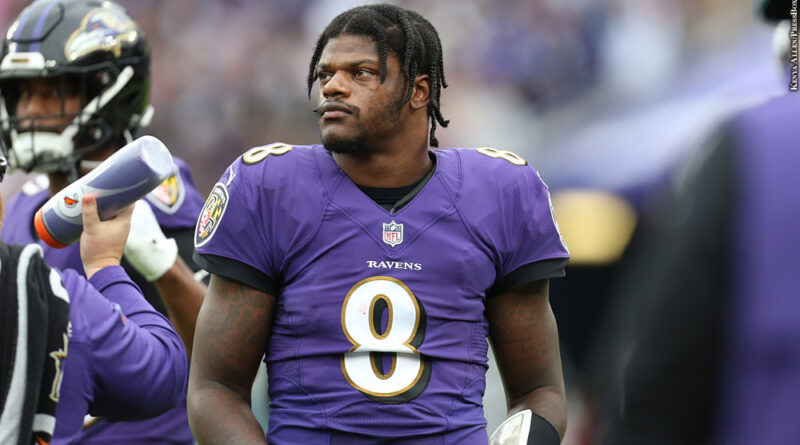
The Lamar Jackson saga in Baltimore, which seemingly gets more curious by the day, took another bizarre turn on Thursday, March 23, with the arrival of Ken Francis. Wait, who?
The NFL sent a memo to all teams cautioning that Ken Francis “may be contacting Clubs and attempting to persuade Club personnel to enter into negotiations with or concerning Lamar Jackson.”
The problem is Ken Francis, reportedly a business partner of Jackson’s, is not an agent certified by the NFL Players Association, and therefore, by rule of the current Collective Bargaining Agreement between the league and the NFLPA, is prohibited from being involved in any such negotiations.
The league memo further stipulated that a violation of this provision could result in “disapproval of any Offer Sheet or resulting Player Contract entered into by Mr. Jackson and the new Club.”
The NFL Network’s Tom Pelissero tweeted that Francis was “a Florida man who most recently was pitching a home fitness invention, I’m told. He is now trying to negotiate a nine-figure contract with NFL teams who are being told they’re not allowed to negotiate with him because he’s not a certified agent.”
Jackson replied to Pelissero via Twitter:
Around the same time, Jackson via Twitter posted a video that teased of a future fitness product:
If this all sounds like the Ravens’ offseason has steered off the rails, that’s understandable.
It’s absolutely fair to question how a Florida man’s home gym invention has become a focal point of a franchise whose quarterback was the league’s unanimous Most Valuable Player just three years ago.
The Ravens earlier this month applied the nonexclusive franchise tag to Jackson, who was set to become a free agent. That means they retain his rights and owe him roughly $32 million should he sign the one-year tender, but it also means that other teams are free to negotiate with Jackson. If any team signs Jackson to an offer sheet, the Ravens have the right to match the offer, or they will receive two first-round draft picks in return as compensation for losing him.
Two weeks into free agency, no offers have come forth, and Jackson’s status remains a daily NFL headline.
Many media and fans suspect collusion among owners, questioning how none of the other 31 teams, several of whom are quarterback-needy, would even entertain the idea of signing Jackson, who is just 26 and was the league’s unanimous Most Valuable Player just three years ago.
The implication is that owners have an unspoken agreement not to replicate the widely-criticized, fully guaranteed, five-year, $230 million contract that the Cleveland Browns gave quarterback Deshaun Watson. Jackson was thought to be holding up that fully guaranteed deal as a reference point.
Others question why any team would extend an offer sheet even approaching that kind of money — which would also cost two future first-round picks — for a player who has missed significant time in each of the past two years, especially when the Ravens have the right to match the offer and retain Jackson anyway. Why do the Ravens bidding for them?
Neither the Ravens nor Jackson have had much to say on the subject, but mounting frustration on both sides is apparent.
Before the 2022 season began, both sides announced that talks on any extension would be shelved until after the season.
Jackson hasn’t met with the media since early December, when he suffered what proved to be a season-ending knee injury, and any insight related to his side of the negotiations have come through social media.
General manager Eric DeCosta said after the season that an extension with Jackson was a top priority but acknowledged that the negotiations were “a burden,” and the stated goal of an extension before the March deadline to apply a franchise tag brought no resolution.
Since the 2022 season ended — after a first-round postseason loss to the Cincinnati Bengals — the Ravens have had little to say about negotiations with Jackson, although DeCosta and head coach John Harbaugh in their postseason news conference were effusive in praise of Jackson and steadfast in their contention that they see Jackson as the team’s quarterback moving forward.
For now, the Ravens still retain leverage by virtue of the franchise tag, but the uncertainty of Jackson’s status hovers over the Ravens’ offseason. The Ravens have to consider the $32 million tag in any offseason calculations, and yet they don’t know when — or if — Jackson will report to offseason workouts or even training camp practices if he remains on the franchise tag.
The uncertainty is part of a palpable shift in the situation.
Four years ago, Jackson was viewed as an energetic, dynamic jolt of energy for a team sorely in need of one. The Ravens revamped their entire offense around his singular talent, and he delivered an MVP season and a franchise-record 14-2 season in 2019. Fans couldn’t get enough of him, and his No. 8 jersey flew off the shelves.
Yet as the contract impasse drags on, and as characters such as Ken Francis join the saga, Jackson’s status as the team’s franchise quarterback seems increasingly tenuous.
Photo Credit: Kenya Allen/PressBox