
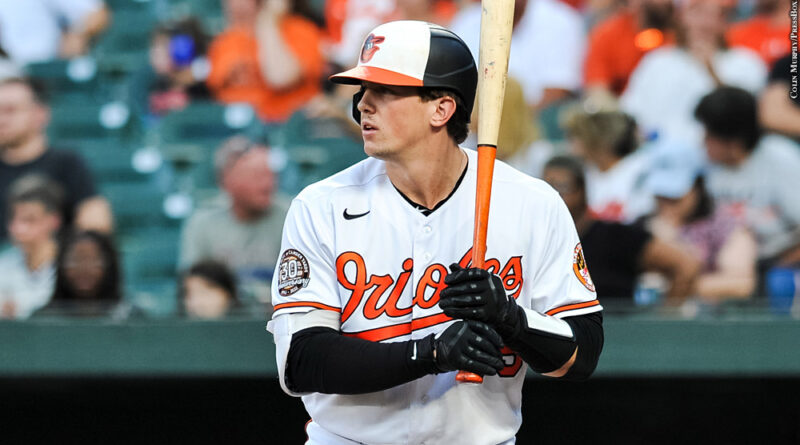
BetMaryland.com sports betting analyst Bill Ordine chatted with PressBox about why in-play wagering is popular in baseball, why the Orioles were so profitable for bettors last year and more.
This has been edited for content and clarity.
PressBox: How can fans have some fun betting on baseball?
Bill Ordine: If you’re a baseball fan, there is I think some real opportunity to enjoy the game and to use a cliché, have some skin in the game — skin meaning your own money — because of the fact that what are known as discrete events are very distinct in baseball. For people who are interested in gambling on a sport in a very granular way, meaning micro-event by micro-event, baseball is much more conducive to that kind of gambling. And remember, you could go to a casino … but you don’t have to do that anymore. You can stop off at a bar or crab shack or just go on home and wager on your cell phone or on your computer.
You can do that at a casino, too. If you want both the ambience of a big, fancy sportsbook with giant TV screens, you can do that. You can go to a casino and have the pleasure of the ambience and the high-tech spectator amenities and still use your cell phone to make wagers. Baseball, because of its pace, is really conducive to betting on more discrete events. It remains to be seen how much pitch-by-pitch gambling will go on, but certainly [bettors can do] inning-by-inning gambling and decide to bet on the game even after the game starts and one sees the flow of the game and is able to ascertain the game script.
PB: How has the new dynamic of starting pitching changed baseball betting?
BO: Going back to old-timey baseball betting, where you bet on the game itself before the event starts, pitching is still paramount but it is trickier now I think for gamblers because of the way baseball managers now choose to manage the game and to handle their starting pitchers. The olden days [are] you see the two starting pitchers who are matched up against each other and see what the odds are and the odds are predicated on those pitchers. You’re counting on the pitcher going six, seven, maybe even eight innings. That is a lot less the case these days, as we all know. When you make your wager and you are making your wager predicated on what the odds are relative to the announced starting pitchers, one has to be braced for the likelihood that those starting pitchers won’t go beyond five innings — sometimes less than that. That makes pre-event betting trickier for a baseball-wagering customer. I think it winds up leaning toward a baseball bettor becoming more engaged in the in-play wagering as the game unfolds and as the pitchers are shuffled in and out.
PB: What goes into deciding what direction to go on an in-play wager?
BO: One tries to divine who the next pitchers will be, who will come in. Sometimes that’s quite predictable. The habits of the coaching staff become predictable. But of course one has to take into account how much rest guys in the bullpen have had and whether or not they’re going to be used the following day, all those moving parts that people who are really into baseball understand. Those things can be applied to making decisions on wagering on the game. … I think the [possible] introduction of robot umpires, whether it’s an intended or unintended consequence, will have a byproduct effect of making wagering pitch by pitch more of a palatable betting proposition.
PB: What types of futures picks are popular for baseball bettors?
BO: The futures bets of specific teams paired up in the World Series will become pretty popular predicated on our friend Mattress Mack linking Houston and Philadelphia. That bet that he won on the Astros last year was an Astros-Phillies bet. I don’t think that prior, necessarily, to Mattress Mack that that kind of a wager was really popular among the masses. I could be wrong on that, but I don’t think so. I will say this: People are now aware that you don’t have to just pick Houston to win the World Series at certain odds or the Orioles or whomever. But if you think you’re smart enough, [you get] much higher payoff odds by linking two teams and picking a winner, and if you put micro amounts of a wager on a bunch of them, you could emulate Mattress Mack. As we look at futures betting in baseball, I think that that type of wager may become more popular among casual bettors because they saw this high-profile wager come in for tens of millions of dollars.
PB: Quite a few National League teams are rebuilding, meaning last year’s six playoff teams from the NL might all return to the postseason. Does this present an opportunity for bettors?
BO: It’s sort of akin to horse race betting where you might wheel a favorite horse or a couple of favorite horses with two or three other horses and bet a bunch of quinellas. You think, “I like these two teams in the American League and I like these six teams in the National League, and I’ll do that. I will just bet every one of those combinations for some amount of money.” … I think that makes for an interesting wager. It kind of brings in the horse racing approach to betting baseball futures.
PB: Why were the Orioles so profitable for bettors in 2022?
BO: This is not the first time this has happened with the Orioles. Back during that stretch when they were competitive and going to the playoffs, they did the same sort of thing. They were a moneyline darling throughout seasons. They did so for these reasons that got overlooked by the bookmakers, I was convinced. Their starting pitching was pretty lackluster, and the odds were predicated on starting pitching. However, the relief pitching was very good and the defense was excellent. Plus, they were a long-ball team. That’s what those teams were known for. A lot of those things, particularly the defense, isn’t really factored into creating odds by the oddsmakers, at least not back then. And a lot of the sins of the starting pitching staff, which is how the odds were predominantly posted, a lot of those sins were wallpapered over by a pretty decent bullpen and an excellent defense. … [In 2022], the fact of the matter is it just took the oddsmakers a while to wake up. Their over-under number was 62.5. Could it just have been that oddsmakers were looking at a regression to the norm? And [they figured], “Well, these guys are doing this well that this point but now they’re going to lose a whole bunch of games.” That might have been it.
Photo Credit: Colin Murphy/PressBox
Issue 279: February/March 2023
Originally published Feb. 15, 2023