
My favorite thing to do is ask questions.
Some people who work in this industry most enjoy going to games or rubbing elbows with “famous” people. Me? I love asking questions. My wife will tell you that what drew her to me (besides of course, being first runner-up for People‘s Sexiest Man Alive for five straight years) was that on the night that we met, I asked her lots of questions and actually remembered the answers.
I’ve had the great pleasure of interviewing some of the greatest athletes in both Baltimore and American history. I never take it for granted when I get those opportunities. But sometimes I have the opportunity to talk to a person I find even more fascinating than that.
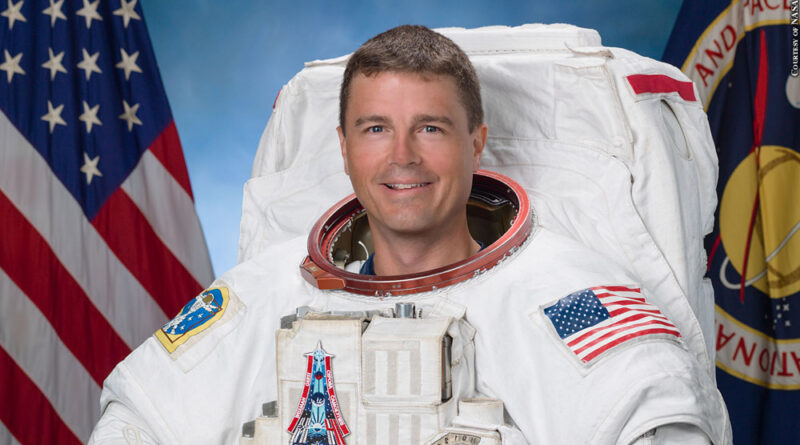
Reid Wiseman is going to the moon. The Dulaney High School graduate will be the commander of the Artemis II mission in late 2024, leading the first crew to travel beyond low Earth orbit since 1972 (Apollo 17). The gravity of those words (pun slightly intended) is as powerful as the rocket that will deliver Wiseman’s crew around the moon.
This isn’t the first time the Baltimore native has gone to space. But this trip is truly historic. The courage to lead such a mission is remarkable. I’ve spoken to Wiseman before, but this trip is so unique. I wanted to know more about his ambitions, his fears, and how his fandom of the Orioles and Ravens can genuinely help with morale while (literally) a world away from family and friends.
This interview has been edited for content and clarity.
PressBox: Congratulations is the first thing that comes to mind. I know this isn’t your first time, going to space, but how do the words, “You’re going to the moon,” strike you when you think about them?
Reid Wiseman: I think it’s still unbelievable to me, quite a bit. We have about 18 months of training ahead of us. I think as we step through that it will become a little bit more real. I was also at the Artemis I launch in November [2022], which was an uncrewed test flight of this vehicle out to the moon. And I know when that rocket left the pad at the Kennedy Space Center and you could see the moon deep on the horizon and the rocket started heading that way and it was a moment of, I couldn’t believe this. I wasn’t alive for Apollo and to watch that rocket start tracking out toward the moon.
PB: A scientist I am not. I’m just a guy who went to Perry Hall. Can you explain for dummies like me why we didn’t go to the moon for 50 years and why do we need to go to the moon now?
RW: We really want to see humans on Mars. We want to be expanding civilization, expanding the human footprint. We also want to be conducting science and research across our solar system so that we can better understand who we are as people [and] what our planet looks like. So if you want to put humans on Mars, the moon is a great first destination.
When we went in the 1960s and 70s, it was technological demonstrations, a little bit of science — actually a pretty robust science platform, and we were trying to achieve President Kennedy’s goal of landing humans on the moon and returning them safely by the end of the 1960s. And we did all of that. When you look at what we’re doing now, wanting to send humans to Mars, the first stepping stone is the moon. To go, to learn to work off of our planet, to learn how the moon was created, what it means for us on Earth and then on to Mars.
So it really is just a stepping stone. And I’ve been telling people, when folks first got on a ship and sailed across the Atlantic Ocean, I think everybody thought they were crazy. And now we get on a plane and we cruise across in a few hours and that’s what I think it will be in a couple of years as we’re heading on to Mars. You know, just jumping over to the moon. It will seem like nothing.
PB: You’re telling me this is real. We see this type of stuff in movies, like Matt Damon and “The Martian.” But you’re telling me that it’s real that at some point, you believe a human being could end up on Mars?
RW: We have rovers and helicopters on Mars right now. So, yeah, absolutely. One hundred percent, humans will be on Mars. We’ll be throughout the solar system. It’s going to take time, it takes money, it’s going to take some technological revolutions, but we will be there.
PB: I know you’ve talked about how the Challenger disaster sort of shaped your interest in space when you were a child. I wonder if you still deal with fears. For context, I jumped out of a plane for the first time a couple of years ago. I hadn’t dealt with anxiety or fear in a long time in my life, but I had a legitimate panic attack the night before and all I was doing was jumping out of a plane. Do you deal with any of that?
RW: Glenn, I have never jumped out of an airplane. So you plus-one me there. I like the way that you explain that. The night before you’re scared but then when it happens … I bet you are still scared! I don’t know. I think jumping out of an airplane would be quite scary. But I think that’s the right philosophy. A couple of days before anything, you get a little worried, you have fear, that’s normal. You don’t really want to say goodbye to your kids because that hurts you a little bit.
But then once you’re doing the act, it’s all about accomplishing the mission and I think those fears go away. You’re well trained. You trust the people who have created the machine that you’re operating, you trust the machine that you’re operating on and you trust your own capabilities and then you go get it done.
Everything that we do as humans is dangerous. Getting in your car and driving to work this morning was dangerous. But if we are not out there pushing the bounds and exploring and trying new things, then we’ve kind of given up and that’s not where we need to go.
PB: So when you’re going through some of those feelings, do you have to try to hide them because you don’t want anybody to know that you’re dealing with legitimate fear and you’re supposed to be the captain? Or are you able to be honest about it and talk through what you’re feeling?
RW: I think the honest route because I want to express my fears. It’s an age we live in where we can do that now. And I want to enable space for my crewmates to talk and for ground teams to talk. And if we’re all hiding our emotions, then you’re tamping out people who might want to say something. So I try to be as expressive as possible and let people know when I’m worried or when I don’t feel worried, I think it’s important to communicate.
PB: I talk to baseball players all the time and they are the most superstitious people in all of sports. They get three hits in a game and they’ll wear the same pair of underwear the next day. This is so much more significant than playing baseball. Do you have any superstitions when you go to space?
RW: Of course, I think we all have our own superstitions. I don’t know anyone who doesn’t. We will have a weightless indicator in the vehicle with us because we always fly with that. It’ll be something like a stuffed animal on a string so that when we see it floating, we know we’re in space. I do have some superstitions. I launched in 2014 on a Russian rocket and there were layers of superstitions involved in that. So there will be a few, but right now I haven’t quite sorted that out yet. I hope I don’t wear the same underwear three days in a row. But I might be.
PB: Can you tell us what they were on your last mission?
RW: I think one of the funniest things, I flew with this great Russian Maksim Surayev, he was my commander. And a few days before launch a black cat came out of the forest and ran across our path. And he turned around, I thought he was not gonna fly! I mean, he was really shook. It was horrible. And then two days later, a dragonfly flew by and landed on him and he was like, “Oh, that clears the cat superstition, so now we can go fly.” And he was one hundred percent serious.
PB: We know you’re an Orioles fan and a Ravens fan. I know this sounds silly and trite, but when you’re on a mission, you are literally at work 24/7. I imagine that can get monotonous or at least difficult, the toll of being away from your family. Does being a sports fan and checking in to find out what the Orioles did the night before legitimately help with navigating some of those feelings?
RW: One hundred percent. When I was on the space station for six months, the Orioles started sending up four-minute recaps of the games and I would watch them in the morning and, you know, I can’t really talk about the weather with my dad or my kids, but I can talk about the game and I can try to follow something. And as humans, we want any sort of connection. We’re social creatures and we want that connection.
Even when I was training in Russia I was watching the Ravens play. I would stay up really late or get up really early to watch them. So that sort of connection back to home, it really means something. That’s awesome.
PB: Orioles assistant general manager Sig Mejdal worked at NASA. Have you ever connected in any way? And do you have an understanding of how experience with NASA could help with what the Orioles have done in putting together this rebuild?
RW: I love watching this team rebuild. I have not met Sig. I will have to change that. But NASA is a team sport. Going to space is a team sport. We have a crew on the vehicle and then we have an enormous support team in Mission Control in Houston that are doing their absolute best to keep us alive and keep the vehicle achieving the mission.
And I think that looks a lot like the Orioles or the Ravens. You know, you’ve got these key players out on the field, but then you’ve got everyone in the dugout, everyone on the sideline, everybody in management and you’re all trying to achieve the same exact goal which is to bring home that world championship.
Photo Credit: Courtesy of NASA