
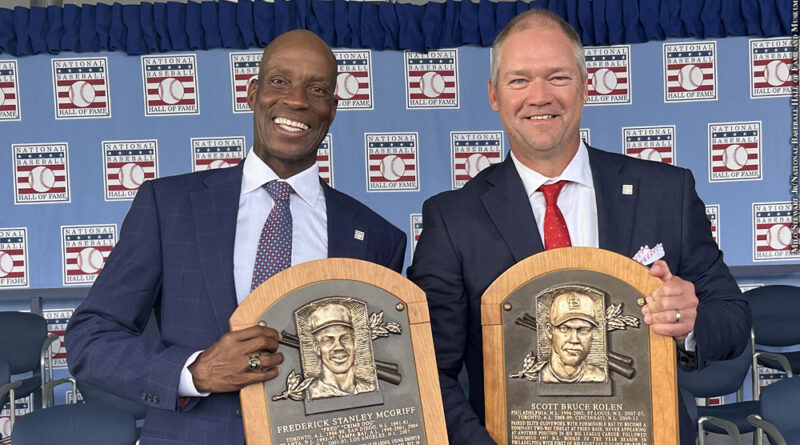
COOPERSTOWN, N.Y. — It will stand as one of the smallest classes in history and played out in front of the smallest audience in recent memory, but there was no disappointment, only praise, echoed from both sides of the stage as Fred McGriff and Scott Rolen were enshrined in baseball’s Hall of Fame during the July 23, 2023 induction ceremony that was as powerful as it was emotional.
There was a strong message that weaved its way through the speeches of the inductees that clearly resonated with the estimated crowd of 10-12 thousand that made up for size with a heavy dose of enthusiasm. “Never give up on your dream — and stay true to yourself,” was the theme of the day, and it was very well received.
Both McGriff and Rolen had to endure varying degrees of patience before receiving the highest honor of their profession. McGriff had to wait for a unanimous vote of confidence by the Contemporary Era Committee after having fallen short in his 10 years on the ballot of the Baseball Writers’ Association of America, while Rolen needed six years on the active ballot to reach the plateau.
The wait hardly dilutes the joy of the achievement.
“Honestly, I would have been happy to play one game in the major leagues,” McGriff said during his remarks as the ceremony’s leadoff hitter.
“At no point in my lifetime did it ever occur to me that I would be standing on this stage,” Rolen said.
Between the two of them, the ’23 inductees played on nine different teams, six for McGriff, four for Rolen — with the Toronto Blue Jays the one team they share. In retrospect, even though their careers weren’t concurrent it’s almost surprising they weren’t teammates at some point.
Both were involved in several trades along the way which, combined with the number of teams they played on, is cited as one reason why it took a longer than normal time to reach the pinnacle of their career. A more significant reason is probably the time. In each of the years McGriff and Rolen were eligible, there were multiple eventual Hall of Famers on the ballot.
Whatever the circumstances, it quickly became obvious that the wait was more than worth it.
“I dreamed of playing in the big leagues,” McGriff said. “This is icing on the cake.”
As part of his journey, McGriff was acquired, and traded, by two Hall of Fame general managers: Pat Gillick, who later served as Orioles GM (1996-98), and John Schuerholz, native Baltimorean whose career started in the Orioles’ front office.
Gillick was a member of the front office when the Yankees drafted McGriff in 1986, and later brought him to Toronto via a minor league trade. It was with the Blue Jays that he hooked up with Cito Gaston, then the hitting coach.
“Every day we hit, and hit and hit,” McGriff recalled. “That’s all we did.”
After being traded to San Diego, McGriff watched and learned from Tony Gwynn, then went to Atlanta and teamed with a host of Hall of Famers to win a World Series title in 1995. He later moved on to his hometown Tampa Bay Rays, where he teamed with Wade Boggs, who convinced him he should look for a fastball in every at-bat.
“I tried it and it worked,” he said.
In his career, McGriff hit 30 or more home runs 10 times for five different teams, both feats unprecedented, and went on to carve out a 19-year career. Not bad for a guy who was cut from his high school baseball team as a 10th-grader.
McGriff, blessed with one of those smiles that lights up a room, with a personality to match, was both emotional and humorous during his speech, crediting parents who never pushed, but “encouraged” his participation in baseball. And he credited being cut from the team as a 10th-grader as “the spark that ignited the fire” that drove him throughout his career.
Rolen’s path to the big leagues may have started with his failure on the basketball court. A proud Indiana “Hoosier” recalled expressing his frustration to his father, Ed, about his shortcomings on the court — dribbling, passing and shooting.
“You told me what you can’t do, but what can you do?” was the question he got in return. When Rolen listed some things he did bring to the court — defense, rebounding, hustling for loose balls, he got this advice: “Well, do that, then.”
It became his driving mantra to never be outworked or underprepared.
“‘Well, do that, then’ carried me to the minor leagues … and eventually put me on this stage today,” he said.
“I dreamed of being a major league player, but I wasn’t raised to be [one]. I was raised to be honest, work hard, be accountable for your words and actions and treat people with kindness and respect. My role models lived in the same house as me.”
As he wound up his speech, Rolen said: “Well Dad — I did that, then.”
In his own way, so did McGriff. It was only fitting that these two, overlooked but not underappreciated, would share the stage. Expectations and/or explanations were no longer necessary.
McGriff and Rolen, finally, could share the same honor. Hall Of Famers.
* * *
The Hall of Fame weekend program got underway on Saturday, July 22, with three prestigious awards.
John Lowe, longtime MLB “beat” writer whose career took him coast to coast, from California to Philadelphia, and peaked in Detroit, was the creator of the often controversial “quality start,” which has become a widely accepted, though technically unofficial, statistic that has become a part of baseball’s daily records.
Lowe, who retired from the Detroit Free Press shortly after the Tigers lost to the Orioles in the 2014 American League Championship Series, was honored with the BBWAA’s Career Excellence Award for meritorious contributions to baseball writing.
In his acceptance speech, Lowe told the story of asking his mother to pick him up from school so he could hear the first game of the 1966 World Series, between the Orioles and Dodgers, from the very beginning rather than risk missing the first inning during the time it would take him to walk home. “Because of that I was able to watch the home runs by Frank and Brooks Robinson in the first inning,” he said.
Throughout his career, Lowe was noted for his persistent attention to detail, perhaps never more evident than that day — when he was in the second grade.
Longtime Cubs announcer Pat Hughes, whose career first surfaced with his sidekick role to the legendary Bob Uecker with the Milwaukee Brewers, was honored with the Ford C. Frick Award for major contributions to baseball broadcasting.
Former Dodgers pitcher Carl Erskine was the recipient of the Buck O’Neil Lifetime Achievement Award, presented no more than once every three years. Among the previous winners of this award were O’Neil himself and legendary baseball executive Roland Hemond, whose resume includes a stint as general manager of the Orioles from 1988-1995.
* * *
Each year as part of the induction weekend the attending Hall of Famers have the chance to meet with commissioner Rob Manfred, an event that reportedly hasn’t always gone as well as either side would like. But from all indications this year was a welcome difference.
In the past, some Hall of Famers have been vocal in their criticism of the game, from both playing and management standpoints. But the tone seemed to change this year, with positive vibes evident throughout the weekend.
More than one veteran of trips to Cooperstown described the annual dinner as “the best ever,” an indication of harmony that hasn’t always existed. The improved pace of the game, generally attributed to the pitch clock, but at least partially because of the enforced 2-minute, 15-second time limit between each half-inning seems to have been favorably received.
In addition, there is a belief that some of the rules implemented after the COVID pandemic might be relaxed — particularly the “ghost” runner rule utilized during extra innings. For the most part, managers are believed to be almost unanimous in their dislike of the rule, a feeling shared for the most part by Hall of Famers who have been vocal in their distaste for the modern tendencies of the game — especially the severe pitch and innings limits on pitchers today.
It’s hardly unusual for previous generations to question modern tactics and that’s not likely to change anytime soon. But there remain some serious reservations about how today’s players, especially pitchers, will be graded when it comes to Hall of Fame qualifications.
The changes, mostly dictated by heretofore unavailable or unwanted analytics, have led to drastic changes throughout the last two decades. Banning certain defensive tactics and introducing a clock of any kind is still not acceptable to some hardliners, but as changes are instituted and players adjust, MLB is hoping a younger fan base will be receptive.
If this week can be taken as any indication, MLB is hoping that reception extends to the game’s legends — the Hall of Famers.
Jim Henneman can be reached at JimH@pressboxonline.com
Photo Credit: Milo Stewart Jr./National Baseball Hall of Fame and Museum