


When he was introduced as the new GM of the Baltimore Orioles in November 2018, Mike Elias inherited a team that had just lost 115 games. He did, however, have the No. 1 pick in the 2019 MLB Draft, and we all know how it’s worked out since then.
Elias has built one of the most talented organizations in baseball through the draft. Names like Adley Rutschman, Gunnar Henderson, Jordan Westburg, Colton Cowser, Jackson Holliday, Heston Kjerstad and Coby Mayo are now synonymous with what Elias has built.
But perhaps it was an unassuming man from Santa Rosa, Calif., who was Elias’ best pick. Manager Brandon Hyde was hired by the Orioles in December 2018, and he has created a culture that doesn’t tolerate fundamental mistakes.
Veteran right-hander Kyle Gibson, who pitched for the Orioles in 2023, told PressBox that Hyde “embodies the culture” the Orioles worked to create, holding himself and his players accountable.
“He’s the same guy every day,” Gibson said. “Sure, does he get frustrated when you lose and when mistakes are made, yep. But he is going to be your biggest fan and he is going to be an advocate for you when you have a bad game or when times are thin. Players really, really appreciate that out of a manager. When you feel like you’re having a bad game, a few-bad-games stretch and you don’t get your back turned on, that goes a long way.”
As the talent improved, so too did the results. The Orioles went 101-61 in 2023, the club’s best record since 1979, and took home the AL East crown for the first time since 2014 — all after losing 110 games in 2021 and 108 in 2019. Hyde is the first manager since Connie Mack to lead a team to 100 wins after losing 100 games with that same club. As such, Hyde became the fourth Orioles skipper to win American League Manager of the Year.
PressBox follows suit by recognizing Orioles manager Brandon Hyde as the 2023 Mo Gaba Sportsperson of the Year. Hyde spoke with PressBox’s Stan “The Fan” Charles and Glenn Clark in November about building a culture, his relationship with Elias and more.
This has been edited for content and clarity.
PressBox: When you were hired by the Orioles in 2018, had you interviewed with any other teams? What attracted you to Baltimore other than wanting to manage in the major leagues?
Brandon Hyde: I had never interviewed for a manager’s job prior to that offseason. I was the bench coach in Chicago for Joe [Maddon]. We lost the wild-card game in extra innings to the Rockies. The next day, I got phone calls from our front office in Chicago saying that there are going to be some teams that are interested in talking to you. I hadn’t put any thought into it. I hadn’t prepared. I had done nothing. I was upset about our season being over. These are guys I had been with since 2012, so I was in no hurry at that time.
I remember the first call. I took the interview without expecting anything. I kind of knew someone else was going to get the job anyway, but I did it for the experience. When that happened, I had three other teams call to interview me. I was, I think, one of the two [finalists] for all three of those. They picked somebody else for those other three, so I thought possibly I was going to have one of these three jobs — or a couple. I thought I was going to have to make a choice. It didn’t work out.
I went home. I called Joe and Theo [Epstein] and everybody and just said, “I’m good.” That was literally three weeks straight of interviewing for a managing job, which I had never even prepared for. It’s quite a process if you ever hear about it. I went home. I was exhausted. I just wanted to relax. I was super excited to be in Chicago still.
Well, then Mike got the Orioles job and I got a phone call from Chicago maybe a week or two later saying, “Hey, we’re hearing that Mike wants to interview you for manager.” I was kind of already in offseason mode at that point because I had just been through the ringer for about a month. I took the interview because I just honestly wanted to hear what Mike had to say.
I loved what he had to say. We had a great day together. I met Mike. I met Sig [Mejdal]. We had dinner. They were very, very transparent of where this organization was at the time, how long it’s going to take to get to where we need to go. I appreciated the patience in that and knew that they had done special things in Houston. And I was ready to be a part of it. When Mike offered me the job, I took it.
PB: Did you get a sense of how many years this rebuild would take?
BH: I don’t think we put a number on it, but I thought the Cubs one was extremely fast. That was three years and then in ‘15 [we made it to the National League] Championship Series — so ‘12, ‘13, ‘14 and then in ‘15 got good. For me, that would’ve been like if all things align. And we pretty much were pretty close to that.
PB: In your initial conversations with Mike, how was the role as manager outlined?
BH: I was the farm director [for two years with the Cubs]. Prior to that, I had never been in a front office before. I had always been a minor league coach, then I was a major league coach and then I went to Chicago and ran the farm system for two years. But I was privy to [a lot]. One year they were interviewing for a major league manager. I was involved in those. I was involved in 40-man decisions. I was involved in trade deadline stuff. We were rebuilding at that time, so I saw Theo’s blueprint on what they were going to do and how they were going to do it. So I understood separation a little bit.
Listen, I don’t want any more responsibility than I have, I’ll be 100 percent honest. For me, I put trust in the people that are making good decisions above you. Mike puts trust in me in making the decisions from a game standpoint and the roster. I have a lot to deal with [regarding] the 26 players on our team as well as the 10, 12 coaches and the 60 to 70 people that we travel with every series.
There has to be a lot of trust back and forth because not one person can do everything [through] a dual role. This isn’t Jack McKeon in 1984 with the Padres — who I love, by the way, as you guys know. This is a major corporation, organization that needs people just to kind of stay in their area and trust others to work because you just don’t have enough time. I put a lot of trust in Mike and I think Mike does in me as well.

(Photo Credit: Courtesy of the Baltimore Orioles)
PB: When we spoke to you before the 2021 season, we talked about how managers from a rebuild often don’t get to see things through. And you had said then that you understood that might be the case here in Baltimore. Before it turned, did you ever think about, “Hey, what might happen here? Where might I be next?” When did you think, “Hey, I’m going to be here, I’m going to be allowed to see this thing through?”
BH: Even in those tough years — ‘19 and ‘21, especially — Mike showed a lot of confidence in me. At the end of the season, when we sit down and meet … our conversations were about the future going forward. I never got any indication from him or thought from him or idea from him that, “We better win and we better win soon or I’m in trouble.” I didn’t have that feeling. He never portrayed that to me. He really talked about us going forward. We talked about the coaching staff. We talked about offseason decisions we were going to make going into the next year. We talked about two or three years down the road.
So I always had every indication that he liked what I was doing and that I was going to be sticking around until we turned this thing around. For me, that was just confidence that he showed in me, that he believed in what I was doing and knew that we were behind the 8-ball those first three or four years. He was very patient about that, but I think he liked the process [regarding] how we went about things on a daily basis. He just knew that we weren’t as talented as other teams.
PB: Outsiders have pointed to Adley Rutschman’s arrival as when everything turned. In looking back at the last year or two, did you have any other moment where you felt everything changed here?
BH: For the 2023 season, I think the series in Tampa [in July] when we went in and won three out of four there. [Félix] Bautista and [Yennier] Cano pitched in three of those games. We always had a tough time playing there. It was close [in the division] at that time. But going on the road and winning in the fashion that we did against a really good team and beating them three out of four to then go into first place for me gave our team a lot of confidence for the rest of the season. So for me, the 2023 turning point was kind of that series. We were playing good baseball up until that point, right there in the thick of things, but then that series kind of solidified that we were real, for me, around the league.
In 2022, for me, [it was] when we won 10 in a row. That was a special achievement, especially with where we were in the season. That really put us on the map. We started getting some national headlines. People started talking about us a little bit and realizing that we were a really talented team. I don’t think that people realized it up until that point when they started to hear about us a little bit, winning 10 games in a row and a lot of those games on the road. For me, that was kind of a “we’re on the map” moment.
PB: Have you had a moment to reflect on the totality of the rebuild, considering how bleak it was when you got here?
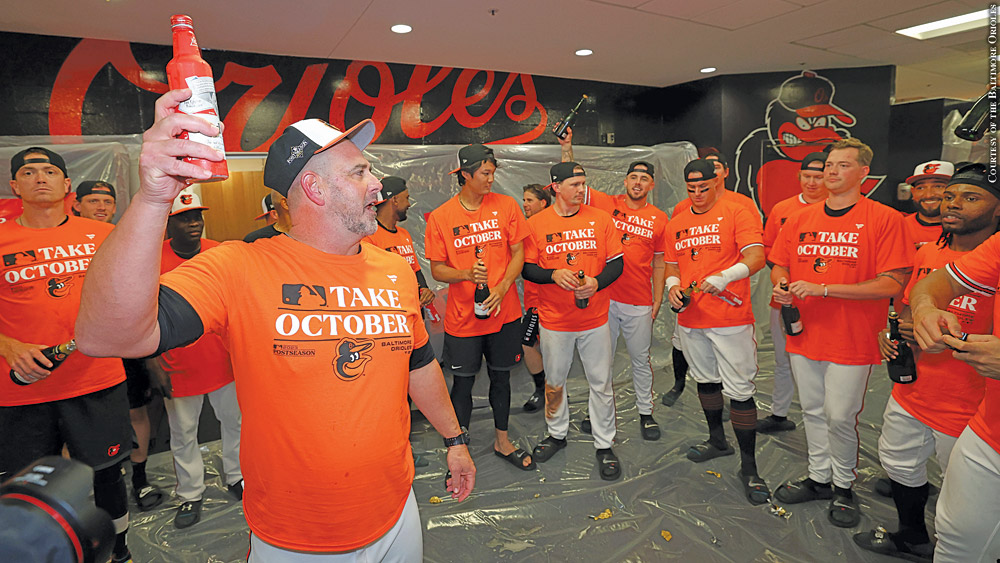
BH: I don’t think as much as people think. You’re continuing to work every day. During the season, I’m not thinking about it at all. I’m thinking about the night’s game or the next night’s game. Even when the season was over, I was mad after the season for a while and still frustrated by some things. For a short period of time, when we clinched a playoff spot and seeing how our team reacted to that — which, I didn’t know we were going to react that way, honestly. I didn’t know that it was going to be “Animal House” in our clubhouse after we clinched a playoff spot with still some of the season left.
(Photo Credit: Courtesy of the Baltimore Orioles)
We hadn’t really set it up that way team-wise because we had to get on a plane to go play Houston that next night. But to see how organic that was, it was just impulsive how it happened. We were going to have champagne. We weren’t going to have much. We were going to celebrate, but not too much. What do you do? You’re facing [Justin] Verlander tomorrow night. We still have a lot of season left. The team that’s chasing us is going to walk down the hall to get on the bus because they’re flying out, too.
But our guys just didn’t care. Our guys straight-up felt like they deserved to celebrate. And they had every reason and every right to. So for me to sit back a little bit in that moment and just watch that, that’s when I realized, “Wow, it’s come a long way in a couple years.”
PB: Which player during the last two seasons had the biggest impact on creating the culture we have seen with this team?
BH: Robinson Chirinos, and it’s not even close. He was [37 or 38] years old. He knew he was kind of at the end. He had a heck of a career. I managed against him in 2007 in the Southern League. He was a shortstop — Double-A shortstop with the Cubs in 2007 in the Southern League. They converted him to catcher that next offseason, so that would have been ‘08. I saw him in A-ball as a catcher.
He helped change the mindset of a lot of our players single-handedly. He was so strong in convincing them that they were better than they thought, I think, and that we need to come to the park expecting to win. We’re talented enough to come to the park expecting to win. He was unbelievably outspoken in our hitters’ meetings. He guided our pitching staff incredibly in a lot of ways. He helped Adley [Rutschman], understanding what it was like to be an everyday catcher and the professionalism behind the plate.

(Photo Credit: Courtesy of the Baltimore Orioles)
But it was just the way he came to the park every day with an unbelievable attitude expecting to win — and would be open about it — and then be pissed if we lost. If we lost, he was angry — whether he played or not. Other guys seeing that, our guys hadn’t seen what a winning player looks like, I’ll be 100 percent honest. These guys hadn’t played with playoff players. It’s a totally different game and different feel when you’re expecting to win because then there’s accountability that takes place with everybody. If you don’t win a game because of certain things, well, guys might be annoyed by that — and Robbie wasn’t afraid to talk about it. That single-handedly changed our team.
PB: How do you govern the team’s culture?
BH: That was my biggest challenge my first year. I knew we were going to be bad, and I had a lot of things that I had to deal with roster-wise. We had so many guys that were DFA’d from other teams. I would always get asked, “How come you guys don’t play better defense or run the bases better?” Well, six of our starters just came off waivers and we have two Rule 5 picks in the lineup tonight. It wasn’t realistic, but I wanted the clubhouse to at least be a place that they enjoyed to be at because it’s miserable if it’s not. If you’re losing and the clubhouse stinks, you dread going to the park. You dread your job.
I at least wanted them to enjoy going to the park. By getting some players around me that I thought might have a chance to be here for a few years, [I could] wrap my arms around them a little bit and talk to them about culture and how important it is clubhouse-wise. “Let’s do a fun road trip, let’s do certain things,” that helped.
Now it’s great because I’ve handed it off to them a couple years ago. When I got Chirinos and [Rougned] Odor and Jordan Lyles and [Trey] Mancini and these guys in the clubhouse, that’s the best thing — when the players run it. I think that they always throw ideas at me. “What do you think about doing this?” And usually I say, “Yes, let’s do it.”
I’m more now overseeing it without having to give ideas all the time, which is the best. Then it’s run by the players. When you’ve got the right players running it, when your better players are running it and they play the game the way they do, then you have a good culture.
PB: Do you ever have to tighten that up? Do you ever have to step in and say, “Hey, I think we’re a little too loose right now?”
BH: Loose? No, I think it’s usually the other way a little bit. Our team, I think guys put too much pressure on themselves. You almost want to get them to relax a little bit, but that would more come from one-on-one conversations. I don’t have a team meeting saying we all need to relax more, but I do little things. I have them show up late sometimes. I think our guys are very, very aware of work days, but also I feel like I have a good feel for when to pull the reins or loosen the reins. We just came off a 10-day trip and it’s 106 degrees, it’s a 4:30 show the next day and make sure you get some rest. I’ve been in the big leagues for 12 or 13 years, I kind of have a pretty good feel for what a player needs on a daily basis.
PB: You replaced a very popular manager at a time when the team was very bad. What has it meant to you and your family to feel the full embrace of this community the past couple of years?
BH: That wasn’t something I understood very well. If you’re not very good, it’s going to be tough with fans. That wasn’t my big concern, honestly. But just to see the reaction around town, that’s been the most enjoyable [thing] for me. To hear people say, “Hey, we really enjoy watching your team play” — I started hearing that a couple of years ago — to people just saying nice things if you walk into Starbucks or something. People saying, “Good luck tonight,” or, “We’re pulling for you.” — those types of things that really didn’t happen my first couple years. That’s always such a nice thing. I live right in that area, right downtown, too, so to kind of be involved a little in that community. When I have a chance to have dinner or in the morning getting coffee, just running into people that say really nice things.
PB: When you look back at what happened to the team against Texas, is it easy enough to just say, “We were a young team that really hadn’t met adversity that will now fuel us for the future?” Was it that the Rangers were a better team? Or was it a combination of both?
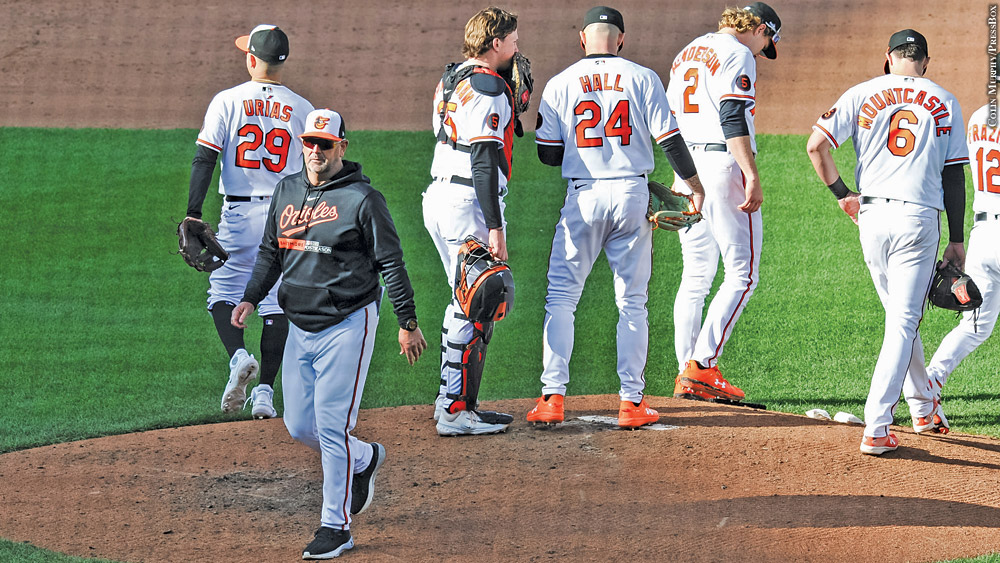
BH: I think a little bit of both. That’s a veteran team, and Corey Seager has been doing that for a while, right? I think that experience helps, there’s no doubt about it — having that type of experience that they had on the field, what they had on the mound. In Game 3, we faced [Nathan] Eovaldi. This guy is one of the best postseason pitchers of the last 30 years, so we kind of ran up against it from that standpoint. I didn’t feel like we were playing our best baseball the last two weeks of the year, either. I was hoping guys would come out of it offensively a little bit and kind of get hot going into the playoffs. We were OK, but we weren’t playing at our best.
(Photo Credit: Colin Murphy/PressBox)
I think the layoff hurt us, too. That layoff was a lot, and that’s something we’re going to have to get used to because I’m hoping to win the division again next year so hopefully we’ll have five days off again. Maybe I can change things up a little bit from what we did. I think that’s something we need to talk about. I thought we did the best we could, but maybe we need to make some changes. Maybe that’s on me.
But for me, we just didn’t play our best baseball. These guys ended up winning the World Series because they were playing great. I think what helped them is they lost that Game 162 and were pissed. [They] went to Tampa and scored a ton of runs, didn’t give up any and came into us feeling really good about themselves with a little bit of a chip on their shoulder. They hadn’t been home in two weeks. So, we just kind of ran into a buzz saw.
PB: At this year’s 40th anniversary celebration, Al Bumbry said he believes the 1983 Orioles were fueled by what happened in 1979 and 1982. Do you think that what happened against Texas left a bad taste for your players in a positive way?
BH: I do. There’s no doubt. I do. I think everybody wasn’t ready for the season to be over and wanted to show everybody how good we were, and we didn’t do that. Our clubhouse was pretty sad, honestly, that night in Texas just because it felt like it went way too fast and we had more baseball left to play and unfortunately our season was over. I think it’s going to fuel them into next year.
Photo Credits: Colin Murphy/PressBox and Courtesy of the Baltimore Orioles
For more Best Of, visit PressBoxOnline.com/BestOf.