
I woke up a bit late on Thursday, April 4, but when I got up, I had several texts, all with Triple-A Norfolk’s box score from the night before. As I wiped a bit of groggy out of my eyes, the numbers started to sink in: Heston Kjerstad, 10 RBIs and two homers; Kyle Stowers, seven RBIs and three homers; Coby Mayo and Heston Kjerstad, five hits apiece, and Jackson Holliday, four hits. The Tides won, 26-11, at Charlotte.
At the same time, major league veterans like Austin Hays, Cedric Mullins and Ramón Urías were off to slow starts.
I don’t shine a light on this to say that somehow the prospects off to hot starts at Norfolk should have taken the places of the struggling veterans a week into the season. But we all know the clock is ticking on as pleasant a problem as any major league team I can recall has had to deal with. The Orioles have an almost unheard-of issue of having a pipeline that is so fully stocked with major-league-ready players who frankly are poster children for something that is unfair for their careers.
Holliday is 20 years of age and we know he’ll be in The Show for a long time now that he has been promoted. But Kjerstad is 25 years old and had the misfortune of losing the 2021 season due to myocarditis and a chunk of the 2022 season due to a hamstring strain. He is still putting the finishing touches on his development and doesn’t have Holliday’s five extra years to make money.
The same is true of Stowers, who is already 26. In fairness, he just didn’t play very well at the major league level when given the opportunity the past two seasons. But he hit seven home runs in spring training and seems ready for another chance. And can you explain to me how Connor Norby, 23, will fit in with Holliday, Gunnar Henderson and Jordan Westburg blocking him?
Oh, he can play a corner outfield spot, you say? Aren’t those likely landing spots for Kjerstad and Colton Cowser?
I haven’t even mentioned Mayo, who is going to be a consensus top-five prospect by the All-Star Game and figures to play first or third base long term.
The key to watch with how the Orioles get this gaggle of players sorted out is how much money the veterans start to make. It’s really not going to be a hard argument for GM Mike Elias to make, even if new owner David Rubenstein figures to be a little looser with financial resources on the payroll side of the ledger.
Anthony Santander is just shy of 30. He’s a player a lot of teams would love to have. He is making $11.7 million in his final year of arbitration. I love the player, but he will most likely leave via free agency after the 2024 season. A trade would have made sense if the Orioles were still rebuilding, but I think he’ll be a bit busy helping the Orioles this summer.
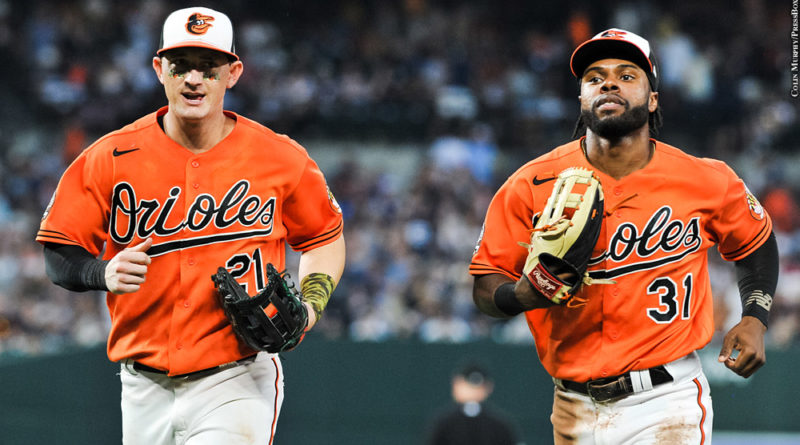
Mullins, 29, and Hays, 28, have been teammates all the way from Double-A Bowie to Camden Yards. And make no mistake about it, both have helped mightily in taking the Orioles from the 52-win days to the 101-win days. Both are making about $6.3 million in 2024 and have one season of arbitration remaining. That makes them very vulnerable for the long haul. Both will still play a big role in determining whether 2024 is a positive follow-up to ’23 or a slight fallback.
In the infield, there is just one player who falls into the Hays-Mullins category. First baseman Ryan Mountcastle is 27 with three-plus seasons of service time. He is making roughly $4.1 million this season and still has two years of arbitration remaining. The better he plays in 2024, the more his trade value increases.
Any general manager is rooting hard for all of his players to have big seasons because big seasons by key contributors can make a huge difference. As such, Elias will be rooting hard for Hays, Mountcastle, Mullins and Santander.
But the clock is ticking. Those down on the farm in Norfolk are playing like they all have a giant chip on their collective shoulder.
Photo Credit: Colin Murphy/PressBox