
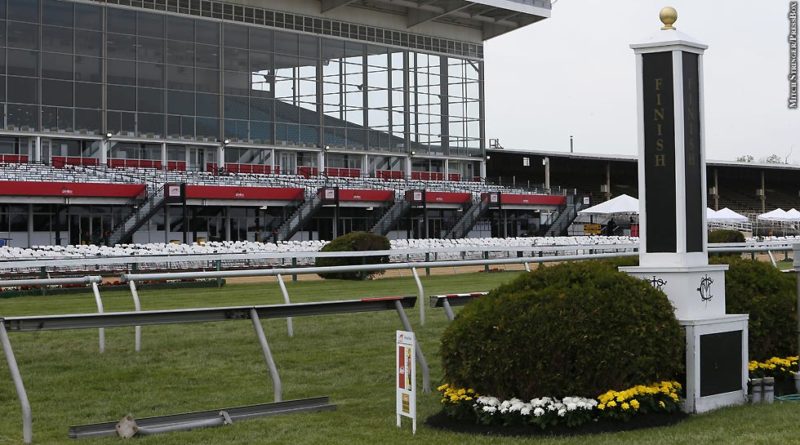
This marked the third consecutive year the Preakness Stakes featured nine or fewer horses, leading some to wonder whether the Preakness should be moved back to allow for more recovery time for Kentucky Derby horses and thus create opportunities for bigger fields.
Count NBC race caller Larry Collmus as one who sees merit in moving the Preakness back. The race is traditionally held on the third Saturday of May, two weeks after the Derby. One exception came in 2020, when the Preakness was held in October, about a month after the Derby, due to the COVID-19 pandemic.
Eight horses ran in the Preakness this year, with Seize the Grey coming out on top and Derby winner Mystik Dan in second. It was unclear in the days following the Derby whether Mystik Dan trainer Kenny McPeek would run the horse in the Preakness, a common theme in recent years. In 2022, Derby winner Rich Strike skipped the Preakness to prepare for the Belmont Stakes.
Collmus, a Baltimore native and Mount Saint Joseph graduate, has come around to the idea of a later Preakness and notes that all sports evolve throughout time.
“I think that because of the way horses are trained and the fact that they’re used to taking more time between races — four to five weeks — and now you’re asking them to do this during the Triple Crown, it just doesn’t make sense anymore,” Collmus said on Glenn Clark Radio May 17. “I would hope that the three tracks could one day get together and say, ‘Hey, let’s map out a new schedule, let’s do it this way,’ and it’ll be better for the game. Not only would you have a better Preakness field, but you’d have a better undercard with all the other races, because all those horses that ran on Derby Day can come back and come to Pimlico.”
Trainer Bob Baffert has won the Preakness eight times and did it with a Derby-winning horse in five instances: Silver Charm (1997), Real Quiet (1998), War Emblem (2002), American Pharaoh (2015) and Justify (2018). Baffert believes it takes a superior horse to handle the two-week turnaround — and he’s fine with that.
Baffert appreciates the tradition that comes with the quick turnaround and worries that the Triple Crown would lose some luster with longer waits between races.
“They’d probably have bigger fields if they did that,” Baffert said on GCR May 17. “Maybe it’ll work, but I think it would lose the excitement of it all. It’s not going to feel like the Triple Crown. It’s just another big $2 million race.”
Baffert, though, understands why some are pushing for more time between races, even if he doesn’t necessarily agree with them.
“Analytics have come into horse racing where if you give him a month, he’ll perform better,” Baffert said. “… Everybody would just automatically go to the Preakness. That was part of the show. But now, these trainers don’t want to run if they’re 10-1 or 20-1. They’d rather just wait for the Belmont or something like that instead of taking a chance. Old-school guys, if our horse is doing well, we’re going to take a chance and run him in the next one.”
Collmus was on Baffert’s side until recently, and he credits NBC horse racing analyst Randy Moss for helping convert him.
“I think that most people are starting to change their tune, me being one of them,” Collmus said. “I know Randy Moss has been on top of this for quite a long time saying it has to change. I’m like, ‘Ah, I don’t know.’ And now I’m like, ‘Yeah, you’re right, it does.’ It’s just that time.”
For more from Baffert, listen to the full interview here:
For more from Collmus, listen to the full interview here:
Photo Credit: Mitch Stringer/PressBox