
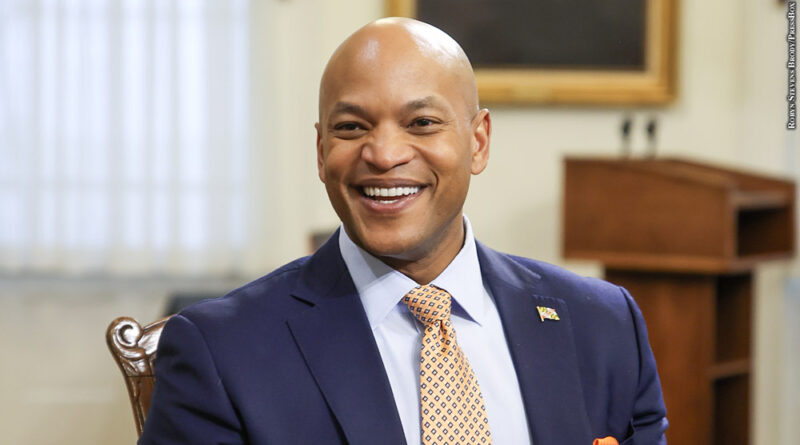
Almost immediately after taking office as the 63rd governor of Maryland, Wes Moore was thrust into one of the more highly-charged sports issues in recent Baltimore memory.
Fears of the Orioles moving may have been unfounded, but many Marylanders expressed frustration about how lease negotiations lingered into the 11th hour before a new 30-year pact was agreed to in December 2023.
The state now has to continue negotiations toward a land rights arrangement with new team owner David Rubenstein. And there is more than a billion dollars worth of public money that has been pledged to the Orioles and Ravens for stadium upgrades.
Moore is no stranger to the sports scene. He played two seasons as a wide receiver at Johns Hopkins after an injury cost him a spot on the Blue Jays’ basketball team. He averaged 25.2 yards per catch and had two touchdowns as a senior. The governor continues to draw on some of the lessons he learned from his athletic career while dealing with his first true crisis as governor, the collapse of the Francis Scott Key Bridge in March.
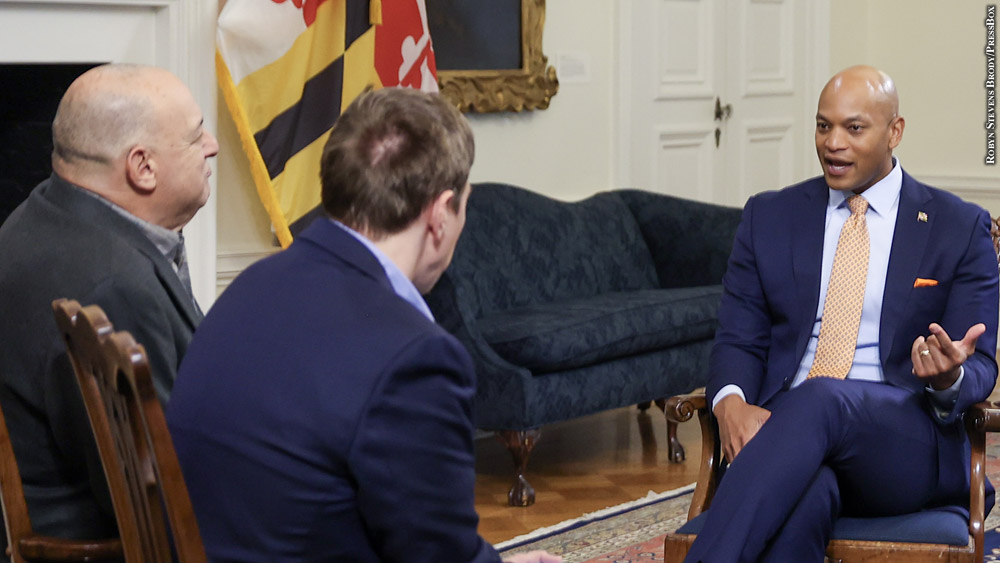
Gov. Moore sat down with PressBox’s Stan “The Fan” Charles and Glenn Clark at the State House in Annapolis in May to discuss these topics, the impact of the “Pimlico Plus” plan on the future of the horse racing industry in the state and why he wouldn’t have been capable of replicating Lamar Jackson on a scout team.
This interview has been edited for content and clarity.
PressBox: The Key Bridge collapse was really your first crisis as governor. Given your time as an athlete, did you fall back on any of that in handling this crisis?
Wes Moore: Very much so. I think partially it’s because I grew up playing team sports. The thing I love about team sports is you could do everything right [but] if your team is not locked in, you guys are going to lose. I don’t care how good you are. You could be the best wide receiver in the world. If you don’t have a good quarterback to throw you the ball, if you don’t have an offensive line that can protect that quarterback, if you don’t have a good running back who can go out there and hopefully get some yards so everybody’s not centering on you, [you are going to lose]. … If you have the best offense in the world and your defense keeps on giving up 50, 60 points a game, congratulations on being a great wide receiver.
I think the thing that I very much leaned on during the bridge crisis and frankly every single challenge that I face as governor is this is a team sport. The most important thing that I can do — and the most valuable time that I spent — was actually during the transition period. Build the right team. Get the right cabinet secretaries. Make sure you get a world-class chief of staff. Make sure you have deputy chiefs of staff. Make sure you have your [communications] team. Make sure everybody is locked in because if you do that, there’s nothing that you are going to face that is going to be insurmountable. There’s this great speech that I heard before where he said, “Don’t ask for easy. Ask to handle hard better.” I think that’s very much what it’s like being governor. I don’t ask for easy days. I don’t get easy days.
PB: Is there anything you heard from a former coach that stays with you as you take on this challenge?
WM: Oh, definitely. My wide receivers coach was a guy named Chris Ogeneski. This is at Hopkins. It was really cool because he was actually a trader for Deutsche Bank. When he left work, unlike the other traders who I’m sure went out and hung out and did what traders do, he went to Homewood Field and was a wide receivers coach. I didn’t start playing football until college. The football coach was [Jim] Margraff. He’s one of the most important people in my life, passed away recently. He came to a basketball game, saw me playing basketball, came up to me afterward and said, “Have you ever played football?” That was my introduction to the Hopkins football team. When I first came on board, I had never played football before, but Coach Oges was like, “You’ve got good hands, good speed, vertical leap, good hand-eye coordination.” … And he was like, “We’re going to make you into a wide receiver.”
I knew because [I was] just learning the sport, learning it in an organized fashion, my learning curve was going to be much steeper than everyone else. Coach Oges was always very clear. He was like, “You don’t have the time to catch up with the football IQ of a person who’s been playing the game since they were in fifth grade. You just literally don’t have the time. They’ve been playing this game month after month after month since they were 5 years old. The thing that you can do more than them, though, is you can outwork them. You can go there and spend more time learning how to do a slant. You can spend more time learning how to do a post. You can spend more time in the film room, watching and understanding how defenses react and know that that’s how you can get your separation. You can spend more time than them just in the weight room. Just outwork them. You’re not going to come in with the natural football IQ. You haven’t put in the same time on task. Just outwork them.”
PB: How important is horse racing to the state of Maryland? How can HB1524, which you recently signed into law, help? What are you looking for out of the new commission?
WM: It’s huge for I think three different reasons, and specifically this bill. It’s huge because it helps to not just protect but create a sustainable equine industry. Twenty percent of agriculture in the state of Maryland is really coming down to horses, and horse racing becomes an incredibly important part of that. It keeps the Preakness here in Maryland, and that is not a given. We’ve been talking for a decade about the Preakness finding other potential homes to go to for the second leg. What this does is it locks it in. This is a Baltimore treasure, and it’s not leaving Maryland.
It’s big because I think it sent the right message to the business community, that we believe in business in our administration. Open for business needs to be more than just a slogan. We need to actually show the business community that we are truly investing in their long-term success — large businesses, small businesses, entrepreneurs, etc. And [another] reason is this is such a great deal for Park Heights. Because I was tired of the days when people would go to the Preakness on one day of the year and basically put blinders on and ignore the distress and the decay and the disinvestment in all the neighborhoods around the area and just try to get into the horse racing track as quick as possible. In and out, right? Those days are now gone, because what “Pimlico Plus” does is it creates actual investments in the Park Heights community.
PB: What is next for Pimlico and Laurel Park?
WM: We still have a future of what’s going to happen with Laurel, whether it be training facilities and things because we’re still going to need it. But what it does is it turns Pimlico into a year-round facility. The way it worked before was you really only had the Preakness. That was the only real thing that happened inside of Pimlico. Now it’s really saying we are going to be able to house a whole series of entities around there in addition to the fact that you’re adding hotels and you’re adding other things that can really help to support the community in a different type of way. I think by that greater consolidation that happens within the industry, it’s going to not just drive measures of interest but also drive a greater measure of economic support and investments that’s going to take place and sustain horse racing.
PB: There was a lot of frustration from the state about the timing and transparency of the sale of the Orioles. Ultimately, was the sale of the club to David Rubenstein’s group a good or bad thing for you as a partner and the citizens of Maryland?
WM: The sale was a great thing. I’ve known David for probably almost 20 years. I was ecstatic when I heard that he was going to be the new owner of the Orioles. When we first came on board, the thing that we knew was that one of the most storied franchises in baseball was months away from not having a lease. What was happening before our administration came on board was it just kept on getting punted. These deals just kept getting punted. We’re doing a [one-year] extension and this and that. That never worked for me because I like predictability. I come from a military background and a business background. I like predictability. I don’t like surprises.
We needed to add that measure of predictability because no one was going to invest in Baltimore if they felt like one of the great anchors of Baltimore could potentially leave. So I came in saying we need to not just create a deal. I’m not taking a short-term deal. Only long-term deals work, and we need to do something that creates winners on and off of the field. We were thrilled that we were able to get that deal with the previous ownership. And when I heard that David was going to be the new owner, someone who I already had a great working relationship with, I was excited because I knew that the larger vision that we could bring for the Orioles is going to come to fruition. We’re going to have I think championship baseball for generations to come. I look forward to the day when I’m able to bring my grandkids to Camden Yards.

PB: John Angelos had a vision of development on the footprint of Camden Yards. Is that workable?
WM: It’s very workable because I think we have to think about this thing in its entirety. Right down there you have Oriole Park, you have Ravens, you have M&T, you have the convention center, you have the Inner Harbor, you have the downtown corridor. We have to think about these things not as one-offs. That was also how I knew that we have to approach our time in office. I believe in Baltimore. I am so bullish on Baltimore. I think this is going to be Maryland’s decade and it’s going to be Maryland’s decade because it’s Baltimore’s time. But I think you cannot look at Baltimore as a one-off. It was, “How can we think about that area — the warehouse and the entire corridor — in a different type of way and re-imagine it? How do we think about housing and the fact that you have so many vacant homes in Baltimore?” The reason that we passed the most aggressive housing package in the history of the state of Maryland in this past session is because you cannot talk about long-term growth ansd development if you don’t fix the housing crisis in Maryland. It’s the reason that we want to invest in transportation and infrastructure and roads and get the Red Line back in Baltimore. We have to think about this thing in a holistic way, and that’s a core part of it.
PB: Would Camden Yards’ footprint need to be expanded for development around the park?
WM: What exactly it looks like in terms of expansion is still to be decided, but actually I think even when you look at the current footprint that’s in the Oriole Park makeup right now, there’s a lot that needs to be done and could be done. I think about some of these other places like Denver and St. Louis and Philadelphia and Atlanta where they have created a real live-work-play environment. They’ve created a place where a person can live downtown, go to work downtown, go grab a meal and then go watch the O’s win. I love that. And a place where a person’s coming in for a conference, they can do all that right there. There’s no reason that Maryland and Baltimore shouldn’t have that, not to mention the fact that we’re I think one of the only places in the country that you have a football stadium, a baseball stadium in the middle of downtown in walking distance. What other city has that kind of opportunity, particularly in the middle of the city? It’s unlike New York, unlike Philly, unliike Kansas City. They’re not in the middle of the city. So we’ve got to leverage those assets there, and I think that this new vision is going to help us find that.
PB: There’s a lot of public money involved in the stadium upgrades. Does that mean that there should be more public usage for the facilities, things like high school sporting events and state colleges playing games there? Is that important to you? Have you worked with the teams to say, “We need that to be a part of this given the amount of public money that’s involved?”
WM: One hundred percent. The deals that were cut in terms of the money that went toward the Ravens and Orioles in terms of stadium development, those were actually done before we came on board. I think they’re great, but it’s not just to be given away to use however you want to use without an understanding of how it’s going to impact the community. For example, I look at the partnership that was just done with the Orioles and Harlem Park Elementary. That’s a great example of how we need to be able to reach out and touch [the] community. I look at the fact that we can have major high school competitions and a bunch of shows that’ll take place on these campuses, that is a perfect example and completely reasonable. It’s one of the reasons why I love the [Maryland Stadium Authority]. People think the MSA is just about the stadiums. It’s not. The MSA is also doing schools. The MSA is developing elementary schools and high schools. I think that’s why the MSA is such a smart configuration. Itt’s one of the reasons why I love Craig Thompson, the new chair of the MSA who I truly think is just a visionary.
PB: Does the amount of money being directed toward stadium upgrades indicate that the state is all-in on these two facilities long term?
WM: I think that was part of the reason I was so focused on getting the Orioles deal done, because I’m not interested in doing something and then in five years someone saying, “We’re going to pick up and move to another place.” This is your home. This is where you are. It is locked in, it is legal and it is leased. You’re exactly right. That was exactly the motivation.

PB: It seems trite at times to think about a single athlete’s importance to an area, but can you define the value of Ravens quarterback Lamar Jackson to the state and the identity people feel because of him?
WM: He makes us a Super Bowl contender overnight. There’s no one in the NFL like him. This is why I was almost confused when I was hearing people try to debate this when he was going through his contract negotiations. I’m like, “I’m sorry, guys. We’re talking about a guy who was at that time one, now two-time league MVP, the most unique character set of anybody in the NFL.” I don’t know how a team prepares for Lamar. Who do you have in your scout team playing Lamar Jackson when you’re getting ready?
PB: Would that have been you at Hopkins?
WM: In my wildest fantasy, yes. But I mean, do you put a cornerback in there? Do you put a wide receiver in there? But then they can’t throw like that. But if you put a quarterback in there, they don’t run like Lamar Jackson. Who do you have on your scout team that prepares you for what you’re going to see on Sunday when Lamar Jackson’s under center? So he’s the most unique player in the NFL. He makes you an instantaneous Super Bowl contender, and, by the way, he’s young.
So the whole debate about, “Is Lamar Jackson worth the contract?” I thought it was a silly debate, frankly, and I said it publicly. This is an absurd debate because yes, he’s worth the contract. And I think he comes out of his contract year and he wins MVP and he shows that yeah, I am worth whatever it is that we’re going to pay. He fills seats. He gets you wins. He’s been great in the community. I think you take Lamar Jackson 10 times out of 10. Honestly, the debate I would have with other people is, “Tell me a quarterback at this stage who you’d take over Lamar Jackson.” Maybe you could argue Patrick Mahomes, but that’s about the list. Who else do you put in that category? I think Lamar Jackson is so incredibly valuable.
PB: What has the Maryland Sports Commission meant to the state economy under the leadership of Terry Hasseltine?
WM: He’s been great. And the thing is when you think about the various aspects of his job and the things that he is involved in, it’s recruiting, it’s retaining, it’s how are we celebrating, how are we marketing, how are we thinking about our sports conversation in a broad [way]? Oftentimes when people think about sports in Maryland, OK, it’s football and it’s baseball. It’s much bigger than that, and it can be much bigger than that. Terry’s been deeply involved in all of those conversations. I’m really grateful that there are just certain people that I inherited who are just lights-out good, who understand the assignment, who understand this moment. The momentum that we continue to see in the state around economic development, around public safety, around educational support, they understand that even in their seats they’ve got a role to play in every single one of those things. Terry’s one of those people.
PB: Are you concerned about the state of college sports in the NIL era, especially since the University of Maryland falls under your purview now?
WM: I’m in favor of NIL. I think that for so long we had college athletes who in no way, shape or form could benefit from the contribution that they were making. We’re talking multi-million dollar contributions that they’re making to these universities. I found [it] to be so exploitative and grotesque, frankly. I think that having the NIL … is a really good thing. I remember there was a book that I read, still one of the most important books I’ve ever read, called “Fab Five,” by Mitch Albom. He was talking about how he was out with Chris Webber. I think Chris was a sophomore at that point. And Chris asked him, “Hey, can I borrow 10 bucks to go eat some lunch?” And Mitch was like, “Chris, you know I can’t give you that, it’s a violation.” And he said as he was asking him that they’re walking past a sports store over in Michigan and he saw Michigan No. 4. Chris said, “They’re selling my jersey for 80 bucks. And I asked you for 10 dollars so I could get lunch.” Mitch talks about, “It waas at that moment I knew, he’s gone. He’s not going to stay in college.” And he’s not wrong. I think the NIL was long overdue. It’s important that these student-athletes have the opportunity to receive monetary value for the contributions that they’re making to their multi-million dollar programs. I think that any argument about the complexity that it makes for the NCAA, my response is the NCAA should figure that out.
PB: What do you think of the job Michael Locksley has done as the head coach of Maryland football in the challenging Big Ten?
WM: I love Locks. It is very difficult because also we now know in the Big Ten, this is not a game. You’re going week after week playing top-10, top-15 teams, so it’s really difficult. I think that Locks, both in terms of his reputation and in terms of what he’s been able to do, has earned time to be able to right this ship. I think we’ve gotten some great recruits on board and specifically people who are very vocal and said, “I came here because of Locksley.” I think that we have to remember that he’s not just a very good coach, he’s also a very good recruiter and we have some real talent that’s coming to College Park because of it. But I also know that for a lot of people and for a lot of us as Terps fans, we like to win. I think more winning is going to be required.
Photo Credit: Robyn Stevens Brody/PressBox