
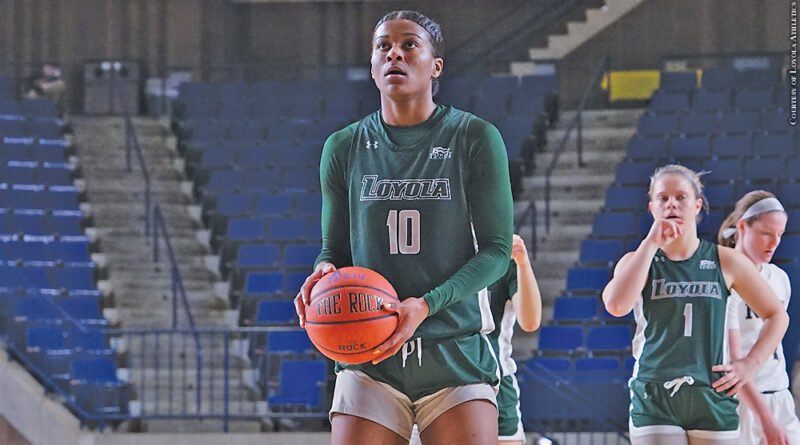
PressBox recently chatted with Loyola women’s basketball senior Koi Sims about coming from a family of football players, recovering from a torn ACL and more. The 6-foot forward averaged 6.1 points and 9.0 rebounds per game for the Greyhounds in 2022-23 but missed all of last season. Sims is a native of Glen Burnie, Md., and graduate of Archbishop Spalding.
PressBox: How did you first become interested in basketball?
Koi Sims: [Sports] run in my family, I would say. My dad, [Ashley], played [football] at Maryland. My uncle played at UVA, then he played professionally in the NFL for the Kansas City Chiefs and the Miami Dolphins. My older brother, [Ashton], played at Syracuse. My younger sister, [Kamari] plays basketball at GW. The list goes on. My younger brother’s going to be D-I, too. I would say that it [stemmed] from my parents always wanting to push me. Being able to have those figures in my life who have been into sports really opened up my interest and naturally made me want to push myself to become just like them.
PB: How did your family influence you as an athlete growing up?
KS: Just having those role models in my life just really pushed me to want to be just like them. I’ve been able to see how hard they work and also being able to hear their stories, their experiences on how far athletics got them academically and athletically, it was something that was kind of instilled in me to aspire to be. Also I would say my siblings, we all play sports and we’re all around the same age, so we’re able train, do basketball together, lift together, all that kind of stuff. Having that whole family environment of wanting to push each other to be better really helped me grow in the process of getting better at basketball.
PB: What are your best memories from playing at Archbishop Spalding?
KS: My younger sister, [Kamari], coming to play on the team with me, I would say. I know I keep on bringing up family, but it’s really a big piece for me, especially when it comes to sports because I have them around me. I would say being able to play with my sister my junior year and senior year were my favorite memories — and being able to be successful on the court with her is my overall favorite memory, I would say.
PB: Why did you originally choose to go to UAlbany?
KS: I originally chose to go to Albany because my last year of recruitment got shut down due to COVID. That was one of the schools that I got to visit and get accustomed to, so I chose to commit to that school during that time and that process. And also, I had family out there, which was good for that experience. It was a blessed experience, I would say, to be able to go to the NCAA Tournament, win a championship [in] the America East, that was a fantastic year basketball-wise.
PB: Why did you choose to transfer to Loyola?
KS: I fell in love with the coaching staff, the school academically and athletically. I fell in love with it when I first came on a visit. Also being able to play closer to home around my friends and family and have that comfort again was something I couldn’t turn down. I just really wanted to come back to play in my home state of Maryland.
PB: How did you suffer a torn ACL in your right knee in January 2023?
KS: It was off of a jump stop. I was dribbling to the basket, and I was going to jump stop to land to go up to shoot a layup. My knee just gave out.
PB: How did rehab go?
KS: When you hear that news, it really breaks you down. But the next thing you have to do is shift your focus to be able to attack that rehab. It’s going to be a year worth of rehab. It was a pretty long year of trying to get my body right and feeling good, but now I’m at the point where I feel really good and confident in my body, especially taking that time of being able to work with physical therapists and trainers and being able to return back to a point where I feel as confident as I was before. Being able to come back after such a hard time and shifting my focus and getting that confidence back in my body, I’m feeling really confident, really good in my body and my movements after working with the trainers and PTs.
PB: How long did it take to get back to 100 percent?
KS: I was out all last year due to my knee and the rehab process of wanting to be back at 100 percent before stepping back out onto the court. … I’m 100 percent healthy now and I’m cleared and ready to go.
PB: What is the most frustrating thing about ACL rehab?
KS: I would definitely say the ups and downs of ACL rehab. One week you can be feeling really good. You can be at a high, feeling really good, your body feels really good. The next week something could hurt, like your patellar tendon because that was the graft that I got. I could have some tendonitis. I feel like those ups and downs and the uncertainties of the whole entire process was very tough for me of some weeks being very good, some days being very good, and then some days not being very good and being frustrated in that process. It’s all about shifting your focus and focusing on those little successes that you have in the rehab process of, “Hey, I got to run and cut today, so that was good.” Focusing on the little good things that occurred during the process to … put yourself in a more positive headspace. So I would say that was one of the hardest parts, just the ups and downs and sometimes the uncertainty of when the time’s going to be that you can come back since it’s such a long rehab.
PB: What’s your favorite thing about Loyola?
KS: I would say my favorite thing about Loyola is my teammates and coaching staff. I feel like the team has such a great family environment. It feels like I have a whole bunch of sisters in our locker room. I can go to my coaches and talk to them comfortably if needed, or I can go to them for a laugh. If I’m feeling down one day, they’ll pick me up. It’s just this loving environment. My teammates, we all just sit around in the locker room and talk before practice. We show up hours before practice just to sit in the locker room and talk and do our work and go about our day. I just feel like it’s a [good] family environment. We never get tired of each other. It’s just love in here.
PB: Who’s your best friend on the team and what’s a story that underscores your friendship?
KS: I would say my best friend on the team is Meliah [Van-Otoo]. She’s all-around just a great person. She lives in Philly and I live in Maryland. I joke with her because I know for a fact that … if I call her in the middle of the night saying that I need help or I need to get something or something like that, I know she would drive all the way down here just to come help me. I feel like that kind of explains how much of a close friend she is to me. I don’t know any specific stories, but I just feel like we are on the same wavelength.
PB: Who did you look up to early in your college career?
KS: I would say who I looked up to the most at Albany was Kayla Cooper. One, before I even showed up, I used to play against her in the IAAM. She played at Saint John’s, and I played of course at Spalding. We used to go head-to-head against each other in high school and then when we both showed up to college it was just so much fun. She is still one of my best friends, but especially when we were there she was like an older sister figure and a vet to me. She’s so great playing-wise and such a great person, so I would say Kayla Cooper.
PB: What advice would you give to younger players?
KS: The advice that I would give to younger players is to just keep working as hard as you possibly can. Coaches want true hard workers. Other than just scoring the ball, you have to do the little things like playing defense [and] grabbing rebounds. All those things are very important to what coaches really want to see — also your body language, how you move about the court, how you move with your teammates, all the chemistry and stuff. I would say just keep on working hard and doing everything hard on the court whenever you possibly can.
PB: What are your goals for after college?
KS: Hopefully be able to play overseas or just to work within the government, so one of those two.
Photo Credit: Larry French