

Archbishop Spalding’s rise to becoming a nationally prominent high school football program was underway before renowned quarterback prospect Malik Washington walked through the door.
The evolution of head coach Kyle Schmitt is also a major reason why the Severn-based program has reached these lofty standards as the top team in Maryland and a staple of ESPN’s SCNext Top 25 poll and MaxPreps’ top 25 rankings.
“Honestly, it hasn’t changed us one bit,” Schmitt said of the national acclaim. “We practice hard. We are relentless in a process each week. You know, for us, maybe Thanksgiving we’ll sit back, and maybe over the holidays we’ll reminisce about some of that stuff.
“I am mindful of it. Don’t get me wrong. I don’t want you to think that I am this robot that doesn’t enjoy it. But as a group, we are just grateful for every opportunity. These kids love playing football. I always tell them, ‘The reward is Friday night.'”
A little more than halfway through this season, the Cavaliers were undefeated and outscoring teams by roughly a 10-to-1 margin.
Much of it has to do with having a player like the 6-foot-5, 200-pound Washington, a do-it-all, four-star quarterback prospect who committed to play his college ball at Maryland back in June.
Washington prefers to stay in the pocket, where he can make accurate throws to all areas of the field with his powerful right arm. He can also hurt opposing defenses with his ability to run.
Last season, he completed more than 60 percent of his passes for nearly 2,100 yards and 21 touchdowns in leading the Cavaliers to their second straight Maryland Interscholastic Athletic Association (MIAA) A Conference championship. He also ran for almost 250 yards and six touchdowns.
The Severn native grew up going to Spalding games. His cousin, Chris Clark, was a star receiver for the Cavaliers, and Washington had several friends who played for them as well.
“I think Malik is one of the most impactful players in MIAA history, frankly, and Baltimore football,” Schmitt said. “That’s a big statement. But I think he’s backed it up with his play, with our numbers throughout the last few years. I cherish getting to coach him every day. Malik is a joy. There’s never a dull moment.”
In order to attract a player like Washington and raise the overall level of his program, Schmitt first had to take stock of what he was and wasn’t doing for his team. The downtime during the COVID-19 pandemic provided plenty of chances for self-reflection.
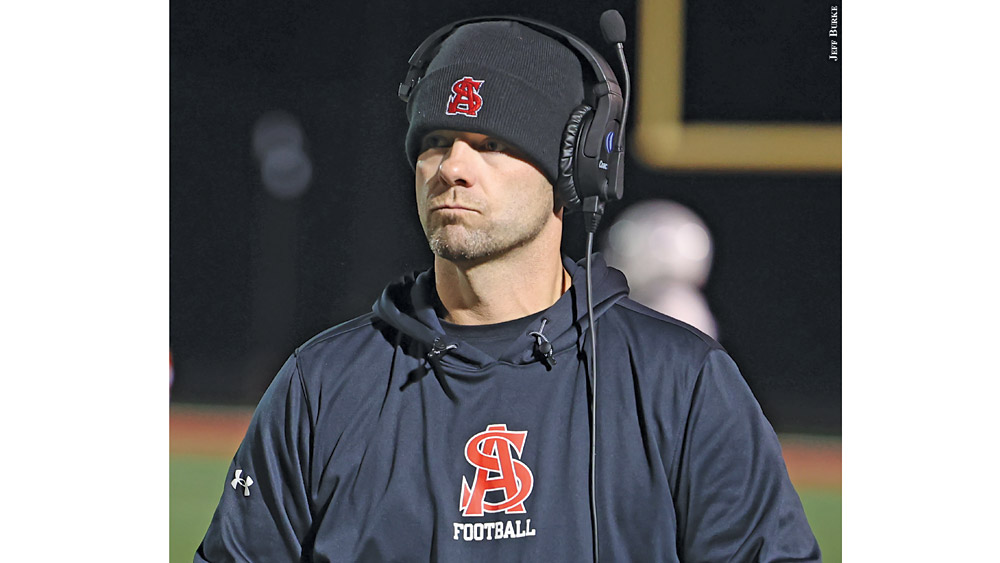
Spalding finished 5-6 in 2019, and Schmitt was searching for ways to make his team better. That started with him relinquishing play-calling duties for the offense, a responsibility he had held since taking the job in 2013.
It was an all-consuming job that was taking him away from other areas of the team. At one point, one of his assistants, John Stine, came up to him and said, “Man, we lose you on Friday nights with your head buried in that play sheet.”
Even Schmitt realized, “If you spend your week thinking about what you are going to run on third-and-4, there is so much else going on around the team, just from checking in on players and all the other aspects of the game. You lose sight of that when you are consumed by what you are going to run on third-and-4, which might not even happen.”
Schmitt dove into the other aspects of the game, such as special teams. He turned to coaching books and podcasts to educate himself.
He refined his recruiting process, focusing on players who prioritized football over all other sports. He tried to eliminate having players play on both sides of the ball, which kept them fresher during games and allowed them to do more during practice.
The thing Schmitt learned through it all was that, often, the most successful leaders were just the head coach.
“They weren’t the offensive coordinator. They weren’t the defensive coordinator,” he said. “They ran the team and the program.”
The approach has worked. Since the Cavaliers’ sub-.500 season in 2019, they have gone 2-0 in the pandemic-shortened 2020 season, 10-1 in 2021, 11-1 in 2022 and 10-2 in 2023.
Enrollment in the program has surged as well, according to Schmitt.
A decade ago, the Cavaliers consistently had 80 or so players in the program. Now, the number is around 120.
“We talk a lot in the program about paying respects to the guys that came before you,” Washington said. “All of them have helped build it to where it’s at now, and we are just trying to ride the wave and set it up for the next guys.”
Photo Credits: Jeff Burke
Issue 289: October/November 2024
Originally published Oct. 16, 2024