

David Rubenstein was approved as majority owner of the Baltimore Orioles on March 27, 2024.
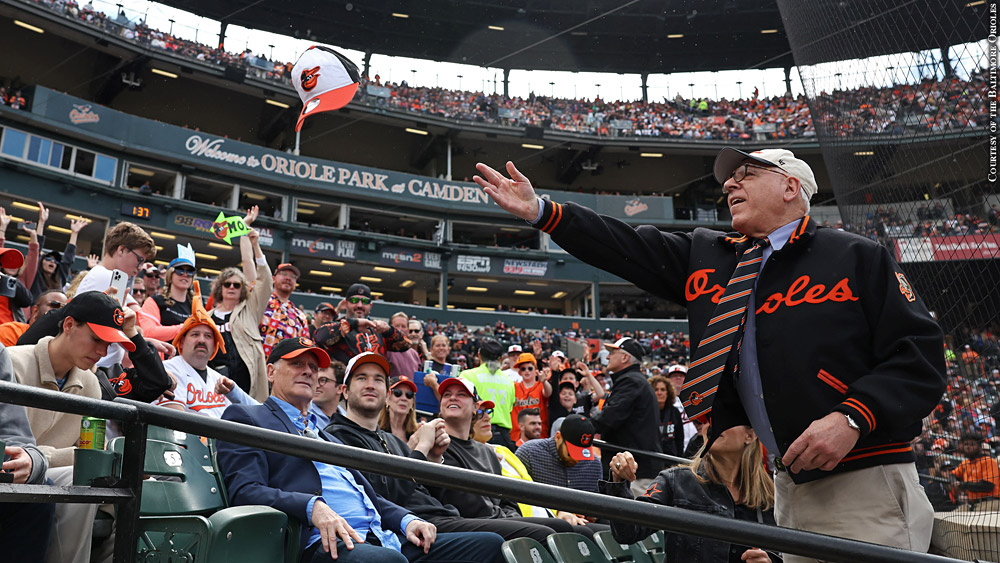
The months that followed were a bit of a honeymoon period for the “local boy done good” who represented change. The City College alum was immediately embraced by the fan base, and Rubenstein said everything you wanted him to. He spoke of extending young stars and wanting to win a World Series. He put himself out there publicly, taking selfies and tossing out hats and working alongside “Mr. Splash.”
As he enters his second season as owner, Rubenstein recognizes that continued popularity will be tied to the team’s success. There are fair questions about whether the Orioles are really any closer to championship-caliber, particularly with the team not dipping into the deep end of free agency in the offseason.
Away from the field, questions linger about the possibility of a mixed-use area near Camden Yards, the future of broadcasts and what events might come to the ballpark, including a potential MLB All-Star Game.
Rubenstein sat down with PressBox’s Stan “The Fan” Charles and Glenn Clark via Zoom in January to discuss these topics, his relationship with general manager Mike Elias and more.
This interview has been edited for content and clarity.
PressBox: Was the lure of buying the Orioles that they were your hometown team? Or could this have easily been another ballclub?
David Rubenstein: It was the only lure. I would not have bought a sports team other than the Orioles. I felt I had a moral obligation to do more philanthropically for the city of Baltimore than I probably had done, and I thought this was one way of doing something. Obviously I can do other things philanthropically, but I thought this might help re-energize Baltimore. It might help with some of the challenges Baltimore has. That’s why I did it.
PB: What does the team need to accomplish or what do you need to accomplish as an owner to feel like you have made that significant civic impact?
DR: Baltimore has lots of challenges that we all know about. From the time that I grew up to the time of today, the city has lost enormous amounts of population and has lots of other challenges that you all know about. I would hope that as a result of many things happening — the Ravens, the Orioles and the good leadership from the governor and ultimately from the mayor — that more and more companies will want to locate in Baltimore as their [headquarter] city. More and more people will want to move to Baltimore. More and more people will want to move to downtown areas of Baltimore. The crime rate will go down. These are the kind of things I hope would be a good sign of progress, but on the field, clearly when you have a winner it does attract more people and more attention, so I would like to win a World Series. The Orioles haven’t won a World Series since 1983. We won in ‘66, ‘70 and ‘83. And three times we got there and we didn’t win. ‘83 is a long time ago, so I’m hopeful that we can bring a World Series championship [to Baltimore].
(Courtesy of the Baltimore Orioles)
PB: How do you measure your desire to win a World Series against not wanting to meddle with the people who make the baseball decisions?
DR: I have to recognize a couple things. I don’t have a 50-year history of making baseball decisions, so if you’ve got a man who was the [2023 Executive of the Year] and a man who was the American League Manager of the Year, who am I to come in and say, “You know what, I played Little League Baseball, let me tell you what you should be doing here.” So I didn’t really feel it was appropriate for me to kind of second-guess people who had won those awards and who actually are extremely knowledgeable and have done a very good job. I have tried to learn from them and I think I’ve been learning a bit, but I’ve got a lot more to learn. My partner, Mike Arougheti, knows a lot more about baseball than I really do, but he’s also running as a CEO of a major company, so he can’t be full-time working on the Orioles but he’s done a very good job so far in working with me. But to answer your question, we have two of the best people in baseball as recognized by their peers, so I don’t think it was appropriate for me to try to make a change without any real knowledge that I could do anything better or find people who could do anything better. I’m very happy with them, very happy with them.
PB: Do you check in with them regularly?
DR: Every day. In this period of time when you have free agency and so forth, every day [Mike Elias is] telling me, “These are the opportunities, this is what it costs, this is the tradeoff,” and so forth. Every day. Now I, 99.9 percent of the time, will say, “OK, I understand. I think what you want to do is good,” because I’m not a baseball expert. If Mike Elias were to get into the private equity world, he would probably rely on somebody who had been in the private equity world. He’s been in the baseball world. That’s his life. He was a baseball player in high school and in college. He knows baseball inside and out, as does Brandon Hyde. He was a baseball player. I think I’m relying on people that know what they’re doing. Now, if they had been in last place and they never had a winning record you might say, “OK guys, maybe you should pursue something else.” But that’s not the case, so I’m very happy with them.
PB: Given everything you’ve accomplished as someone from Baltimore, have you ever considered spending time talking to your young stars about the significance of what it would mean to stay in Baltimore?
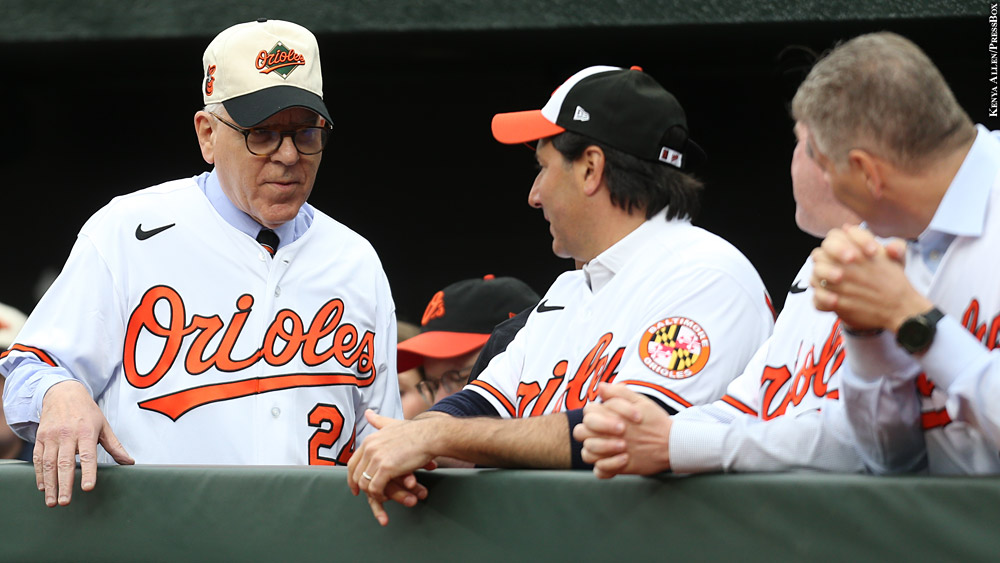
DR: I tried the first year not to be a meddler and to go into the locker rooms and be their buddy and go out and have dinners with them and so forth. I mean, I’m 50 years older than most of these guys. I don’t think they probably want to have dinner with me too much. I did go into the clubhouse sometimes to congratulate them on wins. I would go in and see them from time to time, but I didn’t develop a buddy-buddy relationship. Maybe I’ll get to know them better. Last time in spring training I was not yet the owner, so I didn’t think it was appropriate for me in spring training, where there’s some more informal opportunity to talk to players, to really say, “Guess what? I’m going to be the owner in a month or so if I get approved.” I didn’t think that was appropriate. This year I’ve been the owner for a year, so I’ll have an opportunity in a less formal setting and more casual setting in spring training to get to know the players. Clearly, what you suggest is a good idea, but I want to do it in an appropriate way and with the cooperation of the manager and the general manager.
(Photo Credit: Kenya Allen/PressBox)
PB: Is the day-to-day work of being a baseball owner more or less stressful than running other businesses?
DR: Carlyle has owned more than probably 1,000 companies over almost 40 years. When you own these other types of businesses, when you have ups and downs, everybody doesn’t write about it every hour on the hour. If the Orioles do something great people are going to say, “Hey, this is great.” And you feel good. But if the Orioles do something bad, then they’re going to write about it. You get more up-and-down publicity and attention than you do in the regular world. More people pay attention to how your performance is than they do in the other kinds of companies that we own, so it’s different. More people know every single player’s batting average than you can possibly imagine. People are obsessed with sports statistics, which is OK. People are obsessed with their performance on the field. It’s completely different.
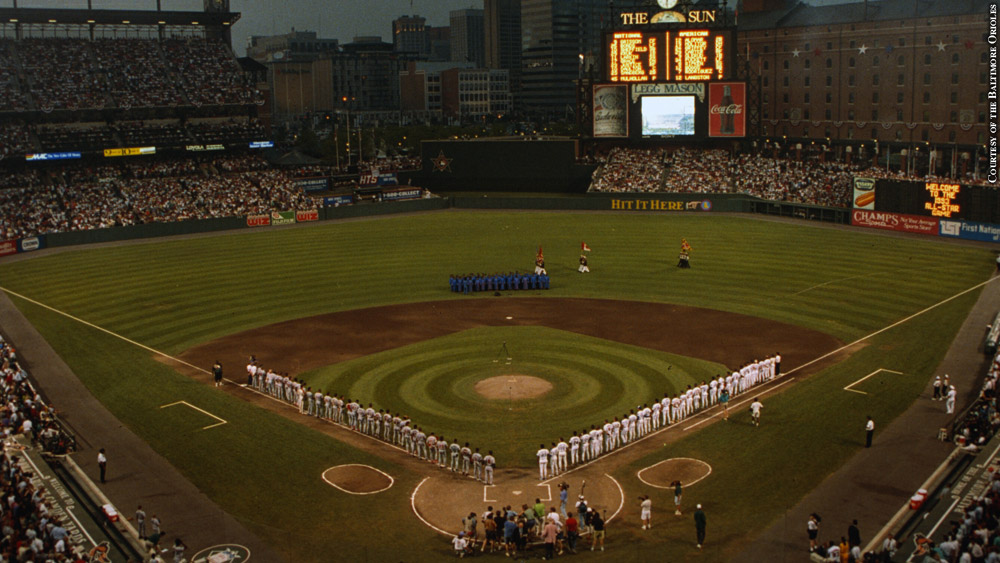
PB: The All-Star Game hasn’t been held at Camden Yards since 1993. How important would it be for you to bring the Midsummer Classic back to Baltimore?
DR: I have talked to the commissioner about it and he knows of our interest. Some commitments have already been made for ‘25 and ‘26. … It would probably be a great opportunity to show off the rehabilitated stadium when it is completed. After that is done, I think we are pretty high on the list. I can’t speak for the commissioner, but I think we have a pretty good chance of getting it and I hope so. I would like to have it, yes, absolutely.
(Courtesy of the Baltimore Orioles)
PB: What’s your relationship with MLB commissioner Rob Manfred like?
DR: I think I have a good relationship with him. I haven’t spent 20 or 30 years with him. Some of the owners have been around for quite awhile, and he’s worked in baseball for quite awhile, so he’s known them much longer than he’s known me. I’m I guess the newest owner. I think I have a good and friendly relationship with him. He told me that I was approved by the other owners as quickly as anybody he had seen. I think he was happy with my decision to try to buy the team. I’m not a drinking buddy of his or [anything] like that, and I don’t play golf. He does play golf. But I get along well with him.
PB: Are you going to prioritize hosting non-baseball events at the ballpark?
DR: Remember, you’ve got to make sure you don’t do anything that damages the field and you’ve got to make sure the groundskeepers can get the field in shape if you have a different type of event. When we have concerts, as we did with the Bruce Springsteen one, you’ve got to make sure that you don’t ruin the field. A lot of things have to be done, but I would like to have more concerts, for sure. I would like to have more events. We’re working on that.
PB: Do you see the Orioles attempting to spearhead a mixed-use development near Camden Yards and perhaps develop properties not currently owned by the club?
DR: As you know, what’s been done in Atlanta and other cities has been very good for the franchises and good for the cities. When John Angelos was negotiating the lease extension, they did have discussions about a so-called ground lease. The ground lease was never executed, but I am interested in a ground lease as the governor is. What we want to do is deal with the second lease extension first. [The club] signed a 15-year lease. Another 15-year lease is desired by everybody. We’ll get to that shortly. When those two leases are done, the money the state has allocated for the rehabilitation of the stadium will be completed, more or less. It’s $400 million. There’s another $200 million if there’s a lease extension. That’s $600 million. We haven’t focused on [the ground lease] because of a couple things. One, we want to get the plans underway for the stadium renovation, make sure we know what that’s going to cost and actually get that moving before we jump to the ground lease. On the ground lease — unlike Atlanta, or Boston, or other areas — we don’t have that much land currently. Your question was would the state in effect get more land? We haven’t had a discussion yet with the state, but I think it would be a desirable thing because there isn’t that much land that the Maryland Stadium Authority owns actually adjoining the stadium.
PB: The Orioles’ relationship with the Ravens hasn’t always been one of cooperation. Are you prioritizing shared objectives with the Ravens under your ownership?
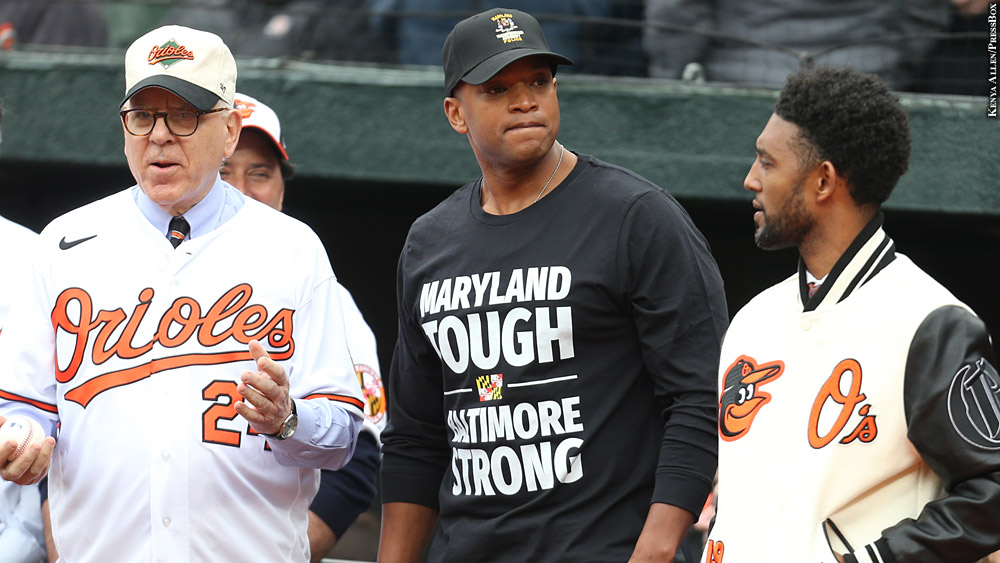
DR: Yes. After I became the owner, I called Steve Bisciotti, who I had never met before. I asked him if I could meet with him and he said yes. The easiest way to do that was I went down to Florida. I think he lives in the Jupiter area. I went down and we had a really, really enjoyable lunch. We suggested we would try to cooperate with each other on things. When the tragedy of the bridge occurred, we agreed to both put in an equal amount of money to [the Baltimore Community Foundation’s Maryland Tough Baltimore Strong Key Bridge Fund]. Since that time, I’ve met with the person running the Ravens on a day-to-day basis. We’ve gotten together a few times. I think we have a very good relationship. We’d like to find ways to cooperate. I think Steve would say that.
PB: With cord cutting so prevalent these days, does your group see a subscriber streaming method as something to address moving forward to increase viewership?
DR: I think all of baseball recognizes that in the media world we haven’t done as well as football or basketball. In … the NBA and the NFL, there are nationwide television contracts. We don’t have something similar in baseball in quite the same way. Every team has its own local deal. I think that many people in baseball administration would like to see if that can be changed and go back to a different kind of model, though I can’t speak for baseball. But I think many people would like to do that. What we’d like to do is make sure that everybody who would like to watch a game can watch a game over the air in a way that is attractive to them. A lot of people have cut their cords … but a lot of people don’t have access to streaming devices or can’t afford them. I think we can always do better.

(Courtesy of the Baltimore Orioles)
PB: What impresses you about Orioles president of business operations Catie Griggs and what makes you believe she is the right person to help execute your vision of what the club can be in this community?
DR: Catie had the advantage of having the exact same job in another organization in baseball, so it wasn’t as if she was in basketball or football or other sports. She was in baseball. So number one, she knew baseball. Two, she had a spectacular reputation in Seattle and they obviously did not want to lose her. Three, she’s very, very smart, very focused … personable, knows how to run an organization. I thought the combination was really good. [Minority owner] Mike Arougheti and I interviewed a number of people. We both agreed from the beginning that if we could attract her, we would try to get her.
PB: What did you learn in your first year of being the owner of a baseball team that you didn’t expect?
DR: I wasn’t expecting that 8-year-old boys would want my autograph. I wasn’t expecting that people would want me to do selfies so much or sign hats or so forth. It’s a more visible role. In private equity, while I’m reasonably well-known in that field, people aren’t coming up to me for selfies all the time. It’s been different. I’m not upset with anything, but I guess I learned how visible a sports owner can be if [he or she] wants to be. I try to be visible in the sense of showing up at as many games as I can and cheering [with the fans]. I even went on the dugout once and danced around. Some Sports Illustrated writer didn’t seem to like that. I did Mr. Splash with Mr. Splash. I’ll do that again. I try to show people that I am engaged in the community. I’ve made a fair number of speeches in the community in the past year and done some philanthropic things and I will do more. I’m trying to do the best I can with the abilities that I have.

(Courtesy of the Baltimore Orioles)
PB: You’ve spoken about knowing that those positive feelings can go away.
DR: Of course. People aren’t cheering and wanting the autographs of people who are in last place, right? They might say, “He’s a nice guy, maybe he’s from Baltimore, but the team is not good.” I realize if the team doesn’t do so well, there won’t be so many 8-year-old boys requesting my autograph.
PB: What did it mean to be awarded the Presidential Medal of Freedom?
DR: Obviously, I come from fairly modest roots in Baltimore. The idea that [this] would happen is something that I didn’t dream of when I was little, of course. The Presidential Medal of Freedom as it currently exists was invented by President Kennedy, who was the president that I was first attracted to public life by watching him and so forth. I only regret that my mother wasn’t alive because she actually believed I deserved it. I’m not sure all the others did. She would’ve said, “Of course he deserves it!” Unfortunately, she passed away in 2017 and didn’t live to see it. Of course I was proud to get that award. The ceremony was great. I think my children all came because they wanted to meet the other honorees. I think they wanted to meet Magic Johnson and Lionel Messi and Bono. I don’t think they were that interested in my getting the award, but they all came so I was happy that they did that. It’s an honor to be honored by the President of the United States. I was pleased and honored to do it, but now I’m tying my shoelaces just like I did the day before.
Photo Credits: Kenya Allen/PressBox and Courtesy of the Baltimore Orioles