
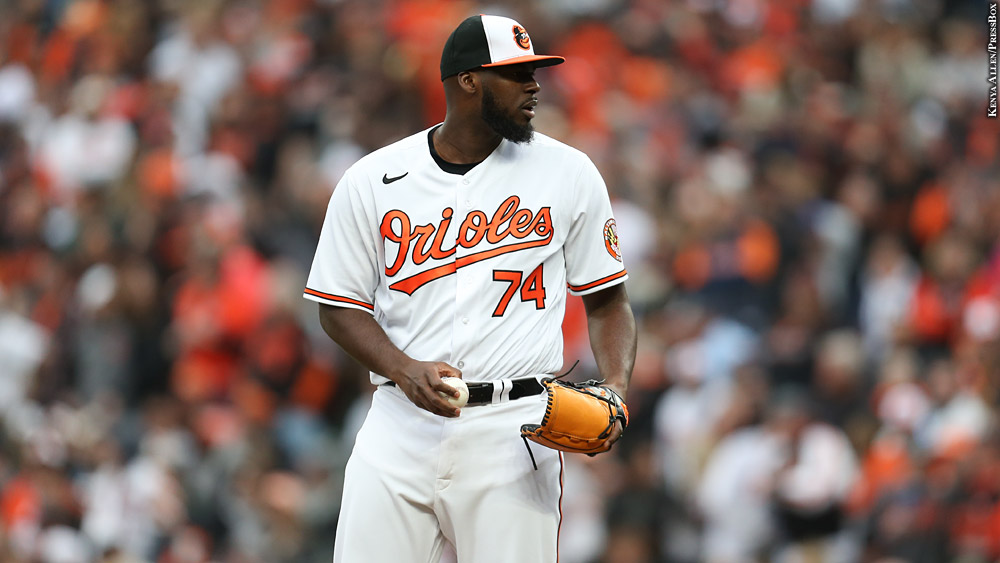
More than 18 months after he suffered a torn ulnar collateral ligament in his throwing elbow, Orioles right-hander Félix Bautista fielded questions about his second spring training outing.
Just 12 of Bautista’s 24 pitches that night were strikes, but he came away from the outing thrilled with his progress. Considering how arduous the Tommy John surgery rehab process is, it’s no surprise he was happy to be back on the mound, even if he didn’t look quite like his pre-surgery self yet.
“It was excellent for me,” Bautista said after his outing against the Pittsburgh Pirates in Bradenton, Fla., through interpreter Brandon Quinones. “I feel like I was able to accomplish what I wanted to, and I’m really content with the way the entire outing went.”
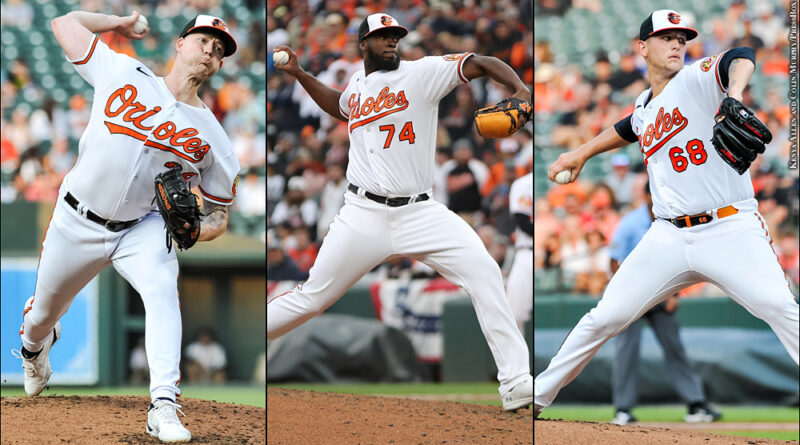
Bautista’s path back to competition is far from unique. Orioles pitchers Kyle Bradish, Matt Bowman, Seranthony Domínguez, Andrew Kittredge, Chayce McDermott, Charlie Morton, Albert Suárez and Tyler Wells have also undergone UCL reconstruction, colloquially known as Tommy John surgery. More than one-third of major league pitchers in 2024 had undergone the surgery at some point. The first such surgery was performed in 1974 by Dr. Frank Jobe on Tommy John, who pitched in the big leagues for 26 years.
The proliferation of major elbow injuries has created lengthy detours for pitchers during their careers, causing introspection across the sport about why such issues are on the rise and changing how rosters are built.
Dr. Christopher Forthman, president of Greater Chesapeake Hand to Shoulder and medical director of the Lutherville SurgiCenter, is well-versed in Tommy John surgery. He performs 12 to 18 elbow ligament reconstructions or repairs per year. About two-thirds are done on baseball players. Most of his patients are college or professional athletes between the ages of 20 and 22. The surgery takes 45 minutes to an hour.
Tommy John surgery becomes necessary when overhead throwers put a lot of stress on their elbow, causing the ulnar collateral ligament — the ligament on the inside of the elbow — to wear out or tear, and no longer function properly. UCL reconstruction calls for a graft — such as tendon from the forearm or knee — to replace the damaged ligament. Rehab typically takes 15 to 18 months for pitchers, who must rebuild strength in the elbow for about six months before beginning a throwing program.
“In the athlete, we’re not just looking for healing of the ligament or the graft that we typically use,” Forthman said of why the rehab takes so long. “We’re looking for it to be able to withstand these … forces that the ordinary person wouldn’t put their elbow through.”
Forthman says the most common story he hears from pitchers is one of attrition rather than one unfortunate pitch.
“I’ve been pitching for so many years,” Forthman said, summarizing the stories he hears. “This is my third year of college. I’ve just lost the velocity. I’ve lost the control. My elbow’s aching and aching. I’m getting some tingling down into my pinky finger. I’m fine in everyday life. I’m fine when I warm up, but by the third inning I’m just dying out there. I think that’s the typical story.”
* * *
A right-handed reliever for seven teams across seven big league seasons, Matt Bowman fits Forthman’s attritional description. Bowman had Tommy John surgery in September 2020, when he was with the Cincinnati Reds. The UCL in his throwing elbow, as Bowman put it, “just stretched out too much,” which led to “more things hurting the elbow than should be.” He tried a rest-and-rehab plan only to realize nothing had changed when he ramped up the intensity of his throwing again.
Bowman signed with the New York Yankees in December 2020. He didn’t pitch competitively in 2021 or 2022 but totaled 52 appearances for Triple-A Scranton/Wilkes-Barre and the Yankees in 2023. Bowman said the Yankees’ physical therapist and pitching rehab coordinator were “essential” in managing his day-to-day rehab while also providing perspective about the long-term goals they wanted to accomplish.
Checkpoints like the first throw are important in the rehab process, according to Bowman.
“I think you spend a long time trying to protect your elbow — make sure you don’t bump it the wrong way, you don’t put it in the wrong position,” Bowman said. “I think after spending that long protecting it, saying, ‘Now it’s time to do the thing that hurt it in the first place,’ I think there’s a little bit of taking the training wheels off in a sense. Once I started throwing, I knew how to throw, but I think there is a little bit of shedding that feeling of, ‘Oh, protect the elbow, protect the elbow.’ Honestly, that took a while for me.”
Albert Suárez’s story is a little bit different. He tore his UCL on one pitch with Short-A Hudson Valley in 2009, when he was with the Tampa Bay Rays organization. Not only did he feel the tear, but he heard a pop, too. He tried to throw two pitches after that but couldn’t get the ball to home plate. He underwent Tommy John surgery shortly thereafter.

Following surgery, patients wear a brace for several weeks to protect the elbow. So what did Suárez do in the early going following surgery?
“Easy stuff just to keep your body moving,” he said, “but when you have the brace you don’t do much because you don’t want to sweat for the first two weeks since it’s really uncomfortable. It starts itching, like a cast or something like that. You don’t want to sweat.”
Suárez has thrown more than 1,500 professional innings worldwide since recovering from Tommy John surgery. The right-hander credits a shoulder program he began during rehab as having helped him stay on the mound. He is still thankful for the time and energy the Rays put into his recovery all those years ago.
“I think they did a really good job with the rehab,” Suárez said. “The program they had in the minor leagues was really good to help you to come back and make sure that you stay mentally focused and stable to come back and play.”
* * *
Former Orioles left-hander Scott McGregor was the club’s pitching rehab coordinator from 2012-2019, typically handling a couple of Tommy John rehabs per year across the organization. He oversaw each pitcher’s throwing progression, starting with 15 throws from 40 feet away with a day off after.
McGregor described Tommy John rehab as a monotonous process designed to eliminate the ghost in a pitcher’s brain about what happened to their elbow in the past. He stressed not doing too much too soon.
“We’re going to do this for another week and then the following week after that, 10 more feet or 15 more feet or whatever the program called for,” McGregor said. “I would always be standing beside one of the trainers. We would together watch it. My biggest thing was to make sure they stayed within their throwing delivery.”
New developments provide options aiming to help pitchers get back on the mound sooner. Forthman explained that evidence suggests there is a way to cut down on the recovery time following Tommy John surgery.
Half of Forthman’s elbow reconstructions in the past year have been internal brace procedures. The ligament is reconstructed with a graft and protected by a brace, which is 2 millimeters in thickness and 2 or 3 centimeters long, between the humerus bone and ulnar bone. The brace is made of non-absorbable material with the strength of metal fiber but flexible as well. Kyle Bradish had an internal brace installed as part of his Tommy John surgery last June.
An internal brace is also used in a UCL repair, which calls for the existing ligament to be repaired rather than replaced. Tyler Wells had an internal brace installed as part of his UCL repair last June. (Wells also had Tommy John surgery in 2019.)
“If a patient comes in with an ulnar collateral ligament tear that’s acute — they were on the mound and there was one pitch or one game and everything went badly after that — and we get an MRI and we see good tissue but an acute tear, we’re now starting to do repairs without using grafts,” Forthman said.
Forthman said this can speed up a pitcher’s timeline and might even be more effective, particularly for younger athletes who haven’t been putting stress on their throwing elbow for 15 years.
“There’s good evidence biomechanically when we do this in the lab that we’re making the elbow stronger than when we just do a reconstruction,” Forthman said. “Adding this internal brace makes the construct stronger. We’re hoping that translates when we look at the numbers in athletes to an earlier recovery.”
* * *
Why has elbow surgery become so common among pitchers? Everyone in baseball has an opinion, but those viewpoints often hit on similar themes. Pitchers are throwing harder than ever. They’re also training harder than ever. And some throw a lot at a young age, perhaps putting those pitchers at greater risk in college or pro ball.
The increase in velocity in the major leagues is the easiest to pin down. The velocity of the average big league fastball rose from 91.1 mph in 2007 to 94.2 mph in 2024, with velocity ticking up a bit nearly every year during that time.
“The better velocity the better results you get, but the more prone to injury and the riskier it is for you to have surgery,” said MLB Network Radio host Jim Duquette, who was the general manager of the New York Mets from 2003-2004 and vice president of baseball operations for the Orioles from 2006-2007.
Bowman says the way pitchers chase velocity can lead to injuries down the road.
“It used to be like, ‘Well, you just don’t throw that hard, too bad.’ But now we have biomechanical data. We have training. We have all these things that can increase velocity,” Bowman said. “We have an understanding of how to make new pitches. I think every pitcher needs to improve nowadays, and that improvement process doesn’t stop at the big leagues or Triple-A. And I think by adding these new ways to improve on pitching, you also expose yourself to forces that your elbow has never felt before.”

The risk surrounding pitching forces teams to enter spring training with as many as 10 starting pitching candidates in order to make it to Opening Day with a healthy five-man rotation and depth behind that.
“I think it’s always been that way. I think the goal years ago was to come in with eight or nine starters and see what happens,” Orioles manager Brandon Hyde said during spring training. “But it does feel like in the past handful of years injuries have gone up, especially early in the season or in spring training. You do your best to create depth within that. You go on team pages right now, there’s a lot of pitching injuries around the league.”
And that ultimately affects the on-field product, according to Duquette, who believes it will become an even bigger issue if Major League Baseball eventually expands from 30 to 32 teams.
“[Teams] have all this money invested in pitching and they’re on the injured list, the product is getting watered down,” Duquette said. “And they’re trying to get this under control because the product is going to get watered down again once they expand by two more teams, if there’s not enough pitching as it is and now you’re going to try to fill two more teams with pitchers.”
* * *
After getting through spring training healthy, Félix Bautista made his first regular-season appearance against the Blue Jays in Toronto on March 29. The right-hander threw 22 pitches, striking out the side in a scoreless ninth inning to lock down a 9-5 Orioles win.
“I was really waiting for this game,” Bautista told reporters after the game through interpreter Brandon Quinones. “I was really happy that I was able to go out there today and contribute and help the team win.”
Bautista can lean on plenty of teammates who have made the trek back from Tommy John surgery and are now performing at a high level. Matt Bowman didn’t injure his elbow on one pitch like Bautista did, but he had to undergo the surgery anyway. Close to five years later, he feels better than ever.
“I think many pitchers would tell you that they have had elbow issues and their elbow has bothered them. Mine was no different,” Bowman said. “It just didn’t need it and then it finally did need it. And now, knock on wood, I am in less pain throwing than I had been for a good amount of my career.”
Photo Credits: Kenya Allen and Colin Murphy/PressBox