
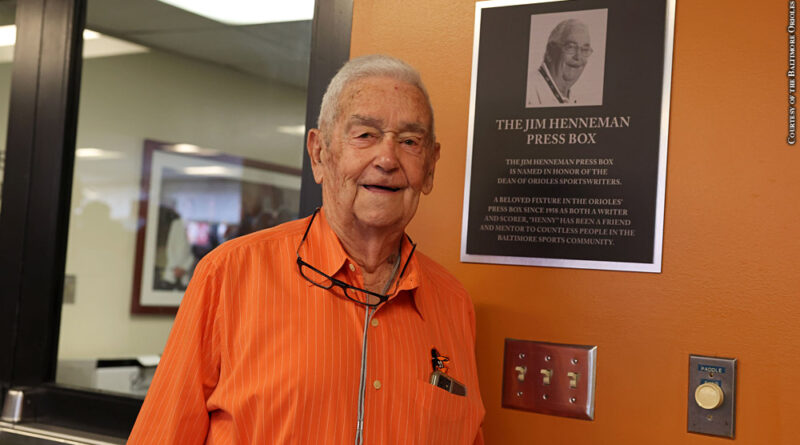
Longtime PressBox columnist Jim Henneman, a legend among baseball writers and an institution at Camden Yards, died on May 22, 2025, at the age of 89.
Henneman covered Baltimore sports across eight different decades starting in 1958. He was a Baseball Hall of Fame voter for 40-plus years and served on the Hall’s Historical Oversight Committee, which puts together ballots for various Era Committees to vote on. He was an official scorer at Camden Yards from 1997-2019. He was also the public relations director for the Baltimore Bullets from 1968-1973.
Baseball Hall of Famer Jim Palmer, The Athletic’s Jayson Stark and longtime Baltimore sportswriter Peter Schmuck joined Glenn Clark Radio May 30 to discuss the life and legacy of Henneman.
The Orioles named the press box at Camden Yards after Henneman in 2024, a truly fitting honor for a man who spent so much time there and meant so much to anyone who passed through.
Jayson Stark: Jim Henneman was a giant in our business. They don’t name press boxes after just anybody who’s passing through that place. They named that press box in Baltimore after Henny because of what he meant to our profession and just as much what he meant to everyone who sits in that press box every night. Here’s what made Henny different: For so many people who have done this for a long time and risen to his level, they always make you feel like it’s about them. That was not true with Jim Henneman. It was never about him. He was so appreciative of other writers’ work and what they thought and how they went about it. He was just interested in everyone and everything. He loved baseball and he loved baseball writing and he loved baseball writers. You never came away from a conversation with him without thinking that — at least I never did. He’s just one of those people who leaves a lasting impression on every life he touches. What a special thing to say about anybody.
Henneman grew up three blocks from Memorial Stadium and was 18 years old when the Orioles moved to Baltimore from St. Louis. He played baseball at Calvert Hall and Loyola during his high school and college days, respectively, even pitching to Baltimore native Al Kaline at one point. He ended up writing about the Orioles in eight different decades. He lived a life of baseball.
Jim Palmer: In the old days, you used to go to the ballpark when they actually had scouts. You’d go into the press room and you’d have a conversation and you’d learn about another team and players and you’d talk about baseball. … Jim was always part of that fraternity. He’ll really be missed in what he represented to baseball writers.
Peter Schmuck: When I would pop off in the press box about something and I was wrong or I thought I was wrong, he had no trouble just completely setting me straight. And the great thing about Jim was when he was done setting you straight, you had enjoyed it. It wasn’t like he was talking down to you, it wasn’t like he was lecturing you, but you realized that Jim Henneman played baseball, coached baseball, wrote baseball, lived baseball.
Jayson Stark: I got to spend so much quality time with him [in Cooperstown talking] about baseball past and present. It’s just hard to imagine going to Cooperstown in July and not seeing him. It’s hard to imagine walking into that press box in Baltimore without seeing him.
Considering he had covered the team for nearly its entire time in Baltimore, Henneman was the perfect choice to write “Baltimore Orioles: 60 Years of Orioles Magic” during the club’s 60th anniversary season.
Jim Palmer: He was nice enough to ask me to write the [introduction] of the book he wrote, “60 Years of Orioles Magic.” I was looking through it for the past couple of days. I mean, it’s a remarkable book. I’m going, “Geez, I don’t even know if there’s anything about him in the book.” That kind of, to me, shows what Jim Henneman was about. He loved baseball. He loved the people. He earned respect because he was so fair and knowledge and all those kinds of things.
Peter Schmuck: Who else is around that could tell you what it was like to go to a Negro League Baltimore Elite Giants game or an International League Baltimore Orioles game or be there when the team came to town? He was an encyclopedia.
Henneman had a way of diving into angles that went unexplored by other writers. He wrote thought-provoking stories that were still easy for readers to digest.
Peter Schmuck: He knew what they needed to know. He had this instinct for what they needed and what they might not know as opposed to everybody in Baltimore is a good baseball fan. They’re all knowledgeable baseball fans, but then there’s another layer of baseball and there’s another layer under that. He could go to the lowest level. … He knew the part that the fans needed to understand and if they didn’t, he could help them do that. But he also understood you can’t get too far into the weeds. On one level, it’s a simple game. You hit a ball with a stick and you run around in a circle. And then you go down level after level after level and it just gets more and more complex. Jim understood it all.
Henneman also had a way of helping young writers getting started in the business and reaching out to fellow writers to let them know he liked what they recently wrote. He loved baseball, he loved journalism and he loved people.
Jim Palmer: It kind of takes me back to a couple years ago when Brooks passed away and they had the memorial at Camden Yards. It would be the same way with Jim. You’re going, “Nobody had to make anything up.” Nobody had to tell some lies or whatever.
Peter Schmuck: Some writers have a tendency to dismiss the readers, like they’re just stupid children. He always respected his readers. He respected them when he ran into them on the street. He respected them in print. He respected them when they contacted him or when we used to answer mail in the old days in the newspaper business. That’s just Henny. Everybody loved him and he loved everybody.
Jayson Stark: He was just one of those people that I would describe as a connector. He connected with everyone and he connected everyone with each other because of just the way he was. It felt like he was so glad to see you. Every time our paths would cross, it just felt like he made me feel like this was a special day for him because he ran into me. I actually felt that about him.
For more from Jim Palmer, listen to the full interview here:
For more from Jayson Stark, listen to the full interview here:
For more from Peter Schmuck, listen to the full interview here:
Photo Credit: Courtesy of the Baltimore Orioles