

There is a rich history of basketball in Baltimore.
Bob Wade’s Dunbar teams in the 1980s are so legendary that movies have been made about them. Sixty different athletes have gone from the Baltimore Catholic League to the NBA. The city has produced men’s and women’s NCAA Tournament Most Outstanding Players. The folklore surrounding legendary high school players like Aquille Carr, Tamir Goodman and Skip Wise has made for never-ending hours of conversation.
But until this year, there has never been a Baltimore basketball player in the Naismith Basketball Hall of Fame. There have been Baltimore Bullets (like Walt Bellamy, Elvin Hayes, Buddy Jeannette, Earl “The Pearl” Monroe and Wes Unseld) in the Hall of Fame but no Baltimore-bred basketball players.
Carmelo Anthony wasn’t born in Baltimore. But he is very much a Baltimorean, as he reminded the country during the Knicks’ playoff run this year while wearing his City Connect Orioles hat to every game. His story is a uniquely Baltimore one. He has said that Baltimore “raised” him. His path from Furman L. Templeton to Mount Royal to Towson Catholic helped shape him as a basketball player and as a man. That impact has been reciprocal. Anthony’s success helped shape and inspire generations of Baltimore basketball players.
After winning a national championship as a freshman at Syracuse, Anthony was drafted by the Denver Nuggets with the third overall pick in the 2003 NBA Draft. The 6-foot-7 forward spent 19 seasons in the NBA and ranks 10th on the NBA all-time scoring list. A 10-time NBA All-Star and six-time All-NBA selection, Anthony also won three Olympic gold medals (2008, 2012 and 2016) and one bronze (2004), becoming the most decorated American men’s Olympic basketball player of all time.
Ahead of Anthony’s Sept. 6 Hall of Fame induction, PressBox’s Glenn Clark spoke to those who know Anthony best and the Baltimore basketball figures who came before and after him about a variety of topics. How did the city shape Anthony? What was his impact on the city? What is his legacy here and throughout basketball? Those who participated include:
- Former Syracuse head coach Jim Boeheim, who won a national championship with Anthony in 2002-03
- Baltimore hoops legend Muggsy Bogues
- Minnesota Timberwolves director of scouting Joe Connelly, who coached Anthony in the Mount Royal hoops program and as an assistant at Towson Catholic
- Darrell Corbett, who coached Anthony in the Mount Royal program
- Former Towson Catholic coach Mike Daniel and his wife, Debbie
- Former Baltimore hoops star Donté Greene, who went to Towson Catholic and Syracuse after Anthony and spent four seasons in the NBA
- Childhood friend Darnell Hopkins, who played alongside Anthony at Towson Catholic
- Eric Skeeters, whom Anthony called his godfather, spoke to Glenn Clark Radio in 2023
These conversations have been edited for content and clarity.
How did Baltimore shape the player Carmelo Anthony became?
Muggsy Bogues: Being that age, being in the city of Baltimore, you just get that aura. You get that understanding of how to survive, understand how to stay focused — especially when you have a task. When the game of basketball became a vision for him and going through that type of path in terms of the environment that he was facing during his journey, Baltimore wasn’t an easy place to grow up in. For him to be able to adapt and adjust coming from New York, it’s kind of similar to Baltimore, but [Baltimore] is where his teenage years [took place], where decision-making comes into play, the people that you associate with, the people that you’re around in order to develop into the player and into the young man that you want to be. He was able to find a nice circle — a small circle, that is. The guys that really believed in him and kept him safe and kept him grounded and kept him focused on his goals allowed him to be the best version of himself.
Joe Connelly: His mom was a janitor at the University of Baltimore. He also had a cousin, [Tavares Graham, who] came down here from Brooklyn that was living with him that got murdered [in New York]. All those things sort of helped shape his decision-making process and what he put his focus and energy into during probably the most crucial years for any young kid like himself in Baltimore. From 13 to 16, those are the make-it-or-break-it years. He and his mom were smart enough to put themselves around the right people that had good intentions around them.
Darrell Corbett: Growing up down off of Argyle and Myrtle, playing in the recreation centers like Robert C. Marshall and Mount Royal back in the day, just the friends he met along the way and how they grew up and where they grew up, to have that common desire to get out of the city, to be the best he could be. He always had that desire and that push to be a great player, but when you grow up down there in that area, basketball is your outlet. Back then, everybody wanted to play ball to get to better schools in the city. To be able to play ball and go to Towson Catholic and then Oak Hill [gave him a chance] to grow and see different things. I would say Baltimore shaped him because of the toughness, the hardness of the city.
Debbie Daniel: I think the nurturing and community sense he picked up from everybody in school. Towson Catholic was a very small high school — maybe 300 kids, if that many. Everybody knew everybody. Everybody knew Carmelo’s story, moving here from New York and having lost his father and his mother raising him by herself. Mike [Daniel] and all of the coaches just took him under their wing. It was, “OK, make sure he’s getting his homework done.” We had people that sponsored a lot of our players with tuition and books and clothing and everything. Carmelo was one of them that everybody [made sure] that he had everything he needed to succeed.
Donté Greene: I would compare it to how I was shaped, to be honest, not to put our two careers in comparison. He was obviously born in New York. I was born overseas. I was born in Munich, but both of my parents were from Baltimore. Once I moved back, it gave you that toughness. It gave you toughness. If you can make it out of Baltimore, if you can make it through the naysayers and the quote-unquote haters — our city is not big, but it’s not small, either, at the same time, so … there are a lot of critics, a lot of people [that] say, “Oh, you can’t do this, he’s not that good, he’s not this, he’s not that.” They’re trying to put their guy on while at the same time putting you down. If you can make it through all that, the sky’s the limit. You can make it anywhere. Baltimore definitely molds players, the ones that make it out. It molds them for the better. It gives them that toughness to be able to take on anything.
Darnell Hopkins: I think just the grit of Baltimore basketball. We grew up just playing basketball, period, just like outside in the court in the neighborhood against our friends and kind of got our opportunity from that. When we actually played organized basketball, it was kind of easy because we were already roughhousing each other growing up. Those bumps and stuff that we took in an organized fashion didn’t really matter and we didn’t cry about it.
Eric Skeeters: Everything about Melo’s game is a direct reflection of [former Saint Frances and Temple star] Mark Karcher’s game. You remember Mark Karcher — 6-5, couldn’t jump over a telephone pole, but all the skills, all the toughness. Baltimore at that time had what you’d call unlimited leagues where the pros and the older guys would play outside. You could go East Baltimore, West Baltimore. There are too many to name, I don’t want to leave any of them out. But there was a maturation for players, like Mark Karcher playing against Keith Booth. … There was a maturation process in Baltimore that the older guys taught the younger guys. Melo patterned his game after Mark Karcher and those years he spent [hanging out] at Saint Frances — all the jab steps, pivots, scoring, the body control. Now, Mark was 6-5 and unathletic. Melo was 6-8 and could jump to the moon. He took that skill set and that toughness and that ability to win.
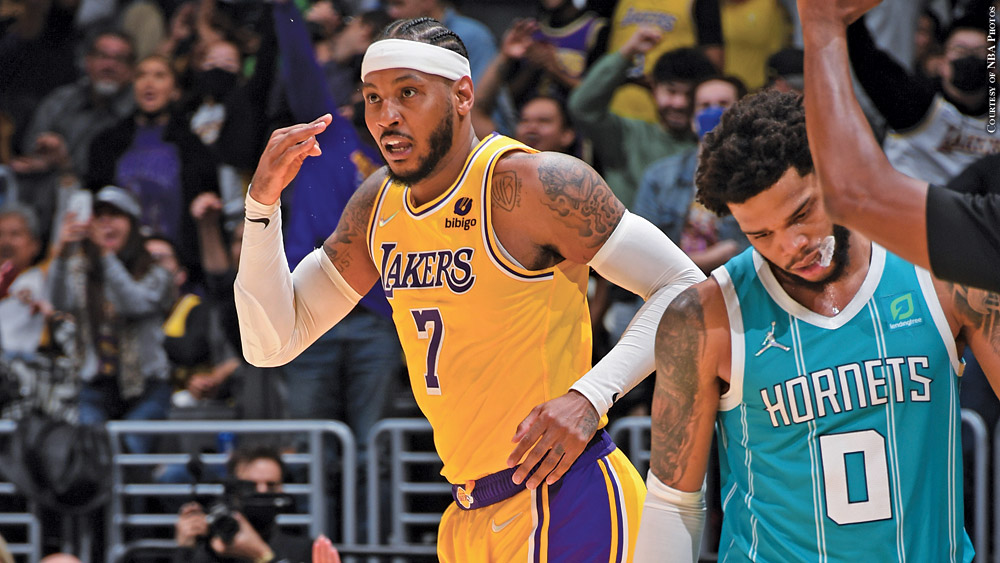
What made Carmelo Anthony so special?
Was there a moment you knew he was special?
Jim Boeheim: The first time I saw him was in high school. He was rated top 50, but he hadn’t broken loose yet. I went to see him play in a game — a good game, a good high school game — and he started out the game with about a 25-foot three. And then he hit a pull-up and then he drove by the guy and dunked. I looked at my assistant Troy Weaver. He told me this guy could help you win the national championship. Of course, you never know. I looked at him and said, “You might be right.” Three of the more impressive plays that I’ve seen, and it was in the first two minutes of the game. … I think it was then that made me realize this kid [will be] a really good college player right away, but he was only about 185. He went to Oak Hill for his senior year and [when] he came up here, he was 220. You watch him in practice, you can’t guard this guy. He’s so strong that if he’s missing jump shots he’s smart enough to get to the basket. You knew right away.
Joe Connelly: [Our AAU team] played at the Boo Williams tournament, which was one of the biggest Nike tournaments at the time. On that day, Melvin Scott and Darshan Luckey, who were two of the top players in the area at the time, had to take their SAT test. We played against a Boo Williams team that had JJ Redick [and] John Gilchrist. It was a great team. It meant that Melo would have an opportunity to shine more. He seized that moment. I think he used that game to put himself on the map. He got an invitation to the Nike camp as a result of that when that was a big thing. That was probably a moment where it was like, “This is about to turn into something really crazy right here.” There was also another game that you can find on YouTube. That same AAU team, we played DC Assault at Towson Catholic in July going into [his] junior year. They had James White, who was the top player in the class at that time a year ahead of him, and Melo gave him work. He ended up giving him like 22 points. He was just following all the steps. As he grew into his body, he already had the guard skills. We had him for four years within the summers, the springs, working out and stuff. He really benefited from being around like-minded guys and the continuity of putting in the work.
Darrell Corbett: That thirst, that hunger, always wanting to be on the court, always wanting to play. He’s one of those kids that always wanted to play. He didn’t just play basketball. Back then, you played everything. He played basketball. He played baseball. He played football. Growing up, you were always challenged by your peers to be the best in your sport. You were going to be challenged, always being challenged to be the best of the best. You were around guys who could actually get it done. Everybody has that opportunity, but only the strong survive. If you’ve got that pedigree in you to go out and challenge other people and to strive to be one of the better players on the court, you’ve got that hunger, that desire, [the mindset that] I’m better than you, I’m going to be better than you and I’m going to push you, you achieve that goal.
Mike Daniel: He was something else. Talent-wise, he could do this, he could do that. He could shoot the ball. He was just so good. … Whenever he needed to get it done, Carmelo did that.
Donté Greene: I would say more so that late growth spurt that he had, I would think. We had the same AAU coach, the same high school coach. I was always considered above-average for height, but Melo wasn’t always tall, so he had guard abilities. He had guard skills, and that’s what set him head and shoulders above guys once he became accustomed to his body frame, from 6-1 to 6-7, 6-8 and still be able to keep your guard skills at that size, especially at that time, was unheard of, for sure.
Darnell Hopkins: He was a good teammate. He was always encouraging. He loved to win. If he saw that you weren’t bringing your “A” game, he would let you know. He would try to psyche you up. There were times where he psyched me up, where he would tell me a player on the other team told me I was sorry. He knew how to press my buttons to wake me up. There were things like that that I recognized later on that he did to kind of elevate my game. … Melo always had that guard-oriented game. By him reaching 6-6, 6-7 [after a growth spurt], he kind of had to get used to his height, but once he got used to his height, it was over from there. I don’t think [anyone] could stop him after that.
Eric Skeeters: I left for Youngstown State in ‘99. He was in ninth or tenth grade. Let’s go back to when he goes to Towson Catholic. … He plays on the JV in the ninth grade. They weren’t that good. I’m in Youngstown, Ohio. There weren’t a whole lot of cell phones back then. It was still beepers, pay phones, calling cards, things of that nature. We’d talk every other day, on the weekend keeping progress. He goes to two places. Joe Connelly takes him up to the Eastern Invitational and the Hoop Group camp. He plays against Rasual Butler. That was kind of his coming-out party. He makes varsity in tenth grade. They go to the championship game, they lose to Archbishop Spalding. That spring, he plays against James White [with DC Assault]. Melo put on an absolute show. Everybody comes to see James White because James White flies through the air, jumps off a trampoline. This kid could dunk. He walked on air. Melo just flat-out outplays him. College coaches couldn’t come — I think it was in the dead period — but the gym was packed. It was one of those DC-Baltimore games, and that was his coming-out party to the area. This kid is legit. He’s for real, big-time. He just outdueled James White. James White’s going to be a McDonald’s All-American. Melo’s only going to be a junior. That’s where he took off.
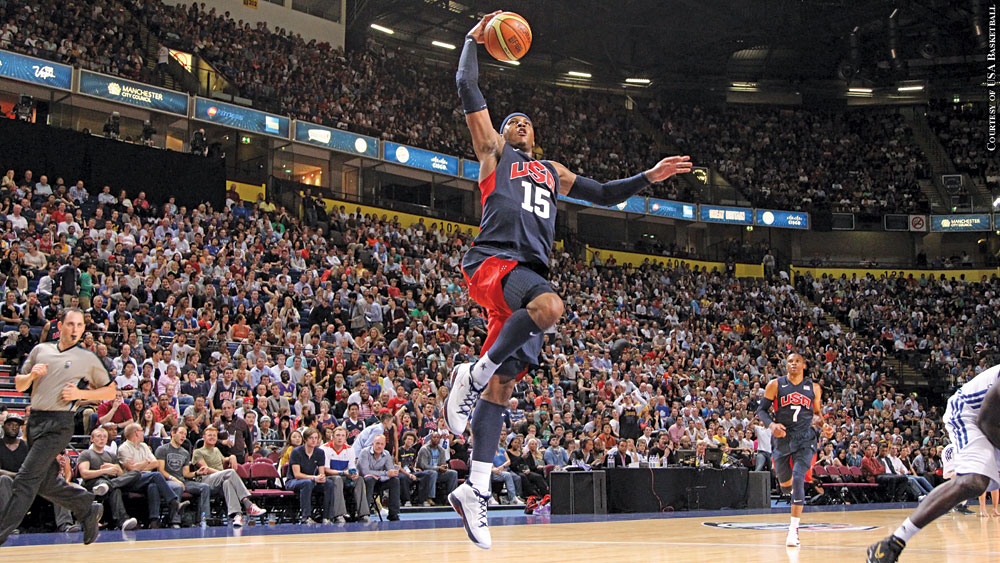
(Courtesy of USA Basketball)
What is Carmelo Anthony’s legacy in Baltimore?
How significant is his success to the community?
Jim Boeheim: He came out of there and won the national championship as a freshman. Nobody had ever done that. Baltimore had had a lot of good players, but nobody who had done something like that. He’s given back to both Syracuse and Baltimore. I think that resonates with people. He gave us money for our practice facility. He helped us build a couple courts in the community here. And he gave back to Baltimore. I think that is another part of his aura, what’s around him. He’s really kind of a bigger-than-life kind of guy. I think [his work with NBC Sports] will show that a little bit, but he’s done very well outside of basketball. He’s really given back to every place he’s been. I think that stands out.
Muggsy Bogues: I would think that a kid that stayed the course, a young man who faced adversity, who saw a way of opportunity through an orange basketball that [he] probably didn’t envision taking him this far — just a way out. Melo, his legacy is more or less a guy that’s always been resilient, overcoming the obstacles no matter what the situation was. He was able to reach the highest pinnacle, which is the Hall of Fame.
Joe Connelly: His legacy is hope. “Hey, if I did it, you could do it, too.” I’ve got to go back to him as a freshman at Towson Catholic. He played JV basketball. He won one game as a freshman at TC. Literally the whole season they won one game, at Calvert Hall. To think in that short period of time, to go from JV [and] winning one game and a couple years later you’re a top-three player nationally? Pretty remarkable, but I also think that the fact that he didn’t get the accolades early helped his process. I debate this all the time being around the basketball scene in Baltimore. When you’re anointed early, there’s a lot that comes with that. Many of the anointed guys never end up making it — definitely not to his level.
Darrell Corbett: A winner, a survivor, an adapter. I’m not going to say you were counted out, but you went through that little hiccup at Towson Catholic and you wound up going to Oak Hill. You were able to prove to everyone who doubted you that you could make it and that you would survive and that you would go on to bigger and better things. … In the city, you will be legendary. You will be one of those people who put Baltimore on the map going back to your first shoe where you had Baltimore on one side. You had the streets and everything on it. You always tried to incorporate the city in everything you did. You wanted to shine a light on the city of Baltimore in a positive way. You wanted people to know that we were more than just the highest murder rate in the country. You have good people in this city and you have people who are trying to good things, and you wanted to be a part of that side that was doing good things for people and to make sure that kids had an opportunity because when you were young, you had an opportunity to play AAU and travel and be exposed to things through traveling. You want to give that back and you build your program and allow kids to travel and not have to go in their pockets and have to put up any money and be able to have those opportunities to be seen throughout this country so that people can say, “Hey, that kid’s from Baltimore, that kid can be great, I can use that kid, I want him in my school.” [He wanted] to put a positive light on the players in the city itself.
Debbie Daniel: The community is so proud to have seen one of our own. When we first met him, he might’ve weighed 50 pounds. We have pictures of this kid. He is so small. Throughout his entire time that he was with Mike [Daniel] everybody said, “Oh, he’ll never make it. He’s too small. They’ll break him up. He won’t be able to stand the pressure.” … We went to different tournaments throughout the country [on the Nike circuit]. Everybody was like, “He can shoot, but I don’t think he’s ever going to make it to the league.” Mike kept telling them, “Y’all keep an eye on this kid. Don’t sleep on Carmelo.” That’s all he kept saying. “Don’t sleep on Carmelo.” He proved them all wrong.
Donté Greene: During the pandemic, we were doing all the rankings. Guys got on Instagram Live and were on Facebook groups. We were just talking. Consistently the three names that were left out purposely — you can’t rank them, they are who they are, they’re not even put on the list — were Carmelo, Muggsy Bogues and Skip Wise. Those were three consistent names that were left off. We’re not putting them on. Everybody knows what they did. His legacy is top-tier. It’s one of one. In my lifetime, I don’t think anybody will ever be able to exceed that — Hall of Fame, top 10 in scoring, national champion, McDonald’s All-American, No. 1 player in the country. You can go on and on about it. You have guys that come close as far as accolades and rankings — myself, Rudy Gay, Josh Selby, Will Barton, guys that came close. But as far as everything that he’s done, from high school through college to the NBA, it’s never been done in our city. In my book, he’s No. 1.
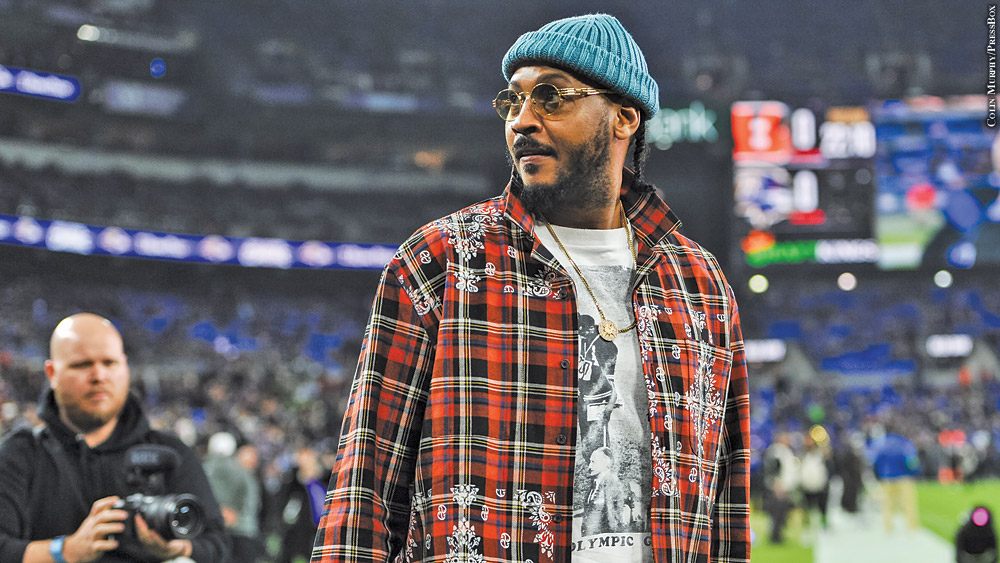
(Colin Murphy/PressBox)
What is Carmelo Anthony’s legacy throughout basketball?
Jim Boeheim: First of all, he was a very well-liked teammate and opponent. People like him. He’s got a lot of friends in the world. He’s a friendly guy. He’s an honest guy. He’s going to have your back. He’s going to do whatever you need to help you. He’s still friendly with guys that he played with here. I just think he’s built an amazing resume with the Olympics, with what he did [at Syracuse and] in the NBA. It all adds up.
Joe Connelly: I think his legacy is probably one of the best pure scorers the game has ever seen. Obviously with the national championship and the Olympic gold medals and stuff, but the scoring ability, some of the stuff he did and how smooth he was. I think even if you poll guys in the NBA today, he still would rank probably among a lot of guys’ favorite players just because of how aesthetically pleasing his game was.
Donté Greene: [Like] Jay-Z said, numbers don’t lie. Obviously he’s a Hall of Famer now, but before he got the nod in my book he was a Hall of Famer. He’s already [on the NBA’s 75th Anniversary team]. His game is one of the games that kind of changed the NBA as far as him having that mid-range, being able to be a three-level scorer at his size. I don’t think anybody has ever been able to do it consistently like he has with his attributes.
Darnell Hopkins: Growing up with him and seeing where he came from and how hard he worked to take care of his family, take care of his mom, his legacy in that sense for me is how I look at him. Other people probably look at him in the basketball sense, but I look at him as someone that worked their tail off to get to where they are right now, and it’s continued, translating into his son [Kiyan].
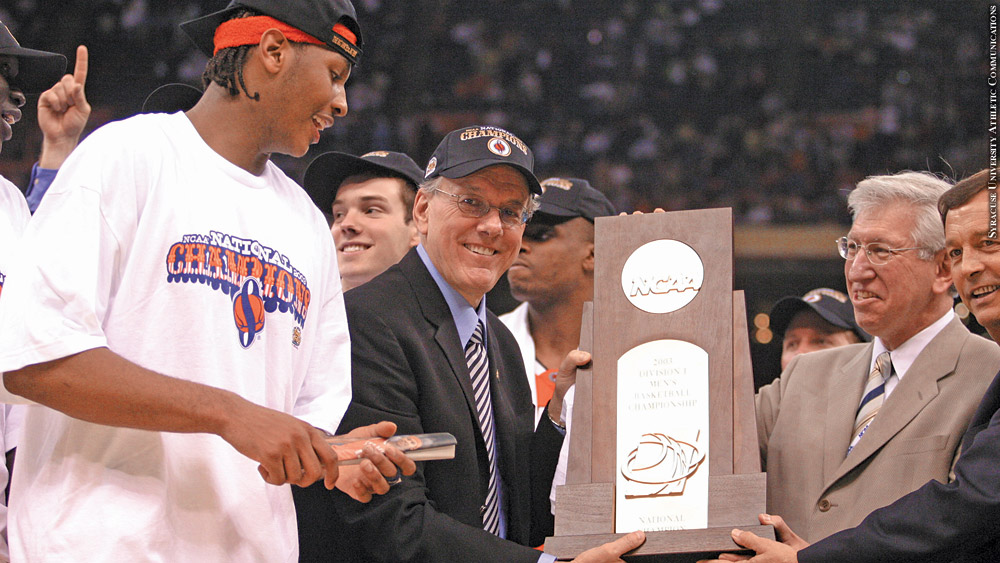
What does Carmelo Anthony mean to you?
Jim Boeheim: We went to five Final Fours and we had a lot of success, but you really have to win one. If we didn’t win it we’d say, “Well, we had a good run.” It’s not the same. You do have to win one. A lot of people say you should win two or three. I’m not sure about all that, but you have to win one. We had a couple chances and didn’t get it done. When Melo was here, he did that. Thirty years from now, he can come back here and they’ll know. It’s something that never, ever goes away. … To win the national championship, there’s nothing quite like it — and he did it as a freshman. The other thing is he’s continued to give back to Syracuse for many, many years and he was only here one year. That means a lot, too.
Muggsy Bogues: I’m so proud of Melo. That’s what really stands out for me. Being one of those guys that paved the way for him and seeing a guy like him pay homage to the guys before him, he always had that type of respect. He always had that understanding of how he needs to pay respect to the game in terms of the guys in front of him. Watching his growth, his development from college [to] the NBA and even off the court, seeing how he operates and where his passion lies and his heart and how he raised his son Kiyan. Now he’s following in his dad’s footsteps. What more can you say? Melo now is a businessman. He’s a family man — always the case, he’s been that way. He’s always had a small circle. But he’s doing some big and major things on and off the court now since he made that transition. To see him get his flowers is [richly] deserved. I’m so happy for him and his family because nobody deserves it more than Melo.
Darrell Corbett: When I first met Melo, he was 10 years old. I met him through Mitch Wise, who has passed away. The way it would work is I did the winter basketball programs and he would do the [Baltimore Neighborhood Basketball League]. All the guys from BNBL, they came up here for winter ball and he was one of those kids. He was like, “Hey, I’ve got a kid for you, he might want to play.” … He played up, continued to play with us, played with us all the way through … high school, all the way up to [age] 15, 16. At 16 years old, he had that growth spurt. We had AAU in Detroit. That was that breakout year. When he hit that growth spurt and he was up in Detroit, he lit the gym on fire.
Donté Greene: I had a chance to first see him when I was in seventh grade. He was at Oak Hill. I watched him on TV and was just in awe. I just got back to the country and I was like, “Man, he’s from Baltimore? That’s where I’m trying to get to. That’s what level I want to be on, just like him.” So I wasn’t necessarily patterning my game after him. I was more so a fan of Kevin Garnett. Kevin Garnett was one of my favorites growing up — Kevin Garnett and Tracy McGrady. T-Mac is 6-9, 6-10. Kevin Garnett is 6-11, 7 feet. I was more so a stretch four. But the most important thing was just to carry the torch. You had Melo, and then right after Melo you had Rudy [Gay]. I actually got a chance to play against Rudy in my freshman year of high school. He was a senior. Those guys were on that top-notch level. It wasn’t necessarily, “Oh, I think I’m better than them,” or, “I want to be better than them,” or, “I want to be them.” No, I just want to continue that Baltimore torch and keep it going throughout the country as far as basketball was concerned. It had nothing necessarily to do with wanting to be like him — more so just carry the torch and to have that Baltimore swagger.
Photo Credits: Courtesy of USA Basketball, NBA Photos, Colin Murphy/PressBox, Syracuse University Athletic Communications