
The first step of any successful fantasy football season is having a game plan for your draft.
Whether you are in a 12-team PPR league, a 10-team standard or a 16-team Superflex format, having a leg up on your competition is vital. Running backs are a higher priority in standard leagues, while wide receivers are more valuable in PPR. Quarterbacks headline Superflex drafts. Knowing the rules to a particular league determines how you approach the draft.
This exercise is a round-by-round model of how you should approach your draft regardless of the type of league you are in. I will have mock drafts for each spot in a 12-team mock draft throughout the summer to help you prepare for your drafts.
For this exercise, we are following traditional league settings of a starting quarterback, two running backs, two wide receivers, a tight end, one FLEX, a defense, kicker and six bench slots in a half-PPR format.
Now, let’s start building your championship-caliber fantasy team.
Round 1: Best player available.
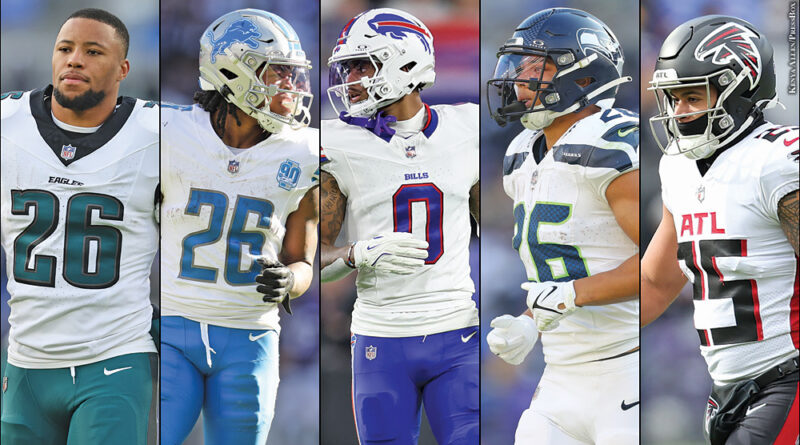
Ja’Marr Chase is my No. 1 overall player, but running backs make up three of my top five picks. Bijan Robinson, Saquon Barkley and Jahmyr Gibbs make up the top tier of backs to build a roster around.
If you cannot land one of those elite running backs, aggressively target receivers. Chase, CeeDee Lamb, Justin Jefferson and Puka Nacua all have the potential to finish as the top player in fantasy football. Second-year sensations Malik Nabers and Brian Thomas Jr. also fall into that category, but should be available between picks 8-12.
Round 2: Take a wide receiver.
Zig where most are zagging. Many are preaching the return of the running back after seven of the top ten players in PPR leagues last year were backs. Christian McCaffrey, the consensus No. 1 pick last season, burned fantasy owners by playing in only four games. Otherwise, it was a relatively injury-free year for early-round backs.
That has many fantasy players reaching for backs, leaving elite pass-catchers to be taken at a discount. Nico Collins and A.J. Brown are safe bets to finish as WR1s once again. I want Drake London or Ladd McConkey on as many of my fantasy teams as possible. If you want one of the top tight ends — Brock Bowers or Trey McBride — you will have to spend a second-round pick to land one.
I understand the logic in taking an elite tight end early after how brutal the position was last year, but Bowers and Sam LaPorta weren’t drafted early before finishing as TE1 the past two seasons.
Round 3: Get YOUR favorite player.
The options here depend on how you want to attack the rest of the draft. There are four quarterbacks with an average draft position (ADP) in the third round. If you want Josh Allen, Lamar Jackson, Jayden Daniels or Jalen Hurts, take one here. All four quarterbacks are virtual locks to score 20-plus fantasy points each week thanks to their dual-threat ability. Barring injury, each has the potential to be the top scorer in all of fantasy football.
If you like to stream quarterbacks, there are other options here. Players ranked between 25 and 50 are all projected to finish within 20 points of each other. If you want James Conner or Courtland Sutton, both with an ADP of 50, over Chase Brown or DJ Moore, take them here. This is the round to get your guy and pivot from there.
Rounds 4-5: Best player available.
Let the board dictate your next pick. Some fantasy owners will panic that they missed out on the run of quarterbacks or tight ends in the previous two rounds. They will then reach at quarterback and tight end to fill out their roster. Stay patient here and grab the running back or wide receiver who falls.
Rounds 6-7: Draft at least one running back.
If you follow the Zero RB strategy, this is the point at which to target running backs. Want a rookie running back who could take over as the lead rusher by season’s end? Omarion Hampton, RJ Harvey, Quinshon Judkins, Kaleb Johnson and TreVeyon Henderson are all possibilities. Rather have a veteran who has the potential to finish as a top-10 back? David Montgomery, Aaron Jones and D’Andre Swift are available here. I am likely doubling down here with both a rookie and a veteran to maximize my roster.
Rounds 8-9: Target high-upside receivers.
It’s a lot harder to find high-impact receivers in the later rounds than running backs. Second- and third-year receivers are known to make big jumps in their performance. There are a handful of receivers in this range who fit that profile. Ricky Pearsall and Keon Coleman each have the opportunity to become the No. 1 receiver for their respective teams. This is also where you can find rookie wideouts Tetairoa McMillan, Travis Hunter and Matthew Golden.
Rounds 10-11: Grab your quarterback and tight end.
There are plenty of capable quarterbacks and tight ends in the double-digit rounds. My strategy for years has been to wait and find value at both positions. (Don’t stress if neither pans out.) Jayden Daniels and Brock Bowers were both drafted in this range last season and were fantasy superstars.
Baker Mayfield, Bo Nix and Sam Darnold were off the fantasy radar, but all finished as top-10 quarterbacks in 2024. The same can be said with tight ends as Jonnu Smith, Tucker Kraft and Zach Ertz were top-10 tight ends despite not being drafted in the majority of leagues. If you strike out with these draft picks, there will be options on the waiver wire.
Rounds 11-14: Stockpile running backs.
I’m a firm believer that there is no such thing as too many running backs in fantasy. Every year there is a preseason backup who ends up being a diamond in the rough and cracks the top 10. Last year was an anomaly with the scarcity of running back injuries, but Kyren Williams was a perfect example of this two seasons ago. Jamaal Williams, Cordarrelle Patterson and James Robinson are other such examples from the past.
Pay attention to the remaining group of rookie backs garnering preseason attention and stash them in the event of injury. This is the area of the draft Bucky Irving was selected a year ago. Keep an eye on Jaydon Blue, Bhayshul Tuten and DJ Giddens come draft day.
Do not shy away from running back by committee and backups this late in the draft. They are an injury away from being the lead back and a must-start player each week. Zach Charbonnet was sensational when asked to step in for Kenneth Walker last season. Tyjae Spears, Tyler Allgeier, Jordan Mason, Ray Davis and Isaac Guerendo are some elite “handcuffs” you can find in these rounds.
Rounds 15-16: Draft a defense and kicker.
If you must draft a defense and kicker to close out your draft, do so with the final two picks. Never, ever draft them any earlier. There is always the one person who breaks this rule for the top kicker or defense. That means more skill players will fall to you in these late rounds. Worst-case scenario, you drop them before Week 1 to pick up your kicker and defense.
There are millions of scenarios that are possible come draft day. Make sure to have a backup plan to your backup plan. If you know ahead of time where you’re slotted in the draft order, prepare every possible outcome. Do not assume your favorite player is going to fall to you in any round. The best way to brace for the unknown is by doing as many mock drafts as possible. Good luck this season!
Photo Credits: Kenya Allen/PressBox
Originally published June 18, 2025