
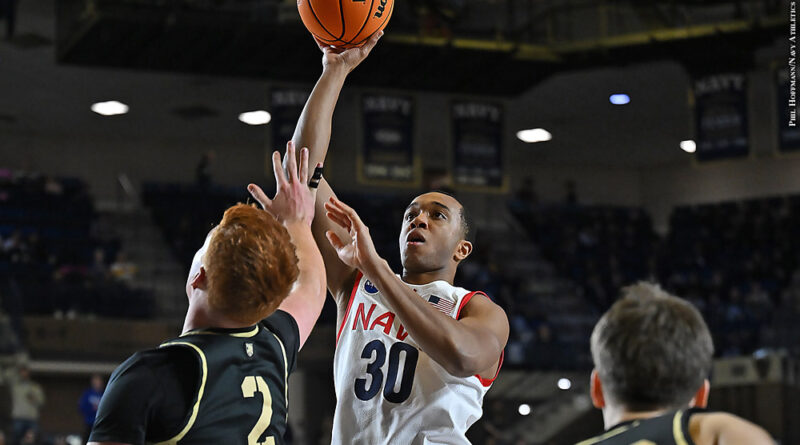
Navy men’s basketball senior Mike Woods recently chatted with PressBox about a typical day at the Naval Academy, the players he looked up to early in his college career and more. The 6-foot-3, 211-pound forward averaged 4.1 points and 2.6 rebounds per game for the Midshipmen in 2024-25. Woods is a native of Upper Marlboro and graduate of Frederick Douglass High School.
PressBox: How did you first become interested in basketball?
Mike Woods: My father, [Mark], was a coach in the area in PG County. He coached at a few schools like Largo and Gwynn Park. He put us in sports young, my brothers and I. Ever since I could pick up a basketball, it just felt like love at first sight. It helped that I was pretty good. I picked it up quickly. I just kept playing throughout elementary school, middle school and went I got to high school I realized I wanted to do this at a more serious level.
PB: Who was the biggest influence on your game growing up?
MW: I would say my dad. We worked out a whole bunch, developing guard skills and overall basketball skills — passing, shooting and dribbling. My older brother, Mark Woods Jr., played in the WCAC for basketball and football. We would play a lot of one-on-one together. We’d go out to the park and play pickup. He would give me critiques on my game. He had a really big impact as well.
PB: Why did you choose to go to Navy?
MW: The Naval Academy offered a whole bunch of unique opportunities. It came down between the Naval Academy and West Point. Being from Maryland, they offer a lot of the same things as service academies but one’s in my back yard and one’s five hours away. [Former head coach Ed DeChellis] recruited me. He was selling me on all the things they had and an opportunity. My parents and I just felt like that was the best opportunity for me for playing basketball and then having a great education and the opportunity after graduation with a guaranteed job in the Navy, this is the best of all worlds.
PB: Have you service selected anything yet?
MW: Service selection preferences are in. I put Surface Warfare as my No. 1 choice, and it’s a high likelihood that I get it. … I went on summer cruises. I just really enjoy what a Surface Warfare Officer does on a day-to-day basis. It’s a really great learning opportunity. You have th opportunity to not only learn but also lead sailors’ day-to-day life. This is a people business, and I feel like I have the charisma to make a positive impact on the Navy going forward.
PB: What’s a typical day for you at the Naval Academy?
MW: I wake up at about 6:30 for formation. After that, we have breakfast with my squad. Class from 7:45 to 11:45 and then after that we have lunch with my team. And then we usually have a lunch lift or a lunch workout from 12:15 to about 1:15. Following that, usually have classes that I have to do for about two hours, usually get out around 2:45, 2:50. Practice starts at 4:15. Before practice you get treatment, recovery, warm up, communicate with your teammates, see how everyone’s day is going. Then have a good, hard practice for about two hours — two and a half, maybe. Then about 7:30 p.m. I go to dinner with my team. It’s called King Hall where all the food is served. After that, we’re grinding on homework and studying. Lights out probably about 10 p.m., try to be in bed by 10:15 and take a nice rest.
PB: What’s your favorite thing about Navy?
MW: The Academy has great people. The people make the experience. The people I live with in my company, we did plebe summer together, we did the last four years together. My teammates are awesome people, tip of the spear. We push ourselves to be better. They’re my best friends. I wouldn’t trade them for the world.
PB: Who’s your best friend on the team and what’s a story that underscores your friendship?
MW: I’d have to say my best friend on the team is Austin Benigni. We were in the same plebe summer company, so we did plebe summer together. After our freshman year we weren’t super tight, but we traveled all the time together for basketball. Going into our sophomore year, we decided to be roommates. We live in the same room now. We do a lot of the same stuff. … He’s been to my house for Thanksgiving. My parents know him. I know his parents. We’re just super tight. We just spend so much time together.
PB: What’s one lesson you’ll take from having been coached by Ed DeChellis?
MW: I would say you’ve got to give your best effort every day, being an everyday person, having the right attitude, control what you can control. Not everything’s in your control, but what you can control do your best at. That kind of resonates with me from him as a coach.
PB: What have been your first impressions of Jon Perry as the head coach?
MW: He’s super energetic, excited to be a head coach for the first time. The guys have really rallied behind him. We’re happy that he’s here — super knowledgeable on the game, so that helps with his credentials. He’s listen to listen [to] — great terminology. And he’s there for us. We have a lot of trust in him as a coach. He was actually here the last [12] years. Now as a head coach, he’s super transparent and he wants the best for us. For a lot of coaches, you’ve got to focus on basketball because it’s your job, but he wants the best for us as men, as Midshipmen, as future officers and on the court, so you can be really appreciative of that.
PB: Who did you look up to early in your college career?
MW: Two guys come to mind. Daniel Deaver was a senior when I was a freshman. He was an all-conference player. He wasn’t the most vocal guy, but whenever I was feeling bad or whenever I had questions, he was always there for me. He kind of was a mentor for me, off and on the court — super encouraging. Christian Jones, I actually knew him before I committed. We worked out together growing up. When I got here and he was here [when I was] a freshman, I was super excited. We had already had a pretty good relationship. He was one of those people that kind of showed me what the Navy was about, kind of how deep it was. He was there for me whenever I needed him. He’s a Surface Warfare Officer now. I kind of forged my way on the Navy side like he has, so he’s a mentor for me as well.
PB: What advice would you give to younger players looking to play in college?
MW: I would say always try to put your best foot forward and just work as hard as you can. There are going to be good days and bad days — days when you’re not going to want to work out, days when you’re going to want to quit, days when you ask yourself why am I doing this? But having a super strong “why” and being a guy who knows I’m doing my best and it’s going to work out, it’s a long journey from when you first suit up as a pee-wee kid at 5, 6 years old to when you get to your junior, senior year, when it really starts to matter, it’s just about having the consistency of being an everyday person and just trying your best every day. Progress isn’t linear. Sometimes people grow faster than others. … Just know that your plan is going to work and you’re going to put in the work to make your plan happen.
Photo Credit: Phil Hoffmann/Navy Athletics