
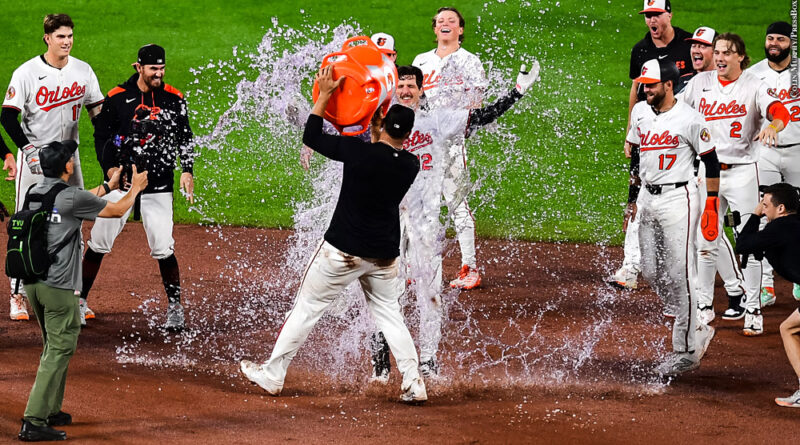
Dylan Beavers blasted the first pitch from Tampa Bay right-hander Kevin Kelly onto the right field flag court for a walk-off home run on Sept. 25. The 24-year-old knew immediately, flipping his bat and screaming toward the Orioles’ dugout.
In the Orioles’ last home game of 2025, Beavers provided a shining moment in a season of disappointment. But the home run did more than just that. While his track record provides optimism for the future, moments like this show he has already arrived.
“I’m glad I’ve been given this opportunity,” Beavers said. “I felt like I was ready.”
Beavers doubled in his first career big league game, homered in his first game at Camden Yards and later hit the walk-off homer. It wasn’t his first ever walk-off, though. That came Sept. 10 against the Pirates with a 10th-inning RBI single.
Beavers played in 35 games for the Orioles in 2025, hitting .227/.375/.400 with four home runs. Even when the 6-foot-5, 206-pound outfielder found himself in a rut at the plate, he still found a way to take a walk, move a runner over or hit a sacrifice fly.
Beavers’ goal is always to do anything to help the team. That has been the case dating back to his days at the University of California.
The Paso Robles, Calif., native was recruited as a two-way player coming out of high school. He spent time as a pitcher in his first fall at Berkeley, but he also showed his offensive potential. Head coach Mike Neu liked Beavers’ makeup and thought he had a great chance to hit.
The pandemic shortened Beavers’ first college season in 2020 to just 12 games. The plan was for him to play every day. Neu knew Beavers would become a middle-of-the-order hitter at some point because of his high upside. He just needed the at-bats to reach his potential since he came from a small high school.
Beavers quickly realized the game played much quicker at the Division I level than when he played for Mission College Prep. Neu noticed how Beavers always spent extra time in the batting cage. The school’s VR program allowed hitters to recognize pitches as part of the drills they’d do in the cage.
Neu knew that while the talent was there, Beavers simply needed to “let the game tell him how to work.” There were going to be failures. The key was finding consistency. Beavers did that through self-analysis and a relentless work ethic.
“He has a great ability to kind of figure out what he needs to work on, be coachable and kind of understand, ‘All right, these are some things that are going to help me be better,’ and then just really invest a lot of time into doing that on a daily basis,” Neu said. “I just think a lot of guys understand what it is and probably what they need to do, but they just don’t have the discipline to work on those things every day. And Beavs, he really did that. He committed a lot of time, and it was really important for him to improve, and he did.”
Beavers focused on hitting his last two seasons at California, posting an OPS better than 1.000 each year. That made him the No. 33 pick of the 2022 MLB Draft and later a top-100 prospect and big leaguer.
None of Beavers’ accolades and success is a surprise for Neu.
“From a tools standpoint, it was a no-brainer,” Neu said.
Beavers started his big league career with a seven-game on-base streak. He batted .333 with a .918 OPS in his first 15 games. That doesn’t mean the big leagues weren’t hard, though.
Beavers hit below the Mendoza Line with 21 strikeouts in his last 20 games of the season and had 13 hitless days. But what didn’t waver was his approach. He still walked 17 times during that stretch, which is why interim manager Tony Mansolino still gave Beavers multiple starts in the top third of the batting order.
Beavers’ approach to hitting major league pitching is the same as it was with Triple-A Norfolk — sticking to his zone in the middle of the plate. If pitchers made pitches on the corner, then so be it.
Though Beavers has tried to have a good sense of the strike zone for a while, the 2025 International League MVP said he has improved in that regard in the past couple of years. He feels better in two-strike counts and isn’t affected by big moments as a result.
“Looks like an old guy hitting in a lot of ways,” Mansolino said. “We’ve seen a lot of young guys come here and be overly aggressive. He’s probably the first one I’ve seen that takes an at-bat like a guy that’s been in the big leagues for seven or eight years.”
While Beavers looks like a big league veteran, his swing isn’t one that has been seen often in the majors. It’s short and quick to the ball — similar to four-time All-Star Kyle Tucker, according to Neu.
Beavers has made minor adjustments in recent years, but he said no observer would be able to notice them from watching a broadcast. He has increased his mobility and stability, allowing more adjustability in his swing and better control of his body.
Those tweaks helped Beavers become one of the best hitters at every level in the minors. He has an offseason plan to make that true in the big leagues. He wants to improve his bat-to-ball skills and increase his strength to do more damage at the plate.
Beavers learned a lot during his six-week stint with the Orioles, which gave him the information he needed to set his winter blueprint. His goal is more consistency.
“He’s never satisfied,” said Coby Mayo, who spent time with Beavers in Norfolk and Baltimore.
Beavers’ talent is undeniable. His character has never wavered. That combination gives the belief that the success he has had is sustainable. And he’s always looking to improve.
“Even if I was here for 10 years I feel like there’d still be stuff I’d want to get better at,” Beavers said. “I don’t think you every stop developing as a player.”
Photo Credit: Colin Murphy/PressBox
Issue 295: October / November 2025
Originally published Oct. 15, 2025