
PITTSBURGH — With the Terrible Towels swirling and the black-and-gold clad Acrisure Stadium roaring, Ravens rookie kicker Tyler Loop calmly walked onto the field for the game’s final play. And on the first truly high-pressure kick of his career, Loop badly pushed his 44-yard field-goal attempt wide right, sending the Ravens to a stunning 26-24 loss to the Pittsburgh Steelers that also ended their season.
The Ravens and Steelers had entered the regular-season finale in a de facto playoff game; the winner would claim the AFC North title, while the loser would be eliminated from playoff contention.
And over a frenetic fourth quarter, both teams created chances to win and also made enough plays to lose. Which made for unforgettable theater.
The Ravens, looking to become the first team since conference realignment in 2002 to win the AFC North three years in a row, had the ball last, and it looked as if that would be the difference after tight end Isaiah Likely made a leaping, 20-yard, season-saving fourth-down catch at the Steelers’ 24-yard line with 14 seconds left.
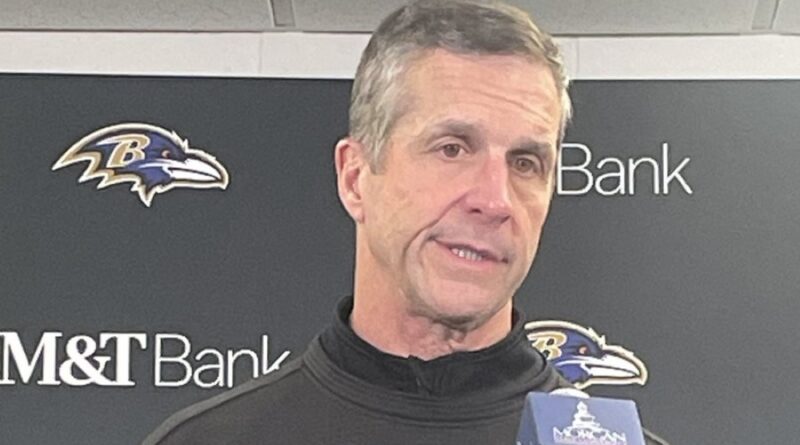
The Ravens still had a timeout, and rather than try to get any closer, coach John Harbaugh opted to have Lamar Jackson run to the middle of the field and center the ball, using his final timeout with two seconds left and setting up Loop for a 44-yard kick.
Loop’s kick never had a chance.
It immediately started right, and Loop just hung his head as the ball drifted into the net well right of the right upright.
“I just mishit the ball,” Loop said. “We call it ‘hitting it thin.’ It spins fast and goes off to the right.” With long snapper Nick Moore and holder Jordan Stout flanking him, Loop said the rest of the operation was on point, but he said he knew the minute he struck it that it was no good.
Before Loop’s kick, the lead had changed hands four times in the fourth quarter. The Ravens thought they had the game won after Jackson ducked away from a sack and lofted a 64-yard touchdown pass to Zay Flowers with just 2:20 to play that gave the Ravens a 24-20 lead.
But then Steelers quarterback Aaron Rodgers gashed a Ravens defense that was missing All-Pro safety Kyle Hamilton, who had left with a concussion. Rodgers quickly moved the Steelers 40 yards in five plays in just about a minute. Then on third-and-10, Ravens cornerback Chidobe Awuzie slipped, leaving Calvin Austin all alone down the left sideline for a 26-yard touchdown with 55 seconds left. Reliable Steelers kicker Chris Boswell missed the ensuing extra-point kick, leaving the margin at 26-24.
The Ravens had taken an early 10-0 lead and appeared to be in command, but then the offense scuffled over the middle two quarters and the Steelers rallied for a 13-10 lead.
Jackson, who finished 11-for-18 for 238 yards and three scores, aired out a 50-yard touchdown pass to Zay Flowers that gave the Ravens a 17-13 lead and seemed to right the Ravens — but only for a few minutes.
Because again, Rodgers and the Steelers had an answer. This time, Rodgers led the Steelers 60 yards in eight plays, and Kenneth Gainwell’s 2-yard run with 3:49 left put the Steelers back ahead at 20-17.
Back and forth these two flawed teams went with their season on the line, until Loop’s kick was off line, and the lights went out for Baltimore.
Here are five quick impressions of the loss, the Ravens’ sixth in their past eight games against the Steelers:
1. Losing Kyle Hamilton changed the game.
Early in the third quarter, safeties Kyle Hamilton and Alohi Gilman collided defending a pass over the middle. Both wobbled off, and although Gilman returned shortly afterward, Hamilton was ruled out with a concussion.
Until then, Hamilton had been the Ravens’ most active defender, and he has been among their most fundamental tacklers all season. All facets of the Ravens’ defense suffered in his absence.
“We obviously tried to fill the gaps,” cornerback Marlon Humphrey said, “but we just weren’t able to get it done down the stretch.”
Hamilton’s replacement, Ar’Darius Washington, missed tackles and struggled in coverage, including when Rodgers found tight end Pat Friermuth down the seam for a 31-yard pass that set up the Steelers’ go-ahead score with 3:49 to play.
The tackling overall got worse after Hamilton left, as the Steelers more than once turned a run or short swing pass into a moderate or long gain.
The secondary was further hobbled when Nate Wiggins left for a while, and at times the Ravens had combinations in the secondary that had hardly been on the field together. Rodgers took advantage, often with quick, short throws. He finished 31-for-47 for 294 yards, with one touchdown and no interceptions, and in the game’s biggest moments, he stayed in control.
Hamilton last week was named the team’s Most Valuable Player by the local media who cover the team, and this game showed how valid that honor was. The team never recovered without him.
2. With many of this team’s flaws on display, the collapse is complete.
The Ravens began this season as a trendy Super Bowl pick among fans and Vegas bookmakers, but they never came close to playing like one and finished with a losing record (8-9). After a 1-5 start that included a Week 1 collapse at Buffalo and a series of injury-ravaged losses, they spent the rest of the season trying to dig out of that hole.
Even after righting themselves with five straight wins against a soft underbelly of a midseason schedule, divisional losses to Cincinnati and Pittsburgh again set this team back. National pundits continued to say the Ravens would be one of the most dangerous teams should they reach the postseason. Those pundits didn’t watch this team often enough.
Because if they had, they would have seen all the flaws that were again on display at Pittsburgh. The offense looked tremendous at times, such as an opening drive that ended with Jackson’s 38-yard touchdown pass to Devontez Walker, who was essentially playing in place of Rashod Bateman (illness). But then it scuffled for long stretches, with the offensive line overmatched by the Steelers’ front seven.
During one telling sequence, Steelers defensive tackle Cameron Heyward pushed guard Andrew Vorhees right back into Lamar Jackson for a sack, and then on the next play, Heyward tipped a pass that was intercepted by T.J. Watt.
The defense again could not get a stop when it mattered most. They did come up with a huge stop at the end of the first half, as Alohi Gilman and Kyle Van Noy stuffed a run by Gainwell from the 1-yard line that preserved the Ravens’ 10-3 halftime lead.
But in the second half, Rodgers carved up a defense that didn’t rush, cover, or tackle particularly well. The Steelers had five second-half possessions and scored on four of them.
And then the special teams unit, which had its moments including a 41-yard kickoff return, had the game’s defining failure with Loop’s missed field-goal attempt at the buzzer. Earlier, Loop had kicked a kickoff out of bounds as well.
In short, this is who this team was all season: A roster with some elite talent that, over the course of 17 games, never got around to putting it all together consistently.
“It’s just a reflection of who we are, and we have to be better,” linebacker Roquan Smith said.
“Why can’t you do this, play in and play out, including myself?” Smith added. “I feel like that’s something we have to do if we want to ever go and get over the hump, and I don’t truly know what it is. I’m searching for those answers.”
3. General manager Eric DeCosta deserves a good chunk of the blame.
Harbaugh has been vilified recently, and his future will be a hot topic over the next week or two, and Loop’s missed kick will linger as one of the defining images of this lost season.
But general manager Eric DeCosta deserves a healthy share of the blame for assembling a roster that wasn’t good enough and for a series of decisions that kept it that way.
Some will point to the injuries that decimated this team early in the year. Losing Pro Bowl defensive lineman Nnamdi Madubuike after two games was huge, and Jackson, the two-time MVP quarterback, missed four games. Every NFL team suffers when the starting quarterback goes down.
During a game against Houston in October, the Ravens started five rookies on defense, and the results were predictable (a 44-10 loss).
But DeCosta’s job is to build a roster that can be insulated from some of these issues, and he never did it. He signed Cooper Rush to be the quarterback who could step in should anything happen to Jackson, and that proved to be a disastrous signing. Rush was so ineffective in two starts that he basically never saw the field again and the Ravens turned to Tyler Huntley instead.
Starting guards Andrew Vorhees and Daniel Faalele were overmatched at times, including in this game, but DeCosta never made any legitimate attempt to improve that group. All season, Harbaugh insisted that “everything is on the table” regarding the offensive line, but DeCosta never brought in serious competition during training camp at the guard position, stood pat at the trade deadline, and then watched week after week as the Ravens struggled to hold up in the interior.
DeAndre Hopkins was little more than Nelson Agholor 2.0. Rashod Bateman, signed to a contract extension, had a lost season as well, finishing with just 19 catches.
The Ravens pass rush was a problem all season, and for the fourth straight year, DeCosta clung stubbornly to the idea that David Ojabo, a player he drafted in the second round, could become a factor. He never did. Odafe Oweh wasn’t a factor either before he was traded to the Chargers, where he flourished.
DeCosta did deal for Alohi Gilman and Dre’Mont Jones during the season, but overall, this roster just wasn’t good enough or deep enough. That falls on the guy that put it together.
4. Torment has become this franchise’s big-game calling card.
This wasn’t officially a playoff game, but essentially it was, with the winner moving on and the loser going home. How is it that the Ravens keep finding the most agonizing ways to lose these games?
Loop’s kick surely will take some fans back to the AFC championship game at New England in 2011, when Billy Cundiff hooked a potential game-tying kick wide left with 15 seconds left.
And after the Super Bowl run of 2012, the Ravens big-game performances is a litany of stunning mishaps: a 101-yard pick-six at Buffalo in the 2020 playoffs; Cincinnati’s 98-yard fumble return in 2022; Zay Flowers’ fumble lunging across the goal line against Kansas City in 2023; Mark Andrews fumbling, and later dropping a two-point conversion that would have tied the game, last season.
Loop’s “wide right” moment fits right in.
Going into last week, the Ravens needed to win at Lambeau Field in Green Bay just to make this latest installment of the Ravens-Steelers rivalry matter. To their credit, they won that game, and played extremely well in doing so. But maybe it should have been a forgone conclusion that the victory would only usher in more agony.
It’s fair to wonder what it will take to exorcise these ghosts. A new coach? A new approach? The compilation of losses, and the way they have come about, at times defies belief. But this is their history, and the next time the Ravens — and Loop — find themselves in this position, this will be hovering over them. Just as it was last season, and the season before.
There is a serious mental albatross hanging over this team at this point.
Maybe all these vexing losses will make finally getting over that hump all the more rewarding. Then again, maybe the Ravens will just find a new, agonizing way to stumble in the biggest spots.
5. This offseason could be especially tumultuous.
Harbaugh’s status as the team’s head coach figures to be the hottest topic coming out of this stunning defeat, which ends just the third losing season in his 18 years as the Ravens’ coach.
Harbaugh received a new three-year contract extension just last spring that only begins with the coming season, so owner Steve Bisciotti, who likes Harbaugh and greatly values organizational continuity, would have to eat the entire extension if he makes a change.
But even if Harbaugh returns, it would be hard for anyone in the organization, from Bisciotti on down, to assess this team, the Super Bowl contender in August, and conclude it is well positioned to just “run it back” again next season.
Defensive coordinator Zach Orr is well liked in the building and viewed as a bright young mind in coaching, but his defense has been gashed time and again this year, and watching the Ravens give up two touchdown drives in the final four minutes with the season on the line might be the final straw.
Offensive coordinator Todd Monken was roundly criticized for getting away from Derrick Henry at times, most notably in a loss to New England, and was publicly chastised at times by Harbaugh. Do the Ravens go in a different direction there? Many will view this as another missed window for Lamar Jackson in his prime. Is there some other system or offensive architect that can more fully help Jackson reach his potential?
Jackson’s future is also in play. His cap number is due to soar to more than $74 million in March. That’s an unsustainable number that will require some sort of renegotiation. Given how this season has gone, with missed practices, injuries, and underperformance, how testy does that get? A newspaper report this past week that suggested tension between the team and Jackson over his work ethic and habits — refuted by both Jackson and Harbaugh — whether merited or not has heightened the scrutiny.
The Ravens have a lengthy list of free agents as well, including center Tyler Linderbaum, tight end Isaiah Likely, fullback Patrick Ricard, and punter Jordan Stout, who just was named to his first Pro Bowl.
Every year, the offseason brings change. This offseason, coming off this disaster of a 2025 season, could bring tumultuous change for an organization that prides itself on stability.
“It won’t be the same guys in the locker room anymore, so it’s like something that we’ll never truly get back,” Smith said. “The ’25 Ravens, we will always remember this, but at the end of the day, it’s a moment, and it’s a year that we’ll never get back. … It’s such a hard pill to swallow.”
Photo Credit: Bo Smolka/PressBox