
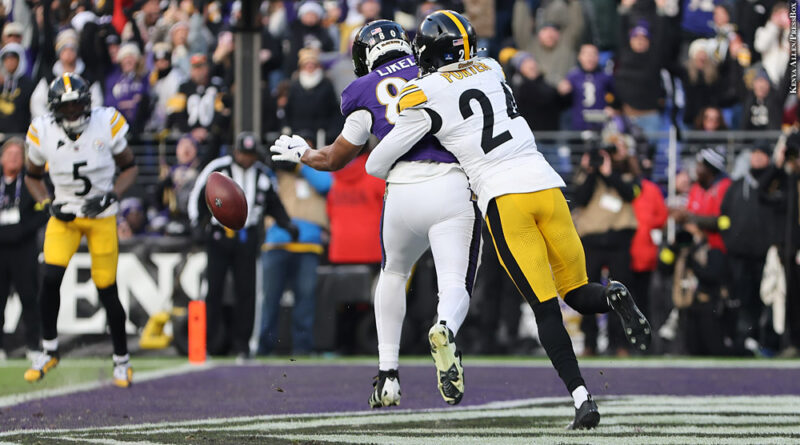
Longtime FOX Sports NFL rules analyst Mike Pereira was recently asked to untangle what became one of the 2025 season’s most contentious conversations: what, exactly, is a catch?
The conversation was sparked again by comments from Troy Vincent, the NFL’s executive vice president of football operations, who recently suggested that Isaiah Likely’s would-be touchdown catch against the Steelers in December should not have been overturned.
Pereira didn’t hesitate in explaining what a catch is.
“The rule as it stands right now, to me, when they changed it a couple years ago, they said time and then obviously it’s control, two feet and time,” Pereira said on Glenn Clark Radio Feb. 25. “Examples of time: turning upfield, tucking the ball away or taking a third step or having the time to do any one of those things, even if you don’t do it.”
Pereira emphasized that the first checkpoint for officials is simple.
“That’s the first thing they’re looking at — is there a third step with control? Getting a third step fully down on the ground and still having control,” he explained. “If it comes out after that, then it is a catch and a fumble, or in Likely’s case it would be a touchdown.”
To Pereira, the controversy surrounding Likely’s overturned touchdown wasn’t really about any philosophy. It was about adding the concept of time to the process of the catch.
“The whole thing is a mess,” he said bluntly. “And I think replay is what created that.”
Asked about Vincent’s comments, Pereira suggested the league’s messaging may have muddied the waters.
“I think that Troy really misspoke,” he said. “I think that the focus really was on Aaron Rodgers going to the ground on the pass that was batted up in the air that he caught going to the ground, and it was ruled incomplete. They changed it to a catch and they were dead wrong.”
Pereira believes if the Rodgers play had been ruled correctly in the first place, much of the current uproar might not exist.
“If you get a chance to get a minute and a half and look at something and then you make a wrong decision, then there’s something wrong with the people that are making the decisions,” he said.
Is there ever a scenario in which officials effectively say they know what the rule is, but they’re going to call it different anyway? Pereira called that a “slippery slope.”
“Can we go by my favorite group of people, the 50 drunks in a bar, could we just go by them?” Pereira asked. “Show them the play really quickly and if they all think it’s a catch and a touchdown, go with a catch and touchdown? … I think if we start setting aside rules, we would be in real trouble in officiating.”
Still, Pereira does see change coming, particularly when it comes to obvious missed fouls. He believes the league will look closely at experimental replay rules in the United Football League this spring.
“In the UFL, you are going to be allowed to call a facemask,” he said. “… You were able to call personal fouls [from replay in the past] — those player safety fouls, if not called on the field, you could add them from the replay center.”
Unlike the NFL’s crowded Sundays, the UFL operates on single-game windows, allowing one person to monitor everything from Los Angeles. In the NFL, Pereira said, the burden often falls on the on-site replay official to stop the game.
“I’m for this,” he said of expanded replay assist, “as long as the on-site staff is properly trained … and the replay assist, make sure they’re trained enough to stop the game when it needs to be stopped — and not stopping when it doesn’t need to stopped.”
Another play under the microscope is the “tush push,” the short-yardage quarterback sneak made famous by the Philadelphia Eagles. Pereira suspects it could be proposed for modification by the competition committee, even if not by a specific team.
“I think it’s kind of unusual for a league … that wants points, to ban this play which gives you generally a much better chance at getting a first down and continuing a drive to lead to a touchdown,” he said.
But ultimately, Pereira returned to the catch itself — and how to simplify it.
“Let’s get rid of the turning upfield. Let’s get rid of having the ball long enough to turn upfield even though you don’t turn upfield,” he suggested. “Let’s just try to keep replay to facts. If it’s out before the third step is clearly down, then no matter what else you do, it’s incomplete. You have to get that third foot down. If you get that third foot down, it’s a catch. That’s what the definition of time is.”
For more from Pereira, listen to the full interview here:
Photo Credit: Kenya Allen/PressBox